A Complete Guide to Crabapple Flower Types and Cultivation Methods
Crabapple flowers have an elegant posture and bloom like brocade. They have long been known as the "fairy among flowers," the "imperial consort of flowers," and the "noble one of flowers." The Song dynasty poet Su Shi once wrote, "I only fear that deep in the night the flower will fall asleep, so I burn tall candles to light up its red adornment," expressing his love for crabapple flowers. There are many types of crabapple flowers, and each type has its own distinctive characteristics. Below we will discuss the types of crabapple flowers and how to grow them.
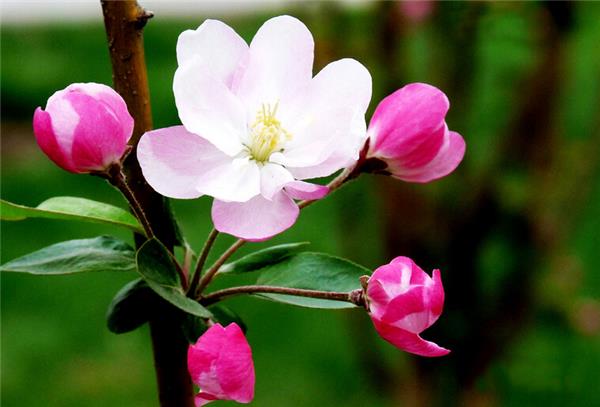
Crabapple flowers are divided into two categories: herbaceous and woody.
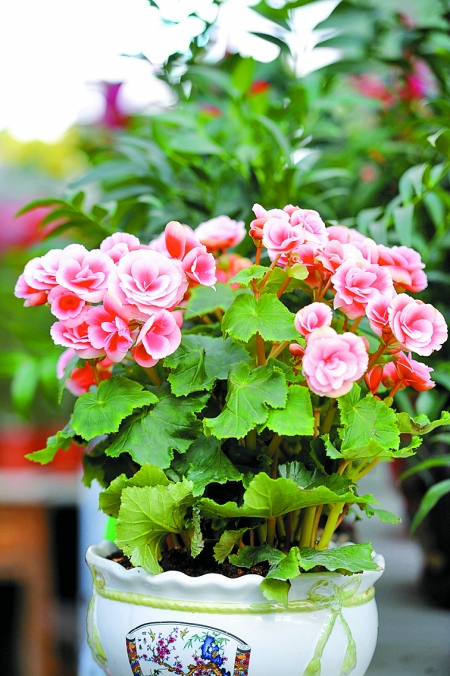
Herbaceous crabapple flowers include: wax begonia, dragon-wing begonia, iron cross begonia, and others.
According to the Ming dynasty text Qunfangpu, which records that "there are four grades of crabapple, all woody," woody crabapple flowers can be divided into four types: Chaenomeles speciosa (flowering quince), Malus micromalus, Malus halliana, and Chaenomeles cathayensis.
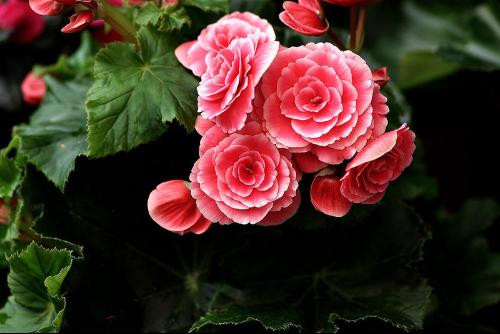
1. Types of crabapple flowers: herbaceous - wax begonia
Wax begonia, also known as perpetual begonia, begonia, tiger's ear begonia, melon-seed begonia, and glass begonia, is a perennial herbaceous plant. Its plant form is rounded and neat, its posture is graceful, and it blooms in dense clusters in all four seasons, carrying a slight fragrance. It is one of the main flowers for indoor and outdoor decoration.
2. Types of crabapple flowers: herbaceous - dragon-wing begonia
Dragon-wing begonia, also known as coral begonia, is a perennial evergreen semi-pendent herbaceous flower of the Begoniaceae family. Its leaves are emerald green and glossy, with slender pointed tips and finely serrated edges. The leaf shape resembles a wing, and the base is slightly tilted, shaped like a dragon's body with inserted wings.
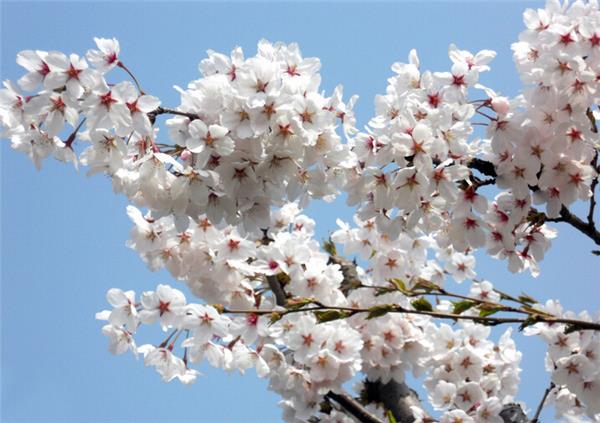
The iron cross begonia has small, inconspicuous flowers, and its yellow-green leaf surface is inlaid with red-brown cross-shaped markings. It is very elegant and is a relatively precious variety among begonias. It is suitable for decorative display in hotels, halls, display windows, and on windowsills.
4. Types of crabapple flowers: woody - Chaenomeles speciosa (flowering quince)
Chaenomeles speciosa, also known as wrinkled-skinned papaya, is a deciduous shrub. Its leaves are ovate or elliptical, and its flowers grow in clusters of three to five. The pedicels are short and thick or nearly absent, hence the name "tiegeng" crabapple. Flower colors include pink, vermilion, or white, and the fruit is yellow or yellow-green with a fragrance. Chaenomeles speciosa is highly ornamental and is suitable for planting in courtyard corners, at lawn edges, around tree clusters, and beside ponds and streams.
5. Types of crabapple flowers: woody - Malus micromalus
Malus micromalus, also known as small-fruited crabapple, is said to be named because it grew in Xifu during the Jin dynasty, and it belongs to the small tree category. Its leaves are oblong-elliptical, and it has umbel-like racemes. Before the flowers open, the buds are bright red, like dots of rouge; after opening, they gradually turn pink. The flowers are relatively large, with 4 to 7 in a cluster facing upward. The pear-shaped fruit is spherical and red. It is suitable for planting by water and in a corner of a small courtyard.
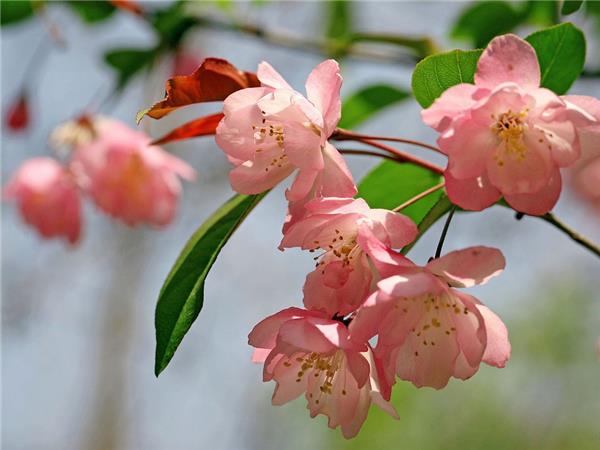
Malus halliana is a deciduous small tree. Its leaves are ovate or elliptical to long elliptical-ovate, narrow and long, with serrated edges, and the leaf surface is dark green often with a purple tinge. The pedicels are slender and drooping, the flowers are pink, and the fruit is obovate with a slight purple tint. Its varieties include: double-flowered Malus halliana, whose flowers are nearly double.
7. Types of crabapple flowers: woody - Chaenomeles cathayensis
Chaenomeles cathayensis is a deciduous shrub or small tree. It has few branches, straight stems, and purple young twigs. The leaves mostly cluster on short branches, are long elliptical to lanceolate, and have finely serrated edges. The flowers are pale red or nearly white, in clusters of 2 to 3, and the yellow fruit is oval.
How to Grow Crabapple Flowers
First, growing temperature. Crabapple flowers are extremely cold-hardy, so they can withstand cold climates, but there is still a limit. Generally speaking, crabapples can grow very well at minus 15 degrees Celsius and can be placed outdoors entirely. However, if it is especially cold, such as minus 30 or 40 degrees Celsius, then protective measures must be taken.
Third, watering. Although crabapple is relatively cold-hardy, that does not mean it does not need water. Necessary watering is what supports its healthy growth. Of course, do not water too much. The most important thing is to ensure that the soil does not become waterlogged, otherwise excessive moisture will cause root rot, and the leaves will turn yellow.
Fourth, fertilizing. Fertilizing crabapple requires special attention, especially in autumn, when crabapple sheds its leaves. After leaf fall, a heavy fertilizer must be applied to make up for the nutrients lost because of it; when it sprouts in spring, an organic fertilizer must be applied again, along with one thorough watering.
Fifth, pruning. Crabapple flowers need one pruning after leaf fall and before spring buds appear. Cut off dead branches, weak branches, and branches with pests or disease to maintain ventilation and light penetration. Of course, to ensure vigorous flowering, long branches need to be cut back so that other axillary buds can obtain more nutrients and nutrient consumption is reduced. During the growing period, pinching should be done in time to keep nutrients from being dispersed.
An organic fertilizer must be applied again, along with one thorough watering.
Fifth, pruning. Crabapple flowers need one pruning after leaf fall and before spring buds appear. Cut off dead branches, weak branches, and branches with pests or disease to maintain ventilation and light penetration. Of course, to ensure vigorous flowering, long branches need to be cut back so that other axillary buds can obtain more nutrients and nutrient consumption is reduced. During the growing period, pinching should be done in time to keep nutrients from being dispersed.