What are the cultivation methods and flower language of the Vanda orchid?
The Vanda orchid is not only dignified and beautiful in appearance, but also has tenacious vitality, and can still emit fragrance under harsh conditions, which is why it was chosen as the national flower of Singapore. Below, the editor will introduce to you the cultivation methods of the Vanda orchid and the flower language of the Vanda orchid, for your reference.
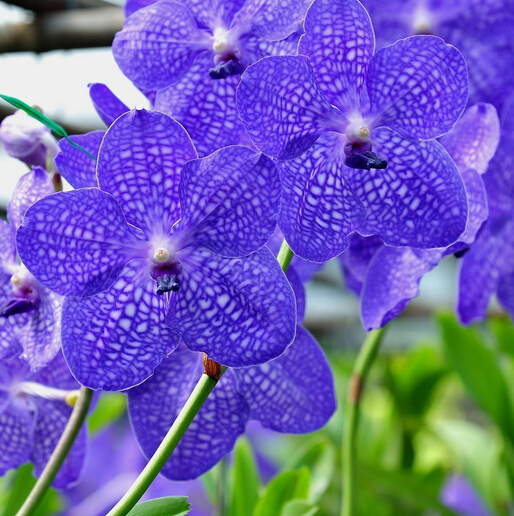
Cultivation Methods of the Vanda Orchid
The Vanda orchid requires more fertilizer than other tropical orchids, so during the vigorous growth period, a diluted fertilizer can be applied once every 7-10 days. The best fertilizer is one with a nitrogen, phosphorus, and potassium ratio of 10:10:5. Since the roots of the Vanda orchid are aerial roots, any well-draining medium can be used, such as tree fern fiber, crushed brick, charcoal, coarse gravel, and so on; whether used alone or mixed, they all make very good potting soil. In addition to the medium, the pot for planting Vanda orchids must also be quite particular; among pots of various materials, wooden slatted baskets and clay pots are superior, and drilling a few more holes in the pot is even more conducive to good drainage and air circulation. Besides wooden slatted baskets and clay pots, Vanda orchids can also grow well on tree fern boards or tree trunks. Vanda orchids should not be repotted frequently; unless they are attacked by pests or diseases, they should be repotted at least only once every 3 years.
In spring, the Vanda orchid is about to enter its vigorous growth period, which is a good time for repotting. For Vanda orchids that have grown for many years, their root systems will cling tightly to the inner wall of the pot, so if they are grown in clay pots, it is best to break the pot before repotting, so as to avoid damaging the roots when taking out the plant.
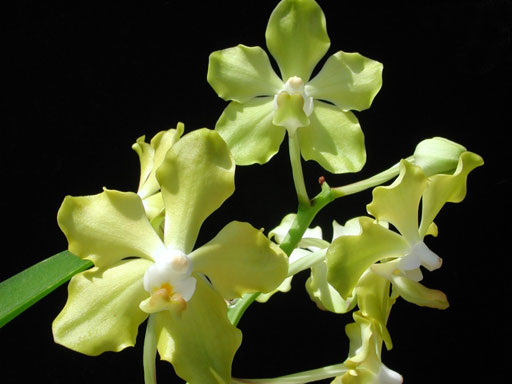
Vanda orchids can be propagated by tissue culture or by keiki propagation; however, the former is not suitable for doing at home because it requires more specialized techniques. In late autumn, the Vanda orchid will grow keikis at the leaf axils. When the keikis grow to 5-7.5 cm, a sharp and sterilized knife should be used to cut the keikis off from the mother plant and plant them in a pot filled with tree fern fiber; they can later be transplanted into a larger pot. Remember that the cut surface must be coated with medicine to prevent infection by pathogens.
In addition, when a plant cultivated for many years grows to more than 1 m, you can cut off the top shoot about 30-46 cm long, apply medicine to disinfect both cut surfaces, and then plant it in a pot and keep it moist. Pest and disease control: The tough leaves are the main reason Vanda orchids are not prone to pests and diseases. Apart from snails and slugs, the common pests generally appear less often on strong and healthy Vanda plants. However, when water remains on the leaves for too long, or when the plant is infected by a virus, dark markings or patches often appear and gradually rot. If the situation is mild, the affected part can be cut away; if the rot spreads too widely, then the entire orchid must be discarded to avoid infecting other orchid plants.
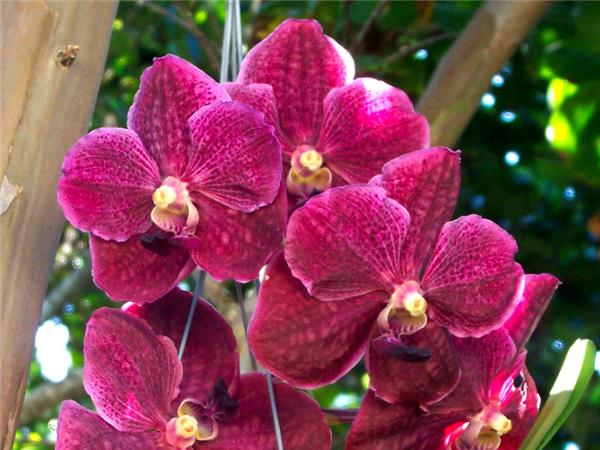
The flower language of the Vanda orchid: individuality, outstanding splendor, and everlasting through ten thousand generations.
The Vanda orchid has a clear, elegant, and dignified appearance, standing out from the crowd, yet also revealing modesty, symbolizing the temperament of the people of Singapore. The Vanda orchid has a beautiful lip and five sepals; the lip spreads out in four directions, symbolizing the four major ethnic groups of Singapore and the equality of the four languages: Malay, English, Chinese, and Tamil.
The column in the center of the Vanda orchid flower, with male and female united, symbolizes the root of happiness. The flower is supported by the opposing lobes below, symbolizing harmony, sharing hardships and honors together. Behind the lip of the Vanda orchid flower there is a pouch-shaped spur containing sweet nectar, symbolizing a place where wealth converges and gathers.
If you lift the pollinia cap on the column of the Vanda orchid, there are two pollinia inside, like two "golden eyes," symbolizing foresight and far-sighted vision. The stem of the Vanda orchid climbs upward, symbolizing upward development and prosperity. One of its flowers withers and another blooms, symbolizing the lifeblood of the Singaporean nation, flowing far and long, with infinite confidence and hope.
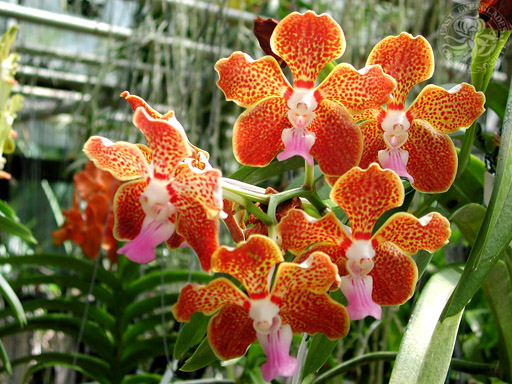
Perennial evergreen epiphytic herbaceous plant. The flowers are large and rich in color, with extremely many varieties. Those currently cultivated are all excellent hybrid varieties. They are usually planted in flower pots or wooden boxes with many holes on all four sides and hung in greenhouses; charcoal, crushed brick, and so on are used as the substrate. The roots require extremely good ventilation, and it likes high temperatures and humidity; the normal growth temperature is above 20°C. It likes ample sunlight; in northern greenhouse cultivation, shade 30%-50%. Maintain relatively high air humidity. During the growth period, spray fertilizer on the leaves once every 1-2 weeks. Spray water on the plant 1-2 times daily.
Propagation: division, sterile sowing, and tissue culture.
Light: likes strong light, not tolerant of shade (ample light).
Water: grows in moist soil.
Temperature: not cold-tolerant; below 0°C it will suffer frost damage.
Humidity: likes moisture; relative humidity above 60%, generally 70%-90%.
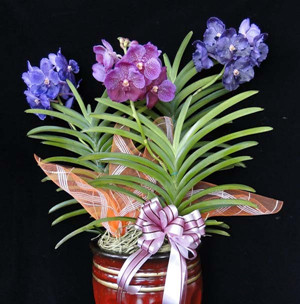
There are extremely many varieties. Those currently cultivated are all excellent hybrid varieties. They are usually planted in flower pots or wooden boxes with many holes on all four sides and hung in greenhouses; charcoal, crushed brick, and so on are used as the substrate. The roots require extremely good ventilation, and it likes high temperatures and humidity; the normal growth temperature is above 20°C. It likes ample sunlight; in northern greenhouse cultivation, shade 30%-50%. Maintain relatively high air humidity. During the growth period, spray fertilizer on the leaves once every 1-2 weeks. Spray water on the plant 1-2 times daily.
Propagation: division, sterile sowing, and tissue culture.
Light: likes strong light, not tolerant of shade (ample light).
Water: grows in moist soil.
Temperature: not cold-tolerant; below 0°C it will suffer frost damage.
Humidity: likes moisture; relative humidity above 60%, generally 70%-90%.