Things to Note When Growing Monanthes (Monanthes spp.) Succulents in Pots
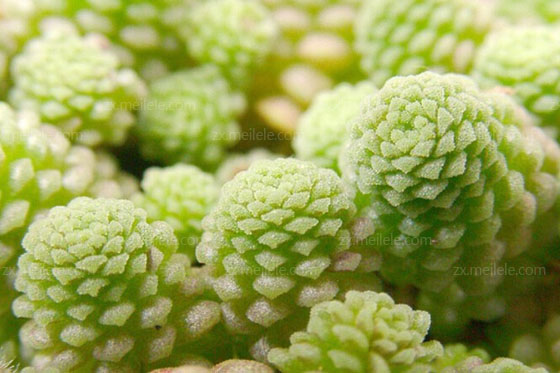
Nowadays, as people increasingly embrace the idea of light renovation and heavy decoration, all kinds of plant decorations have gradually made their way into every household, especially cute and easy-to-grow succulents, which are even more popular. Monanthes, a genus in the succulent family Crassulaceae, is emerald green all over; from a distance it looks like a cluster of bright green yarn, full of greenery and especially pleasing to the eye. So how should Monanthes succulents be grown? Let's take a look below.
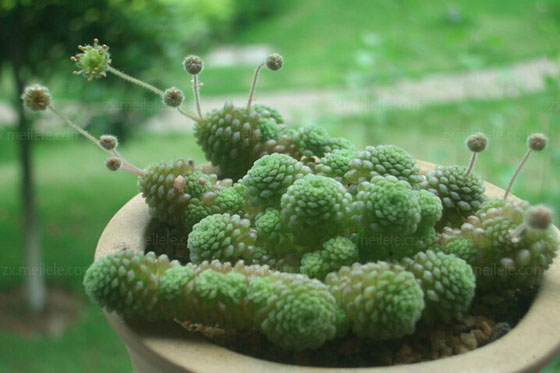
A Brief Introduction to Monanthes
First, let's briefly get to know what Monanthes is. It is said that the so-called Monanthes succulent is actually a very small type of herbaceous plant, a genus of succulents in the family Crassulaceae. Its leaves are fleshy all over and arranged tightly, mostly in rosette or oval-spherical shapes, emerald green all over, looking like a bright green ball from a distance. The inflorescences of Monanthes succulents are hairy, and the genus contains about 25 species of succulents, mainly produced in the Canary Islands and Madeira, with winter rain and summer drought; cultivation is generally quite difficult in summer. Common species include Monanthes polyphylla, Monanthes laxiflora (Swedish Monanthes) and Monanthes muralis.
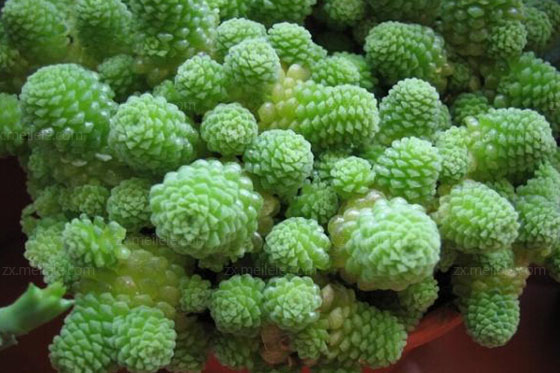
Things to Note When Growing Monanthes Succulents
1. Monanthes all originate from the Canary Islands and Madeira, and the main propagation methods are division and cuttings. Their habit is winter rain and summer drought, meaning that in the scorching summer, Monanthes succulents generally enter a state of deep dormancy and are extremely difficult to grow. In fact, for this kind of emerald green fleshy succulent, to prevent the leaves from turning yellow, shade must be provided when growing them in summer, and at the same time, to avoid water evaporating too quickly, it is best to keep them in a cool, airy place so the plants can survive normally.
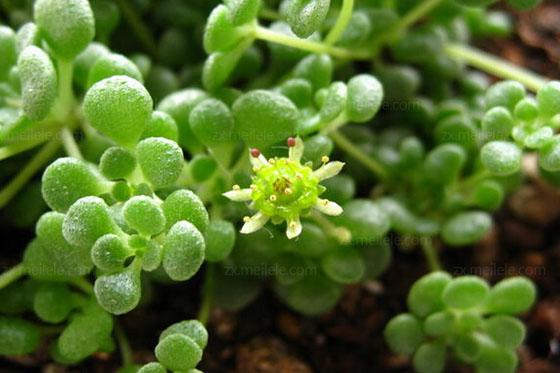
2. Monanthes succulents are very afraid of muggy heat and are hard to keep alive when grown in summer, more difficult to grow than ordinary Lithops succulents. Before summer, you can take apart its pot, cut off the side branches and propagate them by cuttings to prevent all the plants from dying. Summer temperatures are high, so besides keeping them in a cool place, the issue of watering also needs special attention. Watering throughout the summer must be timely, and there must never be a break in watering; besides regular watering, you also need to spray some water mist on the leaves and around them every evening to keep them moist at all times. But the water still must not be too much, as they are prone to both drought and waterlogging.
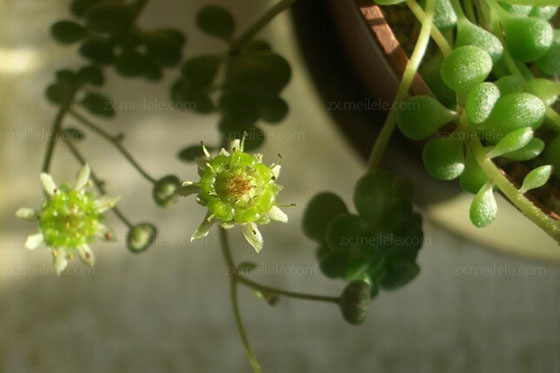
3. Monanthes likes soil that drains quickly and is high in fertility, and generally grows in volcanic ash soil, so when growing it, besides basic soil with good drainage, breathability and sufficient fertility, you also need to find some volcanic ash to mix in, and use a shallower pot to grow the succulent. The plant is still fairly sensitive to temperature; in winter the temperature must not be lower than 10°C, otherwise the plant is easily damaged or killed by frost, and at the same time you should water less or stop watering, reducing the moisture content in the soil to avoid frost damage. Monanthes does not have high light requirements; when there is sunlight you can let it bask a little, but avoid direct light.
Conclusion: Nowadays, growing succulents has become a fairly popular trend. As a succulent with high ornamental value, Monanthes is naturally loved by people, so many people are growing it. It is quite difficult to grow, and everyone needs to spend some extra time and effort on it.
[You May Be Interested In]
☑ Camellia growing methods and precautions ☑ Wallpaper prices ☑ Wall hand-painted murals ☑ Baifu cross-stitch ☑ Leather carving pictures
☑ Knitting pattern charts for needle sweaters ☑ Growing narcissus indoors ☑ Carnation growing ☑ Electric blanket power ☑ Putting on a duvet cover