Hyacinth Picture Gallery and Variety Introduction
The flower language of the hyacinth is victory, competition, joy, love, happiness, deep affection, admiration, stubbornness, life, pride, and eternal remembrance. Because its plants are low and neat, its flower spikes are dignified, its flower colors are rich, and its flower form is beautiful, it is one of the famous bulb flowers that bloom in early spring, and it is very popular among people for growing. The hyacinth has a dust-filtering effect, and its floral fragrance can stabilize mood and relieve fatigue. There are more than about 2,000 hyacinth varieties, but the types are mainly two categories: "Dutch types" and "Roman types." Today, let us look at hyacinth pictures and an introduction to hyacinth varieties.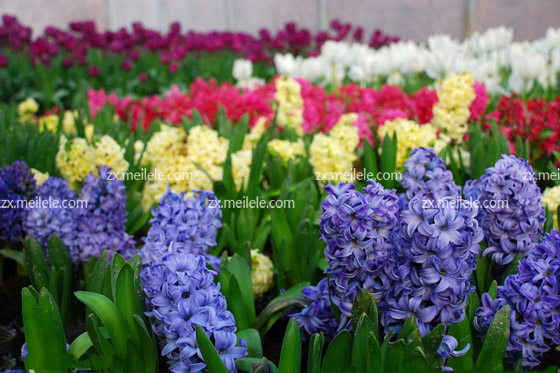
Hyacinth picture one
The hyacinth is a perennial bulbous plant. Its bulb is spherical or flattened spherical, with a membranous outer skin. The outer skin membrane is purple-blue or white, and so on. The color of the hyacinth bulb skin membrane is positively correlated with the flower color. Before blooming, it looks like garlic. During growth, the hyacinth has 4-9 leaves. The leaves are narrowly lanceolate, fleshy, basal, thick, strap-shaped lanceolate, with shallow longitudinal grooves, green and glossy. The flower stem is fleshy, the flower scape is 15-45 cm tall, hollow, with a raceme borne at the top. After the hyacinth blooms, 10-20 small flowers are densely borne on the upper part, mostly growing horizontally, rarely drooping. The flower shape is funnel-shaped, the perianth tube is tubular, the upper part is four-lobed, the corolla is funnel-shaped, the basal flower tube is relatively long, and the lobes are 5. They curl backward and downward toward the outside. Depending on the variety, hyacinth flower colors differ. The flower colors include eight color series: blue, pink, white, goose yellow, purple, yellow, scarlet, and red. The original species of the hyacinth is light purple and fragrant. The flowering period is March-April every year.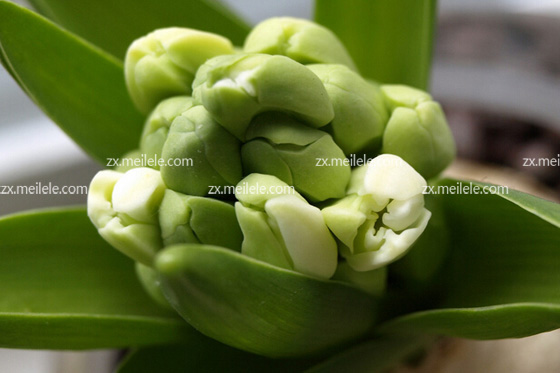
Hyacinth picture two
The hyacinth relatively prefers sufficient sunlight and a humid environment. It is relatively drought-tolerant. It is relatively suitable for growing in a cool and humid environment and in loose, fertile sandy soil, and it avoids waterlogging. The hyacinth likes a warm and humid winter, a cool and slightly dry summer, and a sunny or semi-shaded environment. It is relatively suitable for. Ground planting, pot planting, and water culture. During the growth process of the hyacinth, its bulb grows best at a temperature of 2-6°C, while the growth temperature for sprouting is 5-10°C, the growth temperature for leaves is 5-12°C, and the flowering temperature is 15-18°C.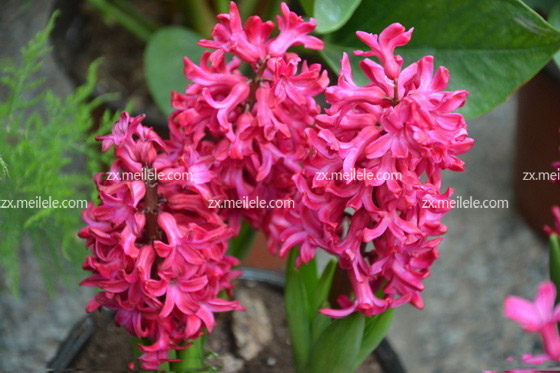
Hyacinth picture three
The hyacinth roots in autumn and its new buds emerge from the soil in early spring. Its flowering period begins in March and lasts to mid-May. In early June, the upper part of the hyacinth withers and enters a dormant period. During the dormant period, it undergoes flower bud differentiation, and the best temperature for differentiation is around 25°C. The differentiation process takes about one month. After flower bud differentiation and before elongation growth, there needs to be a low-temperature stage of about two months, and the air temperature must not exceed 13°C.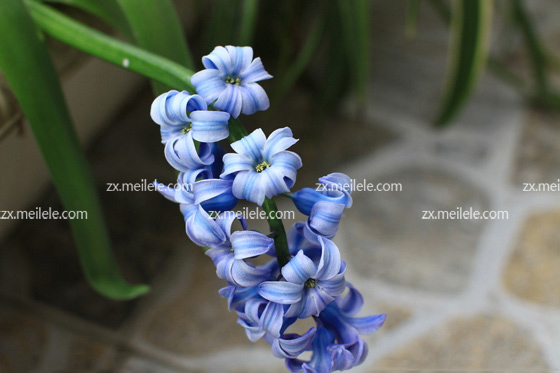
Hyacinth picture four
There are more than 2,000 hyacinth varieties, and among these more than 2,000, they are mainly divided into two categories: "Dutch types" and "Roman types." The varieties we commonly see are divided into very early-flowering types, early-flowering types, mid-flowering types, late-flowering types, other varieties, and double-flowered hyacinths. The very early-flowering types include Amsterdam, with red flowers, and Jan Bos. The early-flowering types include Anna Marie, with pink flowers, Pink Pearl, Innocence, White Pearl, Atlantic, with blue flowers, Giant Blue, Blue Star, Color Blue, Ostara, and Anna Liza. The mid-flowering type has only one, Lady Derby. The late-flowering types include Marconi, Fondant, Pink Queen, Carnegie, with white flowers, Blue Jacket, Marie, with dark blue flowers, Amethyst, with purple flowers, City of Haarlem, with yellow flowers, Gypsy Queen, with orange flowers, and Purple Pearl.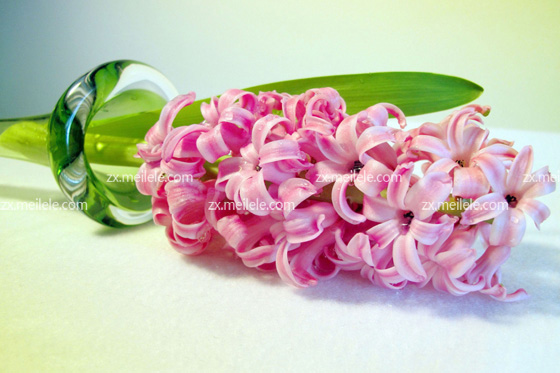
Hyacinth picture five
In addition to the above types, double-flowered hyacinths were obtained through long-term hybridization and propagation cultivation. They include Rosette, with pink flowers, Naples Rose, Royal Pink, Hollyhock, with red flowers, Red Diamond, Annabelle, Chestnut Flower, with light pink flowers, General Kohler, with light blue flowers, Isabelle, Indomitable Hero, with blue flowers, King Codro, with dark blue flowers, and Ben Nevis, with white flowers. Other varieties also include Red Rocket, Red Magic, with a white flower center, Mulberry Rose, and Coren Sugar, with pink flowers.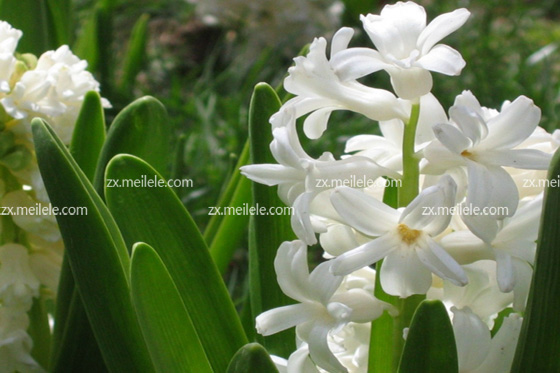
Summary: The above is the hyacinth picture gallery and hyacinth variety introduction brought to you by the editor. After reading the editor's introduction, I believe everyone has a relatively good understanding. The hyacinth has a dust-filtering effect, and its floral fragrance can stabilize mood and relieve fatigue. Its flowers can not only be viewed by people, but can also be used to extract aromatic oil. Other varieties also include Red Rocket, Red Magic, with a white flower center, Mulberry Rose, and Coren Sugar, with pink flowers.
Summary: The above is the hyacinth picture gallery and hyacinth variety introduction brought to you by the editor. After reading the editor's introduction, I believe everyone has a relatively good understanding. The hyacinth has a dust-filtering effect, and its floral fragrance can stabilize mood and relieve fatigue. Its flowers can not only be viewed by people, but can also be used to extract aromatic oil.