Caladium Varieties: Introduction and Photo Gallery
Caladium, also known as the harlequin caladium, has beautifully colored leaves and an extremely large number of varieties. Especially in summer, the leaves of the caladium display a striking medley of colors, and at this time its ornamental value is very high. Caladium is a perennial evergreen herbaceous plant, with shield-shaped arrow-like or heart-shaped leaves, beautiful in color and with an extremely large number of varieties. The spathe is green, with the upper part greenish-white, shell-shaped; the spadix is a fleshy spike. Below, let's take a look together with the editor at caladium photos and an introduction to caladium varieties.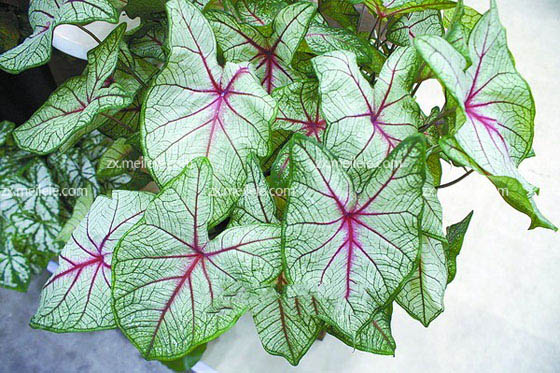
Caladium Introduction
Caladium is also known as painted caladium, two-colored taro, and harlequin caladium, and is a perennial evergreen herbaceous plant of the genus Caladium. The caladium has an enlarged underground tuber that is oblate-spherical and toxic; if eaten by mistake, it causes numbness of the throat and tongue. It likes high temperatures, high humidity, and a semi-shaded environment, is not tolerant of low temperatures or frost and snow, and requires loose, fertile soil with good drainage. Caladium is suitable for greenhouse cultivation and ornamental display. Summer is the main ornamental period for the harlequin caladium, when the striking colors of the leaves are full of coolness. In early autumn the leaves gradually become untidy, in winter the leaves wither and yellow and the plant enters dormancy, and in late spring and early summer it begins to sprout and grow again. Its growing period is from May to September each year.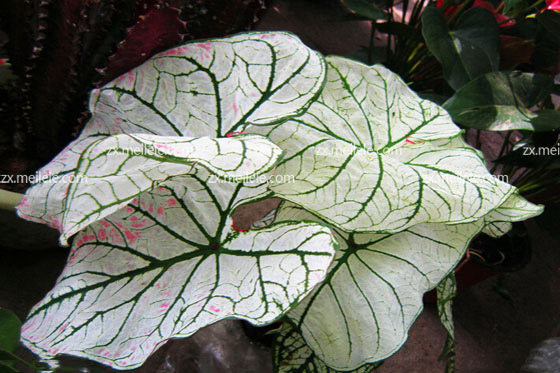
Caladium Growing Habits
Caladium likes to grow in places with high temperatures, high humidity, and a semi-shaded environment, and it is not tolerant of low temperatures or frost and snow. When cultivating it, loose, fertile soil with good drainage is required. The suitable growing temperature for caladium is 20-30°C. From June to October is its growing period, when the temperature is best kept at 21-27°C. From October to June of the following year is the dormant period for caladium, and the temperature during dormancy is 18-24°C. The nighttime temperature must not be lower than 10°C, and the temperature during dormancy must not be lower than 10°C either; it does not like strong light.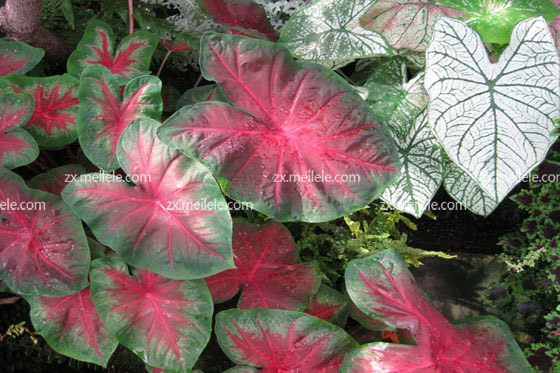
Caladium Variety Introduction
Green-veined caladiums include: White Egret, Snow White, Lord Derby, and Mrs. Chris. White Egret has white leaves, with the main veins and edges green. Snow White is a small-leaved variety, with pure white leaves and dark green veins and edges. Lord Derby has rose-red leaves with wrinkled leaf edges, and the main veins and leaf margins are green. Mrs. Chris has white leaves, and the leaf surface has blood-red markings.
White-veined caladiums include: Miss Muffet, Main Body, and Jo Dai. Jo Dai has relatively small, heart-shaped leaves, with white veins, red patches between the veins, and green leaf margins. Main Body is a large-leaved variety, with the center of the leaf milky white, the leaf edges green, the main veins white, and dark red patches embedded in the leaf surface. Miss Muffet has pale green leaves, white main veins, and small dark red spots on the leaf surface.
Red-veined caladiums include: Red Flame, Red Beauty, Blood Heart, Crown Stone, Snow Queen, Atala, and other varieties. Atala is a large-leaved variety, with pink and green markings on the leaf surface and red main veins. Snow Queen has white, slightly wrinkled leaves with red main veins. Crown Stone is also a large-leaved variety, with dark green leaves that have white spots and orange-red main veins. Blood Heart has rose-red centers to the leaves, white surroundings, green leaf margins, and dark red veins. Red Flame has rose-red leaves with dark purplish-red at the center, white markings around the leaf, and red main veins. And Red Beauty is a large-leaved variety, with rose-red leaves, red main veins, and green leaf margins.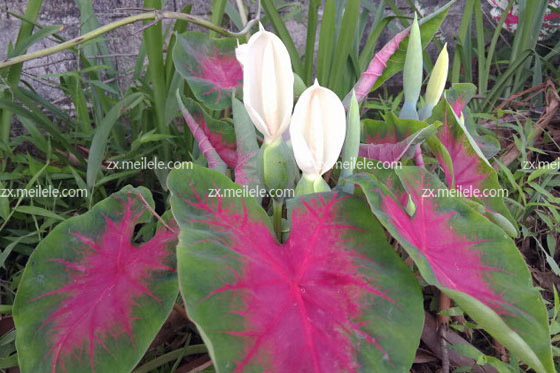
Summary: The above is the caladium photos and caladium variety introduction that the editor has brought to you. After reading the editor's introduction, I believe everyone has gained a certain understanding. The caladium uses the toxic taro, but its roots can also be used as medicine and can be applied externally for fractures. From May to September, planting caladium in gardens, courtyards, and indoors, or placing it on verandas, by windows, and on indoor desks, its rich, elegant, fresh, and pleasing form is quite popular among people.