How to Plant and Grow Variegated Shell Ginger
Variegated shell ginger has beautiful foliage, broad leaves and gorgeous, captivating colors, making it an excellent foliage plant. Let's take a look at how to grow variegated shell ginger.
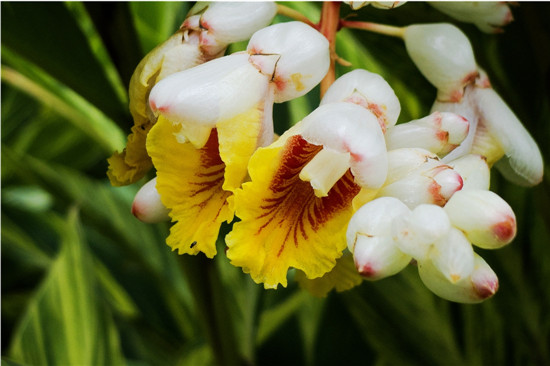
Variegated shell ginger is a perennial herbaceous foliage plant in the ginger family (Zingiberaceae), genus Alpinia. It has beautiful foliage, blooms from June to July, and its flowers are elegant and alluringly fragrant. Potted plants are suitable for display in halls. Grown outdoors, it adds a distinctive touch to courtyards, poolside areas or wall corners.
For variegated shell ginger, use a loose substrate with good drainage and aeration as the growing medium; domestic peat can be used, mixed with water, and then planted in cups. Propagate by division: in spring and summer, dig out the underground rhizomes, cut off the above-ground stems and leaves, divide the rhizomes for replanting, and keep the divided plants in a semi-shaded place for care; once new shoots sprout, resume normal management.
During the growing season, fertilize variegated shell ginger once a month, mainly with phosphorus and potassium fertilizers. Keep the potting soil moist, mist the leaves frequently in summer and autumn, and place it in a semi-shaded spot in midsummer so the leaf markings become more striking. For outdoor planting in the ground, choose loose loam with good drainage; give it more sunlight in late spring and early summer, provide slight shade in midsummer, and in autumn and winter dig out the rhizomes and store them indoors.
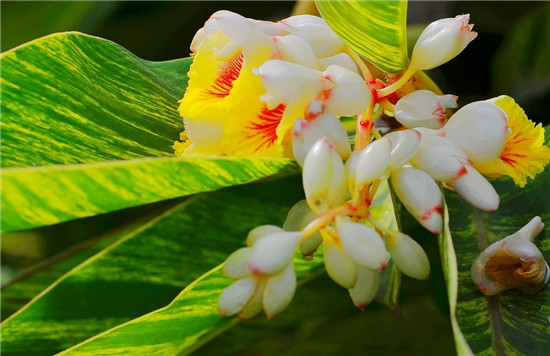
For variegated shell ginger, take the mother plant out of the pot, shake off excess potting soil, separate the tangled root system as much as possible, and cut it open into two or more plants with a sharp knife. Each divided plant must retain a substantial root system, and its leaves should be pruned appropriately to help it survive.
After potting the divisions of variegated shell ginger, water the roots or give one thorough watering. Because its roots are heavily damaged and have very weak water-absorbing ability, it takes about 3-4 weeks to recover and sprout new roots. Therefore, within 3-4 weeks after division, water sparingly to avoid root rot. However, since transpiration from its leaves is unaffected, mist the leaves 1-3 times a day to maintain the water balance of the leaves. Do not apply fertilizer during this period either. After division, also watch out for overly strong sunlight and keep the plants in a shade house for care.
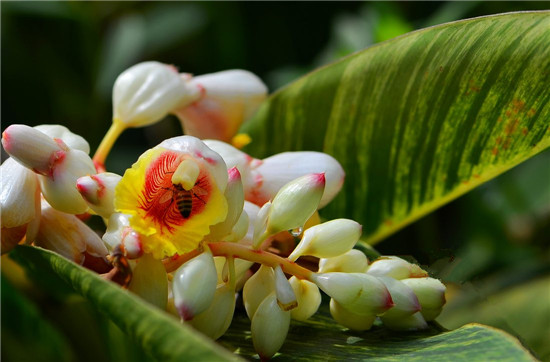
Key Care Points for Variegated Shell Ginger
1. It is not cold-tolerant and generally can only withstand temperatures around 8°C. When the temperature drops to around 10°C, wrap the plant in paper, then put a plastic film bag over it, and keep it indoors to survive the winter. When planted in the ground, it must be placed in a sunny, wind-sheltered spot; it can withstand slight frost. After the Start of Winter (Lidong), the leaf clumps can be cut off and the roots covered well with dry grass to avoid severe frost damaging the roots. In this way, more new shoots will sprout from the roots the following spring, forming a large clump. In the north, it can overwinter safely as long as it is kept indoors. Any plant that can be kept warm through the winter can be enjoyed year-round.
2. From the Spring Equinox onward, it begins to sprout a large number of new shoots. Before it grows long branches and leaves, apply a liquid fertilizer mainly based on nitrogen to encourage fast and abundant growth. When the new shoots gradually form, stop applying nitrogen fertilizer. Around the Start of Summer (Lixia), switch to phosphorus and potassium fertilizers to encourage bud formation and flowering. Variegated shell ginger is a large-leaved plant with high transpiration, so during the growing period it must be watered thoroughly.
3. Propagate by division. Research on the optimal harvest stage for cut flowers of shell ginger (Alpinia zerumbet) and on preservative solutions and pretreatment methods to control bud drop showed that shell ginger cut flowers are best harvested when the flowering branches are well developed but the inflorescence bracts have not yet fallen off; silver thiosulfate (STS) and Al2(SO4)3 can effectively control bud drop in shell ginger and are relatively ideal vase preservatives; a pretreatment solution of 200mg/L 8-HQC + 5% SUC + 5mg/L 6-BA combined with precooling at 10°C for 4h can effectively reduce the bud drop rate of shell ginger cut flowers.
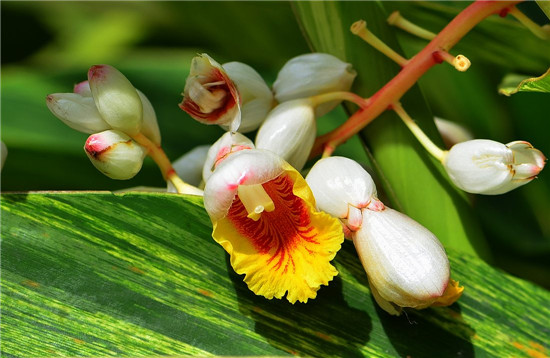
Growing Variegated Shell Ginger at Home
For potted plants, fertilize once a month during the growing season, mainly with phosphorus and potassium fertilizers; keep the potting soil moist, mist the leaves frequently in summer and autumn, and place the plant in a semi-shaded spot in midsummer so the leaf markings become more striking. For outdoor planting in the ground, choose loose loam with good drainage; give it more sunlight in late spring and early summer, and in autumn dig out the rhizomes and store them indoors. In southern regions, it can be grown outdoors in the open, with stems and leaves remaining green all year round.
When variegated shell ginger is grown indoors or outdoors in the open in the south, it has strong tillering ability and grows rapidly. For potted plants, repot once every 1-2 years, cut off dull-colored and overly tall stems and leaves, and replant and trim. For outdoor planting in the ground, frequently thin out overly dense growth and cut off broken stems and leaves to keep the plant shape attractive. After 3-4 years of cultivation, dig out the underground rhizomes again, remove the old thick stems, and replant to renew the plant.
The above is the full content of my summary on how to plant variegated shell ginger and growing methods for variegated shell ginger. I hope this article can help everyone. Please also continue to follow us.
The above is the full content of my summary on how to plant variegated shell ginger and growing methods for variegated shell ginger. I hope this article can help everyone. Please also continue to follow us.