What are the common varieties of Caladium? Let this article give you an overview
Caladium is a shade-loving groundcover plant and can be used as a shade-tolerant ornamental plant. Next, let us take a look at the common varieties of Caladium.
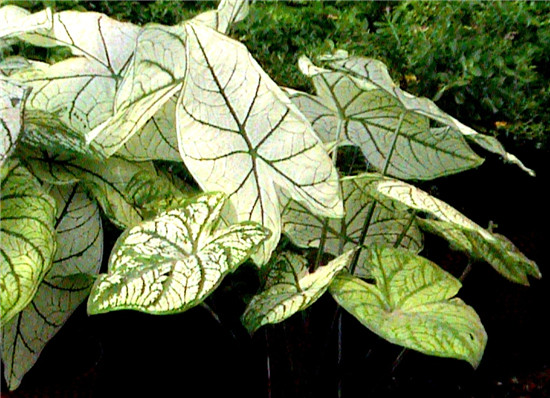
Caladium, a perennial herb. It has tubers, plant height 15-40 cm, with tubers, flattened spherical, with membranous scale leaves. Leaves basal, blades stalked, arrow-shaped ovate, ovate-triangular to round-ovate. Not only are the leaves large, but the leaf color is also bright, with high ornamental value. It is a recently popular indoor foliage plant.
8-20 cm long, 5-10 cm wide; leaf blade textured, dark green, with various transparent or opaque spots of red, white or yellow on the leaf surface; main veins trifurcate, lateral veins reticulate; petiole slender, cylindrical, base expanded into a sheath, with small brown spots. Spathe inflorescence basal, peduncle 10-13 cm long; lower part of spathe tubular, about 3 cm long, green outside, greenish-white inside, purple-green at the base; limb about 5 cm long, white; spadix slightly shorter than spathe, with short stalk; flowers unisexual, without perianth; female flowers borne in the lower part of the inflorescence, male flowers borne in the upper part of the inflorescence, separated in the middle by sterile neutral flowers; neutral flowers with staminodes, berries white; flowering period 4-5 months.
Propagation methods of Caladium
When cultivating in pots, do not bury the tubers in a sand bed to promote rooting; after roots have grown, pot them for planting. It is not tolerant of strong light, so it should be placed under a shade frame during cultivation. During the growing season, keep the potting soil moist and apply fertilizer 1-2 times per month. In winter, keep the temperature above 15°C; for those without heating conditions, after the leaves dry up, dig up the tubers, air-dry them, remove the residual roots, and store them in layered sand until planting in spring.
To ensure uniform sprouting, pre-sprouting can be done first. Arrange the tubers on a sand bed, cover with 1 cm of fine sand, keep the sand bed moist, and maintain room temperature at 20-22°C. After sprouting and rooting, pot them. If the mother bulb is relatively large and has many buds, it can be propagated by division. Use a knife to cut the bud-bearing tubers, and pot them after the cut surface has dried and healed.
Growth habits of Caladium
Caladium prefers scattered light and should not be exposed to excessively strong light. Under blazing sun, the leaves are prone to scorching, the leaf color becomes blurred, the vein pattern becomes dull, and the ornamental quality is poor. If the light is insufficient, the leaf variegation becomes darker, and the leaves become leggy and appear weak. If shaded for too long, the leaves become tender, the petioles elongate, the leaf color is not bright, and the petioles break easily.
1. Light: Caladium likes sunlight but should not be exposed to excessively strong light. If the light is insufficient, the leaf variegation becomes darker, and the leaves become leggy and appear weak.
2. Water: Caladium likes moisture. In spring and summer, a large amount of watering is needed.
3. Temperature: Caladium is not cold-tolerant. The suitable growth temperature is 25-30°C, and the minimum should not be lower than 15°C. At 22°C, the tubers sprout and grow leaves; when it drops to 12°C, the leaves turn yellow and wither.
4. Fertilizer: During the growing period, fertilize Caladium once a week, applying nitrogen, phosphorus and potassium in combination, with nitrogen fertilizer as the main component.
5. Soil: Caladium requires loose, fertile, well-drained soil.
Main horticultural varieties of Caladium
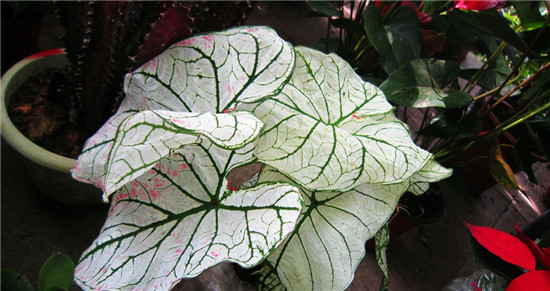
1. White Caladium: leaves white, veins emerald green.
2. Bright White Caladium: leaves white, semi-transparent, semi-bright.
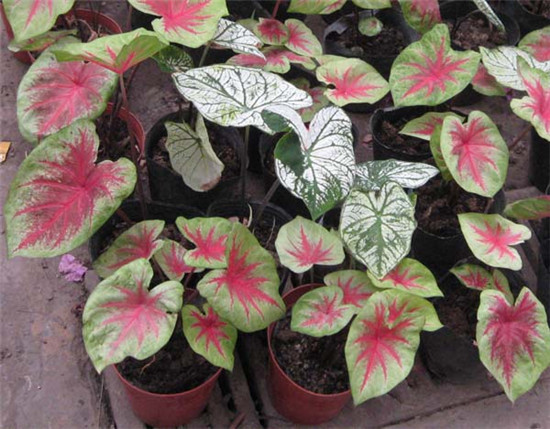
3. Dongdeng: middle of the leaf crimson red, margins green.
4. Seagull: leaves dark green, with prominent broad white veins, bicolor.
5. Red Cloud: leaves with red spots.
6. Edith Mead: leaves almost white, margins green, main vein red.
7. Attala: leaves dark green, with red spots.
8. Mad Altred Rubra: leaves large and round, dark green, surface with irregular white spots, main vein red.
9. John Pecd: veins thick, leaves entirely red.
The above is all the content I have summarized for everyone on what varieties of Caladium there are. I hope this article can help everyone. Please also continue to follow us.