What is the flower language of the four o'clock flower? A detailed introduction to its meanings and symbolism
The common name of the four o'clock flower (Mirabilis jalapa) is rouged flower, also called wild jasmine. In fact, the four o'clock flower does not look like jasmine at all, but it has a faint jasmine fragrance, and the word "wild" is fully deserved - because if you casually drop a few seeds into the soil, the four o'clock flower will grow into a vigorous clump, and year after year it expands its territory.
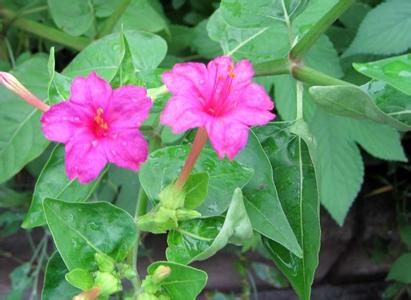
Four o'clock flower language: chastity, simplicity, delicacy, conjecture, suspicion, mature beauty, timidity, cowardice
Introduction to the four o'clock flower
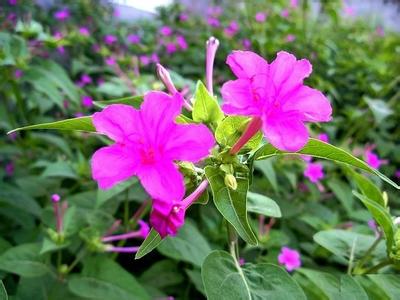
The four o'clock flower gets its name from its purple-red blooms, but its flower colors are rich and varied, with common ones including red, yellow, white and variegated. When it blooms in summer, a single plant is densely covered with many four o'clock flowers of different colors, very cute and beautiful. The four o'clock flower has delicate, charming blooms and a pleasant, light fragrance. It is often planted in flower beds and along roadsides for ornamental use, and can also be made into bonsai for display at home.
The four o'clock flower grows robustly and is extremely easy to keep alive. It also has resistance to sulfur dioxide, so it can be planted whether on residential balconies or in industrial and mining polluted areas. When grown at home, if it is occasionally watered with water used to wash meat or fish, or with rice-washing water, the flowers will bloom more vigorously and the colors will be more brilliant.
The rouged flower is not only fragrant, but its seeds and leaves also have beauty-enhancing, heat-clearing and detoxifying effects. When the seeds mature, they look black and spherical on the outside and white inside. For beauty care, you can take a number of mature seeds, grind them into powder, remove the skin, and use the powder to apply to the face, which can remove facial spots and so on, making the face smooth and fair, achieving a beauty-enhancing effect.
In addition, when blisters or sores appear on the hands, you can also take the powder, mix it evenly with water, and apply it to the affected area to achieve a dampness-removing and detoxifying effect. When the skin is wounded or when there are carbuncles and sores, pick several fresh leaves of the rouged flower, mash them, and apply them to the wound or affected area.
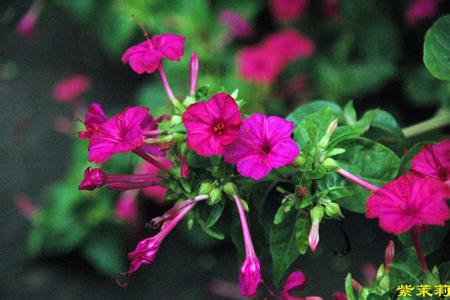
Origin of the flower's names:
1. Four o'clock flower. It is named this because its flowers are purple-red and its fragrance is like jasmine.
2. Night-blooming cereus. The four o'clock flower opens in the evening and has a pleasant fragrance. In some northern places, it is also called "night-blooming cereus".
3. Rouged flower. Legend says that when Chang'e flew to the moon, she accidentally knocked over a rouge box, and the rouge scattered across the human world, producing brilliant four o'clock flowers. Moreover, women in the past liked to pick the flowers of the four o'clock flower, press and extract their juice, and apply it to their lips as rouge, so the four o'clock flower is also called the rouged flower.
4. Cooking-rice flower, bath flower. The four o'clock flower happens to bloom at dusk, when rural women light the fire to cook and help children bathe, so it is called the cooking-rice flower or bath flower. Legend says the cooking-rice flower was transformed from a playful child who played until dark, got lost, and turned into it. It wants to tell children lingering outdoors to come back, that seeing the cooking-rice flower bloom means it is about to get dark and mother has already started cooking, so they must hurry home to bathe and eat.
5. Landmine flower. The fruit of the four o'clock flower is oval, black, wrinkled and patterned on the surface, and looks like a small landmine, so it is also called the "landmine flower".
6. White powder flower. The seeds of the four o'clock flower are rich in white endosperm, which becomes white powder after drying and can be used on the face, hence the name white powder flower.
Morphological characteristics:
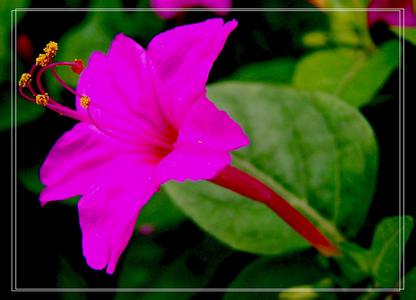
The main stem of the four o'clock flower is erect, 50-100 cm tall, with swollen nodes, much branched and spreading. Leaves are simple and opposite, ovate or ovate-triangular, 3-15 cm long, 2-9 cm wide, with acuminate tips, truncate or cordate bases, entire margins, hairless on both sides, and raised veins; petioles are 1-4 cm long, and the upper leaves are almost sessile. Flowers are often several clustered at the branch tips, with only 1 flower inside the involucre, without petals, the style 1-2 mm long, and the calyx petal-like, trumpet-shaped, about 2.5 cm in diameter, 5-lobed. The lobes are triangular-ovate, with acuminate tips, hairless, with vein lines, and persistent in fruit; the perianth is purple-red, yellow, white or variegated (white, yellow and red are its varieties). It is salver-shaped, with a tube 2-6 cm long and a limb 2.5-3 cm in diameter, shallowly 5-lobed; the flowers open in the afternoon and are fragrant. They wither before noon the next day; there are 5 stamens, with slender filaments often extending beyond the flower, and spherical anthers; the style is single, linear, and extends beyond the flower. The stigma is capitate. The corolla is funnel-shaped, with wavy shallow lobes at the edge, but not divided into petals. The achene is spherical, 5-8 mm in diameter, leathery, black, with longitudinal ribs and netted texture, shaped like a landmine, so the four o'clock flower is also called the landmine flower. The seeds are white, and the cotyledons are very fine and white-powder-like.
Uses and value:
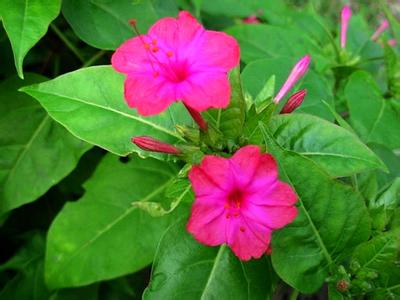
1. Ornamental value. The four o'clock flower has rich flower colors, blooms abundantly, opens at night and closes during the day, and is fragrant when blooming. It is highly ornamental and suitable for placement in places for cooling off in the evening or at night, adding much interest. It can be planted in clumps in front of and behind houses, beside fences, and along roadsides, or cultivated in patches around forest edges. Its tuberous roots' perennial characteristic can also be used to make stump-style exposed-root bonsai. The rouged flower grows robustly and is extremely easy to keep alive. Moreover, the four o'clock flower has resistance to sulfur dioxide, so it can be planted whether on residential balconies or in industrial and mining polluted areas.
2. Medicinal value. The four o'clock flower is not only fragrant, but its seeds and leaves also have beauty-enhancing, heat-clearing and detoxifying effects. When the seeds mature, they look black and spherical on the outside and white inside. For beauty care, you can take a number of mature seeds, grind them into powder, remove the skin, and use the powder to apply to the face, which can remove facial spots and so on, making the face smooth and fair, achieving a beauty-enhancing effect. In addition, when blisters or sores appear on the hands, you can also take the powder, mix it evenly with water, and apply it to the affected area to achieve a dampness-removing and detoxifying effect. When the skin is wounded or when there are carbuncles and sores, pick several fresh leaves of the four o'clock flower, mash them, and apply them to the wound or affected area. At night the flowers release a rich fragrance, which can anesthetize and repel mosquitoes and insects.
Growth habits:
It prefers mild and humid climatic conditions and is not cold-tolerant. In winter the aboveground parts die, and in the Jiangnan region the underground parts can overwinter safely and become a perennial herbaceous flower, sending up new plants again the following spring. Open-ground cultivation requires deep, loose and fertile loam, while pot cultivation can use general flower-growing soil. It grows even better in slightly shaded places. The flowers open from evening to early morning and close under strong light. If there is light shade in summer, it grows and blooms well; under intense summer heat and blazing sun, leaf drop often occurs. It likes a well-ventilated environment.
2. Medicinal value. The four o'clock flower is not only fragrant, but its seeds and leaves also have beauty-enhancing, heat-clearing and detoxifying effects. When the seeds mature, they look black and spherical on the outside and white inside. For beauty care, you can take a number of mature seeds, grind them into powder, remove the skin, and use the powder to apply to the face, which can remove facial spots and so on, making the face smooth and fair, achieving a beauty-enhancing effect. In addition, when blisters or sores appear on the hands, you can also take the powder, mix it evenly with water, and apply it to the affected area to achieve a dampness-removing and detoxifying effect. When the skin is wounded or when there are carbuncles and sores, pick several fresh leaves of the four o'clock flower, mash them, and apply them to the wound or affected area. At night the flowers release a rich fragrance, which can anesthetize and repel mosquitoes and insects.
Growth habits:
It prefers mild and humid climatic conditions and is not cold-tolerant. In winter the aboveground parts die, and in the Jiangnan region the underground parts can overwinter safely and become a perennial herbaceous flower, sending up new plants again the following spring. Open-ground cultivation requires deep, loose and fertile loam, while pot cultivation can use general flower-growing soil. It grows even better in slightly shaded places. The flowers open from evening to early morning and close under strong light. If there is light shade in summer, it grows and blooms well; under intense summer heat and blazing sun, leaf drop often occurs. It likes a well-ventilated environment.