How to Grow Marguerite Daisies? Care Methods, Precautions and Flower Meaning Explained
Marguerite daisy, also called marguerite, is a very common small flower nowadays, and it is easy to grow at home. After it blooms, it is very lovely. Today, the editor will tell everyone about the growing methods and precautions for marguerite daisies and the flower meaning of marguerite daisies.
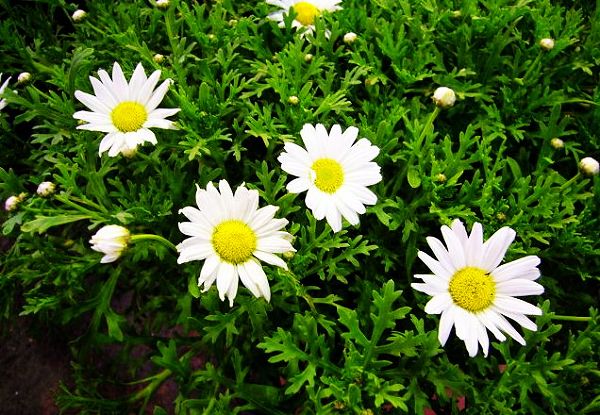
Aliases: marguerite, crown daisy, woody marguerite, East Asian daisy, marguerite
Scientific name: Chrysanthemun frutescens
Family and genus: Asteraceae, Chrysanthemum genus
Place of origin: Canary Islands
Perennial herb or subshrub, plant height 60-100 cm, the whole plant smooth and hairless, much branched, stem base woody, simple leaves alternate, irregularly bipinnately parted, lobes linear, lower leaves obovate-lanceolate, base gradually narrowed into a long petiole, middle leaves oblong to lanceolate, apex acute, base slightly narrowed, upper leaves gradually smaller, lanceolate or linear-lanceolate, capitula borne in the upper leaf axils, pedicels relatively long, ray florets in 1-3 whorls, white or pale yellow, disc florets yellow, pappus scales crown-shaped, toothed or with short awns. Flowering period year-round, peak flowering period April-June.
Marguerite daisy is an evergreen, many-branched subshrub of the Asteraceae family. It likes a cool and humid climate, is not tolerant of heat, and especially avoids strong sunlight in summer. In summer it must be shaded, avoids waterlogging, and is also not tolerant of drought. On hot summer days, water should often be sprayed on the leaves to keep them moist. Because the stem tends to become woody, it is named woody marguerite, and because the plant gives off a special fragrance similar to crown daisy, that is, garland chrysanthemum, it is called marguerite daisy.
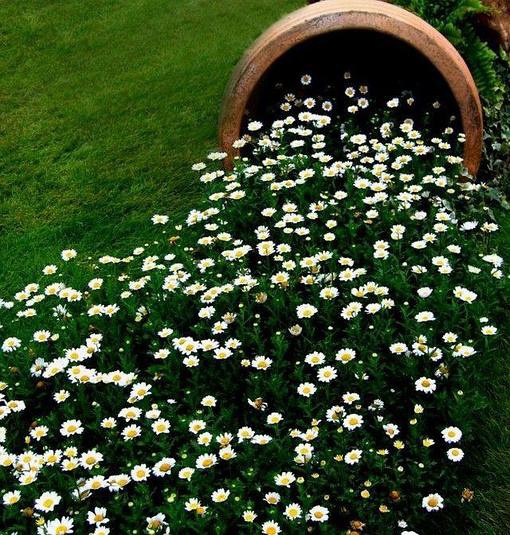
1. Soil: Marguerite daisies like loose, fertile, well-drained soil.
Soil: 5 parts black mountain soil, 5 parts peat soil. Friends who do not have black mountain soil can replace it with garden soil.
2. Cuttings: Marguerite daisies seem not to set seed, and their propagation mainly relies on cuttings.
Generally, a covered seedling box is used for cuttings. The cutting soil is peat soil plus vermiculite, or peat soil plus perlite. The best cutting seasons are spring and autumn; the other two seasons are also very easy for cuttings to survive. The cutting seedlings are always kept on the terrace. Except in summer, in the other 3 seasons the seedling box lid is put on during cutting, which can retain water and heat and improve the survival rate of the cuttings. In summer, cuttings are placed directly in flower pots because the seedling pots are too small and water evaporates easily.
3. Fertilizer: Generally, sufficient base fertilizer is applied when repotting and planting out, and no more fertilizer is applied at other times. The base fertilizer uses chicken manure fertilizer and a small amount of slow-release fertilizer. Because the chicken manure fertilizer has already been composted, using a little more is no problem. The slow-release fertilizer must have its amount controlled according to pot size, and the most important point is that the roots must not touch the fertilizer. During the flowering period, fertilizer is occasionally also applied as a top dressing, using "Bi Kai Hua."
4. Environment: Marguerite daisies are always kept on the terrace, and in summer the time they are in direct sun will not be too long. In winter, several pots that receive key care are placed in a place where rain cannot reach them.
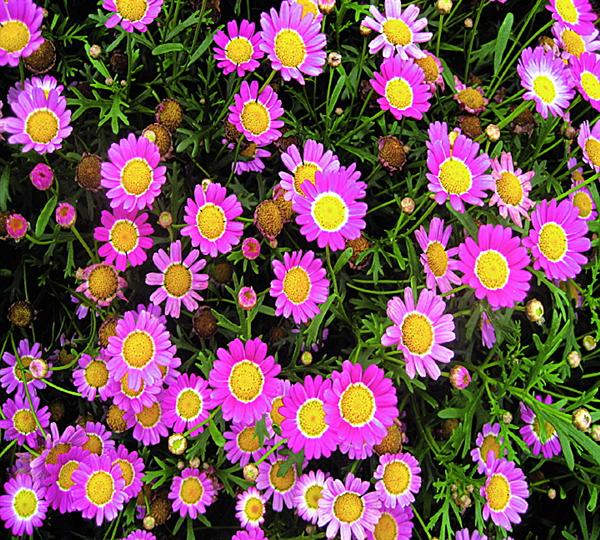
6. How marguerite daisies form a ball. A marguerite that has just survived cutting in the first year will not grow into a very dense ball. Only after experiencing the intense heat of summer and the severe cold of winter is it easy for the marguerite to grow into a very dense ball. Everyone should note that after summer and winter, many leaves may have dried up. As long as there is still green in the center of the branches, do not discard it. With ordinary care and watering, by March or April of the second year, after cleaning up dead leaves and repotting and fertilizing, the marguerite can quickly grow very dense shoots and buds, and its size will be more than 3 or 4 times the original.
Sunlight is also very important. Sunlight and rain are the best nourishment for plants.
The Flower Meaning of Marguerite Daisies
The flower meaning and symbolic significance of marguerite daisies and East Asian daisies: pride, satisfaction, joy.
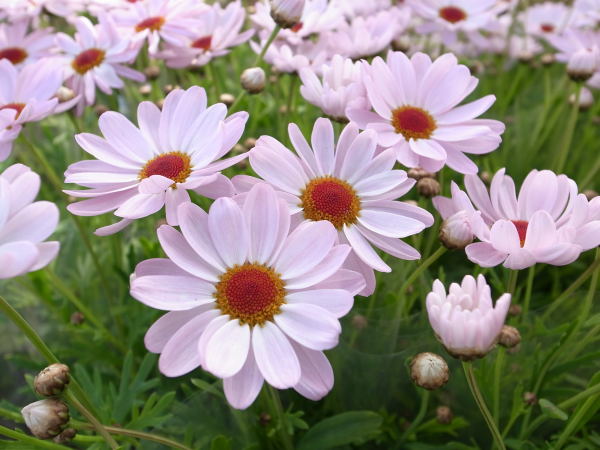
The origin of its flower meaning comes from a legend. The story says that as long as you hold marguerite daisies or East Asian daisies in your hand, and when you carefully pluck the leaves of the marguerite one by one, while plucking you should say: love, love not, love, love not... when you count to the last leaf, you can make a divination about the love between you and him.
Propagation and Cultivation of Marguerite Daisies
Marguerite daisies are propagated by cuttings, which can be done in spring and autumn. The specific time is generally determined according to the required flowering time. Cuttings taken from September to October bloom the following "May 1," and cuttings taken from June to July bloom in early spring the following year. Select mature, robust branches as cuttings. At a temperature of 20-24°C, they root in about 2 weeks. When the seedlings are 10-15 cm tall, pinching can be done to encourage branching. September cuttings can be planted in pots in November and kept in a greenhouse for care. In the early growth stage, light fertilizer can be applied several times, and later, depending on growth, a more concentrated top dressing can be added. After May, as the weather gradually becomes hot, the leaves begin to turn yellow and dry, so watering should be gradually reduced, and the upper branches and leaves should be cut off, then in July-August they should be moved outdoors. For plants grown in the ground, attention should be paid during the rainy season to drainage and waterlogging prevention.
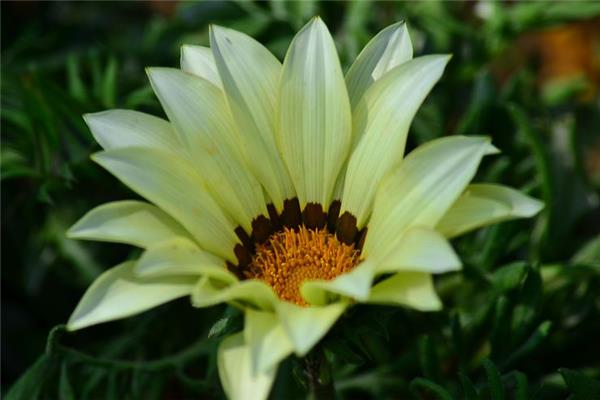
And when you carefully pluck the leaves of the marguerite one by one, while plucking you should say: love, love not, love, love not... when you count to the last leaf, you can make a divination about the love between you and him.
Propagation and Cultivation of Marguerite Daisies
Marguerite daisies are propagated by cuttings, which can be done in spring and autumn. The specific time is generally determined according to the required flowering time. Cuttings taken from September to October bloom the following "May 1," and cuttings taken from June to July bloom in early spring the following year. Select mature, robust branches as cuttings. At a temperature of 20-24°C, they root in about 2 weeks. When the seedlings are 10-15 cm tall, pinching can be done to encourage branching. September cuttings can be planted in pots in November and kept in a greenhouse for care. In the early growth stage, light fertilizer can be applied several times, and later, depending on growth, a more concentrated top dressing can be added. After May, as the weather gradually becomes hot, the leaves begin to turn yellow and dry, so watering should be gradually reduced, and the upper branches and leaves should be cut off, then in July-August they should be moved outdoors. For plants grown in the ground, attention should be paid during the rainy season to drainage and waterlogging prevention.