How to Grow Hymenocallis littoralis: Uses and Benefits
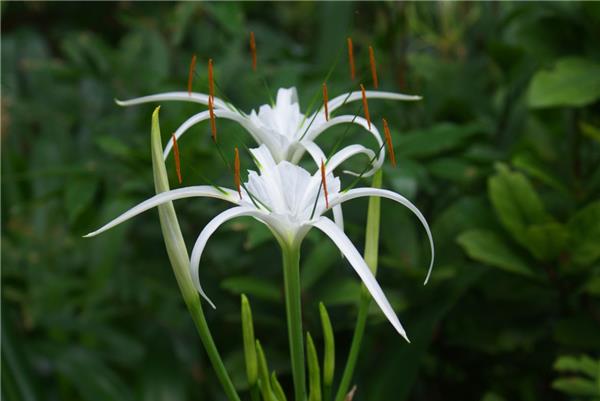
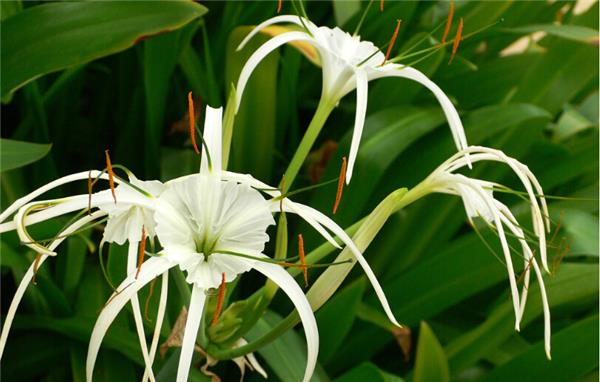
Hymenocallis littoralis is a rather unique flowering plant, with graceful foliage and unusual flowers that stand tall and elegant, resembling a spider, revealing a touch of liveliness and oddity within its fresh, natural look. Below, the editor will introduce how to grow Hymenocallis littoralis and its uses and benefits.
A Brief Introduction to Hymenocallis littoralis
Hymenocallis littoralis (Latin scientific name: Hymenocallis littoralis (Jacq.) Scalisb.), also known as the American spider lily, American water ghost lily, spider lily, spider lily, etc., is native to southern and central America. It is not cold-tolerant and prefers a warm, humid environment. It is widely adaptable to soil and suitable for cultivation in clayey soil. The name Hymenocallis littoralis probably comes from the characteristics of its flowers: its petals are slender and spread very wide apart, closely resembling the long legs of a spider, while the central part of the flower can be seen as the spider's body. Like many orchids, the Latin name of Hymenocallis littoralis also comes from Greek.Hymenocallis littoralis has several leaves, dark green in color, with a sword-like leaf shape; the flower stem is flat, the flowers are white, without a flower stalk; the perianth tube is cylindrical; the flowering period is late summer to early autumn, the flowers are generally relatively large, the petals are thick and covered with a waxy layer, generally yellow-green to yellow, and dotted with some brown or purplish-brown spots. The inflorescence of Hymenocallis littoralis is racemose, often bearing many flowers. Its leaves generally grow on both sides of the stem, arranged very neatly.
Growth Habits of Hymenocallis littoralis
Hymenocallis littoralis likes light, warmth and humidity, and is not cold-tolerant; it prefers fertile soil. In warm regions in winter, with only a little care, it can grow and bloom year after year; in the north it is mostly grown in pots, with an overwintering temperature of 15°C. During the growing period, water and fertilizer must be sufficient. For open-ground planting, dig up the bulbs in autumn and store them dry indoors.
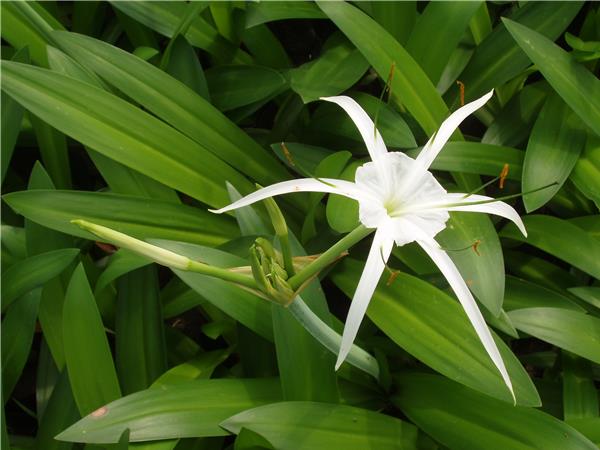
1. Soil: Hymenocallis littoralis is not demanding about soil; it can be potted in leaf mold, or planted in clayey soil.
2. Watering: After Hymenocallis littoralis is brought outdoors in spring, as temperatures rise, gradually increase the amount of watering. In midsummer, it is best to spray once in the morning, then water thoroughly in the afternoon, keeping the soil constantly moist and the ambient humidity relatively high. After moving it indoors in winter, control watering; as long as the potting soil is kept slightly moist, it can get through the cold winter.
3. Sunlight: Hymenocallis littoralis prefers a semi-shaded environment and dislikes strong direct sunlight. When the light is too intense in summer, it should be appropriately shaded or the pot moved to a semi-shaded spot.
4. Temperature: Hymenocallis littoralis likes warmth and is not cold-tolerant, so the overwintering temperature for potted plants is above 15°C.
5. Fertilizing: During the growing period, fertilize Hymenocallis littoralis once every half month. After entering the flowering period, apply manure once every 7-10 days; if phosphorus and potassium fertilizers can be appropriately supplemented, the flowers will bloom even more vigorously.
6. Pests and diseases: The main diseases of Hymenocallis littoralis are leaf spot and leaf scorch. When only a small amount is found, remove the diseased leaves and destroy them. In severe cases, spray with a 500-fold dilution of 75% mancozeb wettable powder for control.
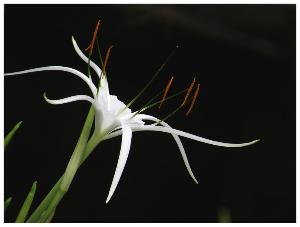
1. Ornamental. Hymenocallis littoralis has graceful foliage, large flowers, pure white color, slender petals with curved tips, and fragrance; its emerald-green leaves set each other off, appearing fresh and elegant, and it has relatively high ornamental value.
2. Home decoration. Hymenocallis littoralis has pure white flowers, bright green leaves, and unique flower shapes, standing tall and elegant, giving people a fresh feeling. Used in places such as the living room and study, it appears relatively elegant and natural, and is a good flowering plant for decorating the home environment.
3. Freshening the air. Hymenocallis littoralis has a certain environmental protection effect, with a certain adsorption effect on dust in the air, and can purify the household air, making the home fresher.
4. Medicinal use. The bulbs of Hymenocallis littoralis contain various alkaloids such as lycorine and polyflorine. Its nature and flavor are pungent and warm, and it has the effects of relaxing muscles and promoting blood circulation, reducing swelling and relieving pain. It can mainly treat bruises and swelling, early-stage carbuncles, rheumatic joint pain, hemorrhoids, etc.
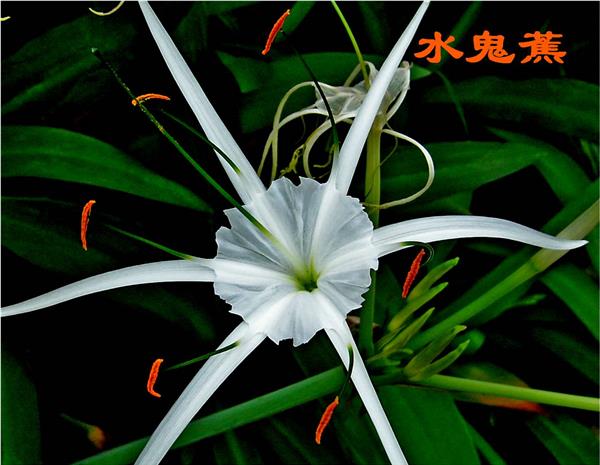
The flower language of Hymenocallis littoralis is: naturally beautiful. People blessed by Hymenocallis littoralis essentially possess irresistible charm, combining many merits in one, and are a standard heartthrob. Unfortunately, others only appreciate her appearance and cannot see her efforts, so she is misunderstood as a beautiful vase.
The flower motto of Hymenocallis littoralis: An idle heart is the source of all ruin.
Propagation Methods of Hymenocallis littoralis
Hymenocallis littoralis is usually propagated by dividing bulbs, and can also be propagated by sowing. Bulb division propagation is more suitable in spring combined with repotting. In winter, place it in a sunny spot in the greenhouse for cultivation, and appropriately control watering; in summer, place it under a shade shed for cultivation, and once it enters the flowering period, supply sufficient water.
If grown in open ground, place the bulbs in April in a warm, sunny place in the greenhouse to prompt root activity. The planting site should be chosen in a sunny spot with humus-rich sandy or clay loam. Deep plow in the autumn of the previous year and apply base fertilizer; plow again in the spring of the following year, apply base fertilizer again, and prepare the land into beds. Plant in late May, with a covering depth of 3-5 cm and a bulb spacing of 15-20 cm. When frost comes in late autumn and the leaves turn yellow, harvest the bulbs in time, dry them, and store them at around 8°C.
Appropriately control watering; in summer, place it under a shade shed for cultivation, and once it enters the flowering period, supply sufficient water.
If grown in open ground, place the bulbs in April in a warm, sunny place in the greenhouse to prompt root activity. The planting site should be chosen in a sunny spot with humus-rich sandy or clay loam. Deep plow in the autumn of the previous year and apply base fertilizer; plow again in the spring of the following year, apply base fertilizer again, and prepare the land into beds. Plant in late May, with a covering depth of 3-5 cm and a bulb spacing of 15-20 cm. When frost comes in late autumn and the leaves turn yellow, harvest the bulbs in time, dry them, and store them at around 8°C.