How to Grow and Propagate Calathea orbifolia
Green plants are an indispensable part of our daily lives; they not only help us decorate our interiors well but also purify the air effectively. Calathea orbifolia is very suitable as a houseplant for home greenery. Today, the editor will introduce to you how to grow Calathea orbifolia and its propagation methods.
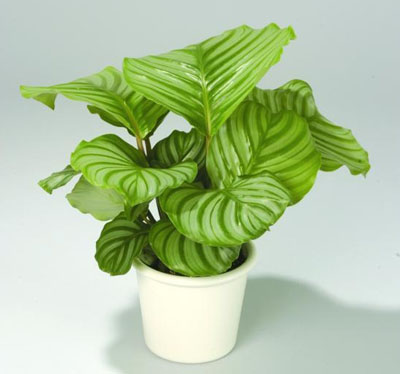
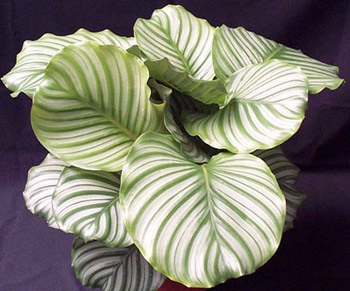
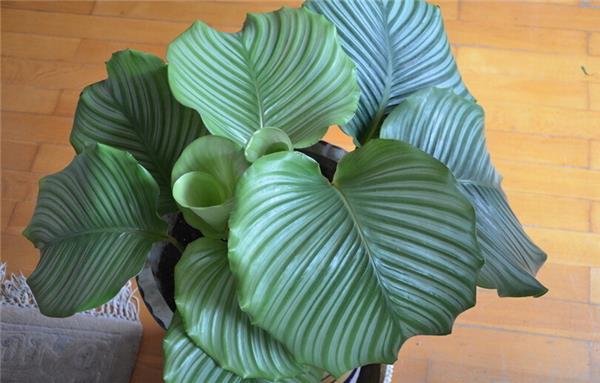
Calathea orbifolia is a perennial evergreen herbaceous plant with leaves growing from the roots in a clumping habit, and leaf sheaths clasping the stem. The plant is relatively tall, usually reaching 40 cm to 70 cm. The petioles are light brownish-purple; the leaves are round or nearly round, with a length-to-width ratio of about 6:5 and a diameter usually between 20 cm and 30 cm; the leaf margins are wavy and the tips bluntly rounded. The leaf surface is pale green or silver-gray, with 6 to 10 pairs of silver-gray striped markings along the pinnate lateral veins; the midrib is also silver-gray, and the underside of the leaf is pale green tinged with light purple. The inflorescence is a spike.
How to Grow Calathea orbifolia
The original species of Calathea orbifolia is native to Brazil and other countries, and was selected and bred by Europeans from Calathea rotundifolia. It is a very popular indoor foliage plant, suitable as a medium-sized potted plant to decorate living rooms. It likes a warm, humid, semi-shaded environment, fears cold, and dislikes strong light. For cultivation, use loose, fertile, well-drained, organic-rich acidic leaf mold or peat soil. Its key management points are as follows:

Fertilizer: During the growing period, you can apply dilute organic fertilizer once a week. When potted plants are displayed at home or in public places, you can apply or spray a mixture of 0.2% urea plus 0.1% monopotassium phosphate. After summer arrives, when the temperature is above 32°C, stop fertilizing. In late autumn and early winter, if the greenhouse temperature is below 18°C, you should also stop all forms of topdressing, otherwise it easily causes fertilizer burn and root rot.
Light: It likes semi-shade and dislikes strong sunlight. From mid-spring to mid-autumn, shading is required; too strong sunlight easily causes the leaf color to become pale and dry, and can even cause severe scorching of the leaves. But the light must not be too weak either, otherwise the leaves become thinner and dull, losing their proper fresh beauty. Therefore, potted plants placed in the greenhouse in winter should be given supplementary light.
Temperature: It likes a warm and mild environment, is not tolerant of intense heat, fears high temperatures, and has poor cold tolerance. Its optimum growth temperature is 18°C to 30°C. In late spring and early summer, when the ambient temperature exceeds 25°C, measures such as building shade and misting the environment should be used to create a cool, ventilated, humid, semi-shaded environment for it. In winter, the ambient temperature should not be lower than 10°C; when the greenhouse temperature is below 5°C, the aboveground parts will suffer severe frost damage. Generally, before the ambient temperature drops to 10°C at the end of autumn, promptly move it to a sunny spot inside the greenhouse.
Diseases: Common diseases include leaf spot and rust, which can be controlled by spraying Bordeaux mixture at 0.5:0.5:100 or 50% carbendazim wettable powder at 800 times dilution, once every 10 days, spraying 2 to 3 times in succession for good control results. Pests: Under high temperature and dry conditions, leaves attacked by red spider mites develop large numbers of small yellow spots, severely reducing their ornamental value; they can be killed by spraying 25% fenbutatin oxide wettable powder at 2000 times dilution. Sometimes scale insects also occur.
Other notes: For ventilation of Calathea orbifolia, the outside temperature needs to be above 16°C; it can be blown directly onto the plant, but in strong winds reduce the amount of ventilation or stop ventilating to prevent leaf damage. Below 16°C, do not ventilate much, as it is not good for its growth; a gentle breeze can also be used to improve air quality. Ventilation is needed both at night and during the day; in autumn, just ventilate during the day and reduce or stop ventilation at night because of the low temperature, mainly to protect the calathea.
Propagation Methods of Calathea orbifolia
Division can be carried out along with repotting. When dividing, make sure each division has more leaves and strong roots. New plants should not be planted too deep; simply bury all the roots in the soil, otherwise the growth of new shoots will be affected. New plants should have their soil moisture controlled, but you can often mist the leaf surface to increase air humidity. Only after new roots grow should you water thoroughly.
Prevent leaf damage. Below 16°C, do not ventilate much, as it is not good for its growth; a gentle breeze can also be used to improve air quality. Ventilation is needed both at night and during the day; in autumn, just ventilate during the day and reduce or stop ventilation at night because of the low temperature, mainly to protect the calathea.
Propagation Methods of Calathea orbifolia
Division can be carried out along with repotting. When dividing, make sure each division has more leaves and strong roots. New plants should not be planted too deep; simply bury all the roots in the soil, otherwise the growth of new shoots will be affected. New plants should have their soil moisture controlled, but you can often mist the leaf surface to increase air humidity. Only after new roots grow should you water thoroughly.