How to Grow and Care for Tradescantia zebrina
Tradescantia zebrina is a common green plant, seen everywhere in homes, courtyards and even along roadsides. Let's take a look at how to grow Tradescantia zebrina.
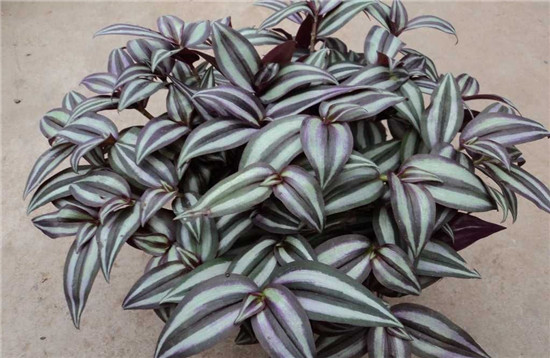
Tradescantia zebrina, also known as inch plant, silver inch plant, wandering dude and red lotus, among other names. It belongs to the Commelinaceae family, genus Tradescantia. Native to Mexico. Tradescantia zebrina is a perennial herb. The stems are somewhat weak, green, drooping, semi-succulent, branching, and root at the nodes. The leaves are oblong, spreading or hanging, about 1 m long, hairless or sparsely hairy.
The leaves are sessile, elliptic-ovate to oblong, 3-6 cm long and 2 cm wide, with a short pointed tip; the upper surface is purple-green mixed with silvery white, with purple stripes along the middle margin, while the underside is purplish red; the top and base of the sheath, or the whole sheath, are sparsely covered with long hairs. The small white flowers are axillary. The flowers cluster within large and small terminal bract-like leaves. There are 3 sepals, fused into a cylindrical tube about 5 mm long; the corolla tube is white, slender, about 1 cm long, with 3 rose-colored lobes about 2.5 mm long, 5 stamens, and a 3-chambered ovary. The fruit is a capsule. The flowering period is irregular.
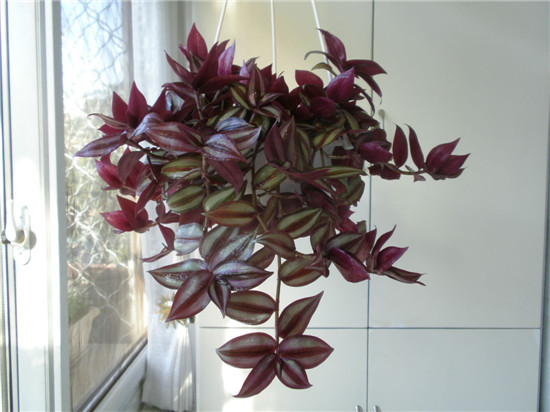
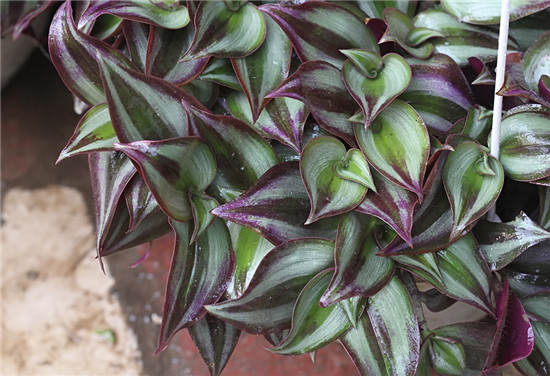
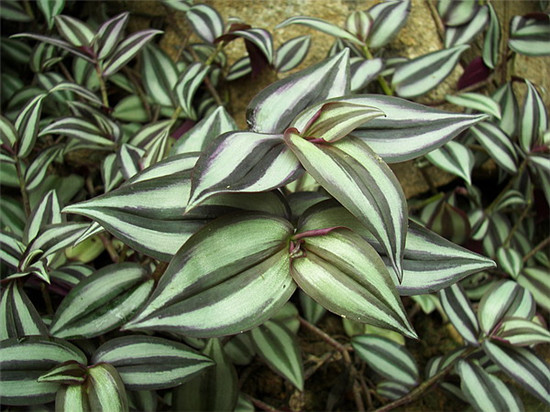
Tradescantia zebrina has weak, brittle stems that creep along the ground in a trailing growth habit. Common varieties include Tradescantia zebrina 'Quadricolor': the upper leaf surface is dark green with red, pink and white stripes, and the leaf underside is purple. Tradescantia zebrina 'Discolor': the leaf surface is green with two distinct silvery white stripes. Tradescantia zebrina 'Minima': the leaves are small and the plant is shorter than the original species. Tradescantia zebrina 'Purpusii': the leaf shape and flowers are basically the same as those of Tradescantia zebrina. The plant form of Tradescantia zebrina 'Purpusii' is slightly larger than that of 'Quadricolor', and the leaf bases are more hairy. The leaf surface is dark green and wine-red, without white stripes.
How to Grow Tradescantia zebrina
1. Soil: Tradescantia zebrina is highly adaptable and has low soil requirements, but it grows better in fertile, loose soil.
2. Sunlight: Tradescantia zebrina fears direct strong light and needs to be kept in partial shade, or given 70% shade. If kept indoors, place it in as bright a spot as possible, and every one or two months move it outdoors to a partially shaded spot or keep it shaded for a month, so it can accumulate nutrients and recover its vigor.
3. Temperature: The optimum growing temperature for Tradescantia zebrina is 18°C-30°C. It dislikes cold and frost, and the overwintering temperature must be kept above 10°C. When the winter temperature drops below 4°C, it enters dormancy; if the ambient temperature approaches 0°C, it will die from frost injury.
4. Fertilizing: Tradescantia zebrina has high fertilizer and water demands, but it is most harmed by careless fertilizing, concentrated fertilizer and one-sided application of nitrogen, phosphorus or potassium. Follow the fertilizing (and watering) principle of "light fertilizer applied frequently, small amounts but more often, complete nutrition."
5. Pruning: In Tradescantia zebrina plants that have been grown for too long, the leaves at the base often fall off, which affects their ornamental value. At this point, cut off the overly long branches and leaves to encourage new buds to sprout from the stem base and grow new branches and leaves.
The Benefits of Tradescantia zebrina
The benefits of Tradescantia zebrina: 1. Decorating the home
Tradescantia zebrina grows quickly, with branches and leaves that creep and hang down. Its leaves are a mix of purple, green and silver, dazzling to the eye. Grown in pots and placed on a tall stand or the top of a cabinet to let it hang down naturally, it forms a green curtain with a very pleasant ornamental effect and a distinctive artistic appeal. It is often used for overall arrangements in homes, courtyards and other places.
The benefits of Tradescantia zebrina: 2. Freshening the air
Most plants have some air-freshening effect, and Tradescantia zebrina is no exception. Moreover, it grows vigorously and is a very suitable herbaceous foliage plant for ground cover greening that is quick and effective with little input. In places covered in large patches of Tradescantia zebrina, the air is also relatively fresher.
The benefits of Tradescantia zebrina: 3. Medicinal value
Tradescantia zebrina is a perennial herb of the Commelinaceae family, also known as variegated bamboo-leaf herb, water bamboo grass and purple-backed spiderwort. It has the functions of clearing heat and detoxifying, cooling blood and stopping bleeding, and promoting urination. Its main effects include clearing heat and draining dampness, cooling blood and detoxifying, treating edema, difficult urination, strangury, dysentery, leukorrhea, hemoptysis, red swollen painful eyes, sore swollen throat, sores and abscesses, burns and scalds, and venomous snake bites.
The above is the full content of my summary on growing Tradescantia zebrina and caring for Tradescantia zebrina. I hope this article can help everyone. Please also keep following us.