What are the characteristics of Golden-heart Boxwood bonsai? A detailed introduction
Golden-heart Boxwood, also known as small-leaved boxwood (Chinese boxwood), has a trunk that grows extremely slowly and is very rugged and vigorous, but its young branches grow relatively quickly. Next, let us take a look at the characteristics of boxwood bonsai.
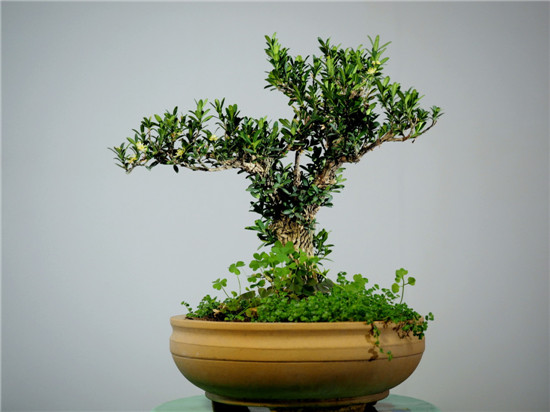
Most boxwood bonsai materials are taken from wild old stumps growing by the water. Because of their small evergreen leaves and slow growth that makes them hard to change shape, they have become artistic treasures. Purple clay pots are commonly used, with pot colors mostly purple or light yellow. The pot shape is determined by the styling form: for cascade style, a deep cylindrical pot is suitable; for slanting style or curved-trunk style, an oval or rectangular pot is used. Today, the editor will briefly introduce boxwood bonsai.
Boxwood bonsai is relatively cold-tolerant and has strong sprouting ability. Through coarse wiring and fine pruning, it is made into cloud-layer or steamed-bun shapes, or processed into a natural tree form. The trunk is made into a slanting style or lying style following its natural tendency. Some boxwood bonsai are accented with ornamental rocks, forming a "boxwood overlooking" scene. In spring, when the tender leaves of boxwood bonsai first emerge, the whole tree is tender green and very pleasing to the eye. Among boxwood mountain stumps there is no lack of fine specimens, especially pearl boxwood. Pearl boxwood has made its home for generations on high mountain ridges or in rock crevices. Through the harsh tempering of wind, frost, snow and ice, it naturally grows into a tree form with twisted branches, curved trunk and strange, varied postures, becoming an excellent material for stump bonsai.
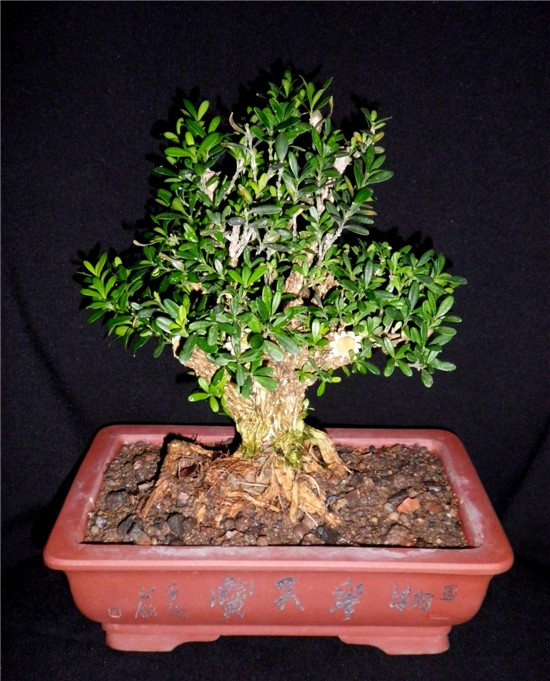
In the Yuan Dynasty, Hua Youwu's poem praising boxwood wrote: "A boxwood tree so near at hand, with lush and layered branches and trunk, deep leaves like jade-green fields, ancient roots like coiled dragons. Through years of wind and frost long endured, and frequent heavy rain and dew. It should not meet misfortune in a leap year, its firm substance rivals the cold pine." Boxwood bonsai has a graceful tree posture, leaves as small as broad bean petals, thick and glossy, evergreen all year round, and can be enjoyed throughout the year.
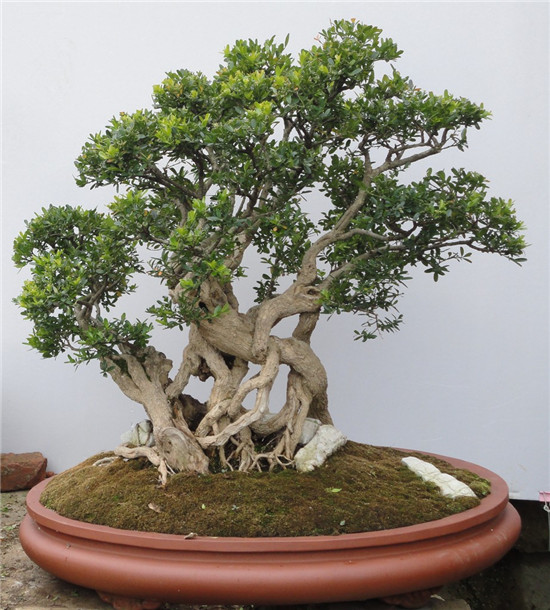
Yang-school boxwood bonsai has branches and leaves that are pruned and wired into a "cloud-layer shape," flat and thin as if shaved, then accented with mountain rocks, elegant and beautiful as a painting. In spring, when the tender leaves of boxwood first emerge, the whole tree is tender green and very pleasing to the eye. An ancient poem praising boxwood says: a boxwood tree so near at hand, with lush and layered branches, deep leaves like jade-green fields, ancient roots like coiled dragons.
North of the Huai River is located in a warm temperate zone, where winter and spring are dry and cold with strong winds. After the leaves fall, there are few cold-tolerant and drought-tolerant evergreen trees. Oriental arborvitae, Chinese juniper, Thousand-head arborvitae, boxwood, glossy privet, photinia, small-leaved boxwood bonsai, small-leaved privet and, in recent years, introduced evergreen coniferous and broadleaf tree species such as osmanthus, southern magnolia, camphor tree, Michelia maudiae, Elaeocarpus, palm and Aphanantze are among them. Some of these tree species belong to subtropical species and have been planted north of the Huai River for only a short time.
Species such as southern magnolia, camphor tree, Aphanantze and Michelia maudiae show varying degrees of yellowing, greatly marring the scenery. The native evergreen trees are mostly shrubs; among arborescent species there are only the cypress types, but because they grow slowly and their winter leaf color is dark and monotonous, it is difficult for them to meet people's visual, landscape and new rural construction needs.
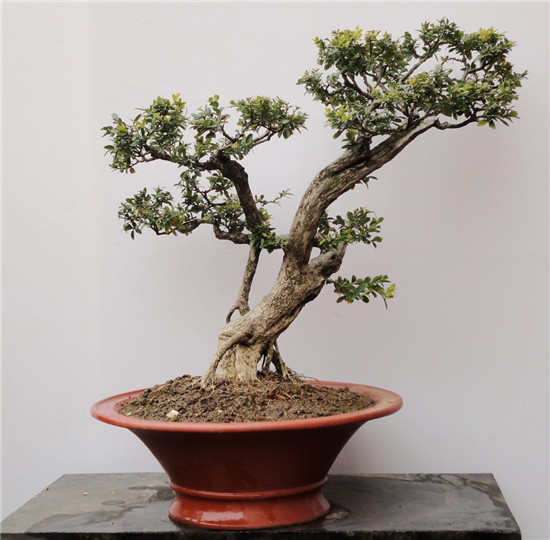
There are many factors affecting the price of boxwood bonsai. In terms of price, there are many influencing factors, such as tree shape, plant size and so on. Therefore, the editor cannot blindly give everyone a price. Generally, an ordinary boxwood bonsai costs one hundred to several hundred yuan, and a good one may cost over a thousand yuan.
The above is the full content of the characteristics of Golden-heart Boxwood bonsai and the introduction to Golden-heart Boxwood bonsai that I have summarized for everyone. I hope this article can help everyone. Please also continue to follow us.