How to grow maidenhair fern? These methods you need to know
Maidenhair fern is a perennial herbaceous plant and a common fern. Next, let us take a look at how to grow maidenhair fern.
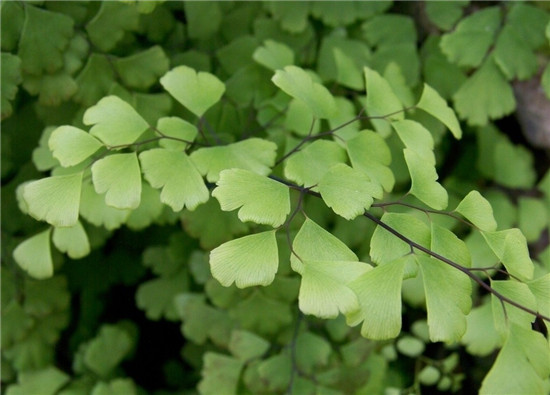
Maidenhair fern is generally perennial and can grow to about 50cm. The leaf stalk generally accounts for about half the height, with a thickness of around 1.3cm. It is rather slender and breaks easily. In many cases its color appears black, and the surface is glossy. Both the rhizome and the base have scale-like parts. The leaves are mostly triangular-ovate in shape, and thin, mostly grass-green in color, rarely white, smooth and glossy, and without fuzz. As a maidenhair fern that was already used in medicine and horticulture in ancient times, it is very popular as a household potted plant, and it is easy to keep alive. So if you want to grow maidenhair fern well, you first need to understand its habits.
As a wild plant, maidenhair fern prefers loose, airy, moist calcareous sandy soil. It can often be seen under trees in the wild, because it is not suited to direct sunlight; under trees it can receive a small amount of scattered light. Although it prefers a temperature of around 20°C, its cold tolerance is not bad either; generally, at a temperature of around 5°C it can still safely get through winter. Maidenhair fern is a perennial spore-propagated plant. It is generally planted by spores, but if you want rapid growth, you can cultivate it directly by division. The general cultivation methods are mostly similar to those for ferns.
What value does maidenhair fern have?
Medicinal value: The whole plant of maidenhair fern can be used as medicine. It can clear heat and detoxify, and also drain dampness and reduce swelling, promote urination and treat strangury, and can also be used for dysentery, etc. It usually has a good therapeutic effect on lung-heat cough, hepatitis, venomous snake bites, bruises and injuries, etc.
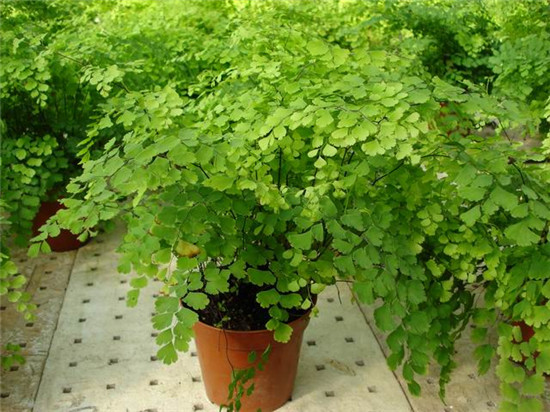
Ornamental value: Maidenhair fern likes shade, has strong environmental adaptability, and is very easy to cultivate. It is very suitable for year-round potted cultivation and viewing indoors. If it is a small potted plant, we place it on a desk or coffee table, while larger potted plants are used to decorate corridors or living rooms, etc. Moreover, the leaves of maidenhair fern are also very good cut-leaf material and dried-flower material. Combined with fresh flowers in a vase, it has very good ornamental value for beautifying the home environment.
Common varieties of maidenhair fern
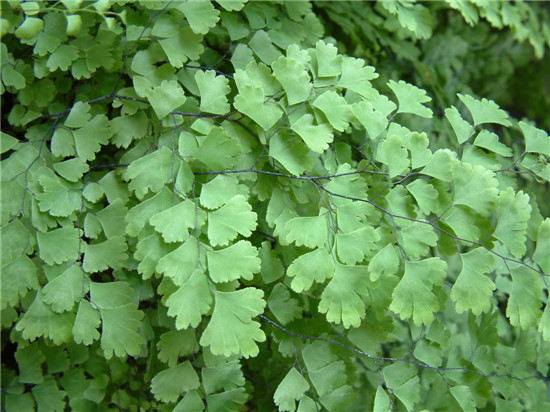
Fan-leaved maidenhair fern: The leaves are fan-shaped to irregularly broad-ovate, with 2-3 palmate branches to bird's-foot-like dichotomous branching; the middle pinnae are the largest, and the pinnules have some short stalks.
Whip-leaved maidenhair fern: Also called hairy maidenhair fern, its leaves are linear-lanceolate, about 10-25cm long, and the tip is often elongated into a whip shape that can touch the ground and take root.
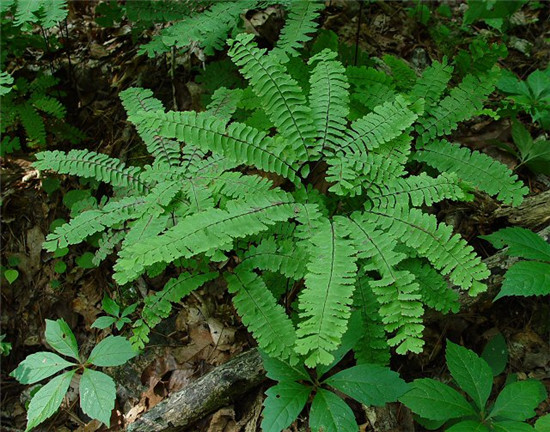
Wedge-leaved maidenhair fern: The leaves are broadly triangular, with 2-4 times pinnately divided leaves, and the lobes are rhombic or oblong.
Cultivation methods for maidenhair fern:
1. Soil: Maidenhair fern prefers loose, permeable, fertile calcareous sandy loam. When potted, the growing medium can be made by mixing equal parts loam, leaf mold and river sand.
2. Watering: Maidenhair fern prefers a moist environment. During the peak growing season, water it thoroughly. In addition to keeping the potting soil moist, also pay attention to maintaining relatively high air humidity; when the air is dry, sprinkle water around the plant. Especially in summer, water 1-2 times a day. If it lacks water, the leaves will shrivel. Avoid letting the potting soil alternate between dry and wet when watering, as this easily turns the leaves yellow.
3. Sunlight: It prefers bright scattered light and is afraid of direct sun. If the light is too strong, the leaves will wither and yellow or even die. In summer, appropriate shading can be provided; long periods of strong direct light will cause most of the leaves to wither and yellow. Indoors, it should be placed in a dark spot; even if placed there for 1 year, it can still grow normally.
4. Temperature: It likes warmth and is also cold-tolerant. The suitable growing temperature is 21-25°C during the day and 12-15°C at night. In winter it should be moved into a greenhouse; at temperatures above 5°C the leaves can still remain fresh green, but below 5°C the leaves will suffer cold damage.
5. Fertilizing: Apply dilute liquid fertilizer 2-3 times a month. When fertilizing, do not contaminate the leaf surface, so as to avoid causing leaf rot. Because maidenhair fern likes calcium, the potting soil should be supplemented with an appropriate amount of lime and crushed eggshells; frequently applying calcium fertilizer will give better results. In winter, reduce watering and stop fertilizing.
6. Pests and diseases: Potted maidenhair fern often suffers from leaf blight. In the early stage, Bordeaux mixture can be used for control; in severe cases, a 1000-1500 times dilution of 70% thiophanate-methyl can be used for control. If scale insects harm the plant, a 1000 times dilution of 40% omethoate can be used for control.
7. Pruning: After autumn begins, as the temperature drops, maidenhair fern enters a stage of slow growth, and the old leaves will gradually turn yellow. At this time they should be cut off.
The above is all the content I have summarized for everyone on how to grow maidenhair fern. I hope this article can help everyone. Please also continue to follow us.
When maidenhair fern enters a stage of slow growth, the old leaves will gradually turn yellow. At this time they should be cut off.The above is all the content I have summarized for everyone on how to grow maidenhair fern. I hope this article can help everyone. Please also continue to follow us.