How to Water Succulents? A Detailed Guide to the Correct Watering Method
There is no fixed formula for growing plants; every grower has their own way, and presumably no one concedes to anyone else. Likewise, there is no fixed formula for watering. Some people prefer dry growing - dry growing is good for a plant's reproductive growth and helps it accumulate more dry matter, but the plant may not look quite so lush. Others prefer wet growing - wet growing supports a plant's vegetative growth, with abundant branches and leaves, but its resistance may be somewhat weaker. So there you have it, the pros and cons laid out before you, and you can choose how you want to grow. Today I will tell you how to water succulents: how to water succulent plants.
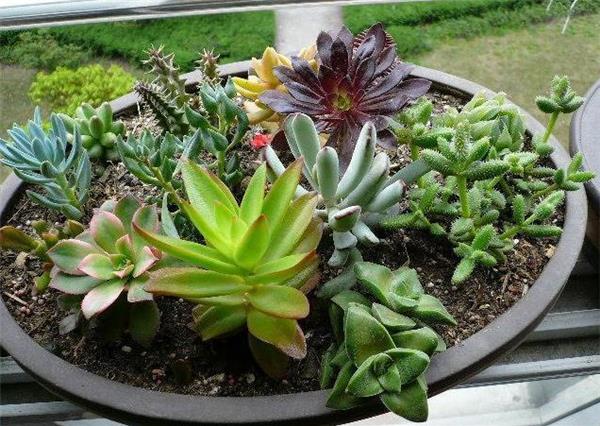
Growing medium: If you use granular soil or another growing medium with good air permeability, the moisture dries quickly. In well-ventilated conditions, you can appropriately increase the amount of water. If you use ordinary soil, or peat soil with poor water and air permeability, you must water cautiously. This type of growing medium is prone to mold infection, causing the whole plant to rot in an instant. You can try spreading breathable stone such as volcanic rock on the surface to reduce the chance of infection.
Containers: For highly breathable red clay pots, moisture can escape through the pot walls, so you basically do not need to worry about dangers such as root rot. For containers with holes, as long as drainage and ventilation are handled well, alternating between dry and wet is not a big problem. Succulent roots are generally shallow, and overly deep containers tend to accumulate water at the bottom, so when using them you should lay a sufficiently thick breathable layer. For containers without holes, besides needing a drainage layer, the watering frequency should also be lower than with other containers.
Summer-growing (spring-autumn-growing) types: This type grows rapidly in spring and autumn; depending on different factors such as growing medium and container, the frequency is about 3-6 times per month. From the plum rain season until the end of summer, although they still keep growing, to prevent rot you should reduce the watering frequency, with about 1-3 times per month being appropriate. In winter they enter dormancy; to prevent frost damage, you must also control watering, with 1-2 times per month being enough.
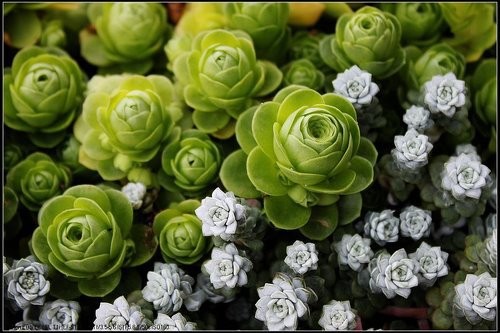
When Should Succulent Plants Be Watered
When it comes to when succulent plants should be watered, of course we must talk about grasping the "timing" of watering. It is impossible for us to repot and inspect every time we water. Besides needing to painstakingly train basic skills such as feel and eye, there are actually tricks to it~
Trick 1 - the weighing method. First determine your own soil mix, and try to use the same formula each time you pot. At the same time, prepare an empty pot, fill it with thoroughly dry soil, then weigh it. After recording the weight, water it thoroughly, weigh it again, and record the two data points. Next, weigh it once a day. Besides checking the water retention of your own soil mix, the ultimate goal is to see how many days it takes to return to the weight of the dry soil when potted. Subtract 1-2 days from that number of days, and that is the watering cycle you need. The above is for Haworthia; for Mesembryanthemum, you do not need to subtract days. Of course, this method ignores the water uptake and transpiration of the plant's root system. Generally, potting soil with a growing plant will dry faster, so if the data obtained above can also be compared over the same period with the weight of a pot containing a plant, the watering cycle obtained will be even more precise.
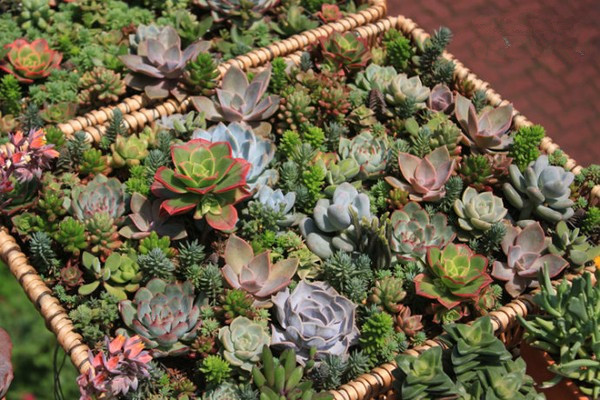
Trick 2 - the growing medium color-change method. Increase the proportion of akadama in the soil mix, because akadama soil particles have quite good water absorption and water transfer ability, and they change color as soon as there is a bit of moisture, making wet and dry very intuitive. Increasing the proportion of akadama in the soil mix can strengthen water transfer within the potting soil: the upper soil dries quickly, and moisture below will keep being transferred upward until the moisture content in the lower growing medium decreases to a critical point, and this critical point is often the beginning of the signal to water. It is recommended to increase the proportion of akadama in the soil mix to above 40%, and use pure akadama of 2-3 particle size for top dressing on the pot surface. When the akadama on the pot surface turns pale yellow and whitish, Haworthia should be watered after waiting at most 1 more day, and Mesembryanthemum should be watered after 2 days. If you want to use this method to determine the watering cycle, you still need to adjust it according to your own soil mix.
1. The toothpick method. Many people like to use this, but in fact it easily punctures and damages the root system growing along the pot wall, and then when you water, it will rot without question. Spurn rating: 3 stars.
2. The finger-in-the-pot probing method. I once saw this method in a translated article by someone else, and I do not know whether anyone actually does it. I think this method is very foolish. Never mind that everyone now likes to use granular soil, so a finger cannot be inserted at all; even if it could be inserted, the finger would get dirty, the nice decorative top dressing on the pot surface would be messed up, and worse, some precious fine roots floating on the pot surface might be broken off. It can be said that this is completely a foolish method with a hundred harms and no benefit. Spurn rating: 4 stars.
3. The tap-the-pot-and-listen method. I do not want to criticize this method anymore; it is far too unreliable. Unless everyone has trained their hearing like the musician Lang Lang, this method is not as good as directly inserting a finger. Spurn rating: 5 stars.
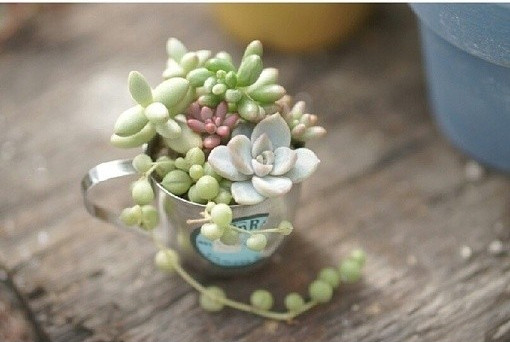
Succulent Watering Tricks That Should Be Spurned
1. The toothpick method. Many people like to use this, but in fact it easily punctures and damages the root system growing along the pot wall, and then when you water, it will rot without question. Spurn rating: 3 stars.
2. The finger-in-the-pot probing method. I once saw this method in a translated article by someone else, and I do not know whether anyone actually does it. I think this method is very foolish. Never mind that everyone now likes to use granular soil, so a finger cannot be inserted at all; even if it could be inserted, the finger would get dirty, the nice decorative top dressing on the pot surface would be messed up, and worse, some precious fine roots floating on the pot surface might be broken off. It can be said that this is completely a foolish method with a hundred harms and no benefit. Spurn rating: 4 stars.
3. The tap-the-pot-and-listen method. I do not want to criticize this method anymore; it is far too unreliable. Unless everyone has trained their hearing like the musician Lang Lang, this method is not as good as directly inserting a finger. Spurn rating: 5 stars.