How to grow string of beads (Senecio rowleyanus)? A detailed guide to cultivation methods
String of beads is what we commonly call string of pearls (Senecio rowleyanus). Perhaps many people are not very familiar with how to grow string of beads, so let us take a look together!
The characteristics of string of beads
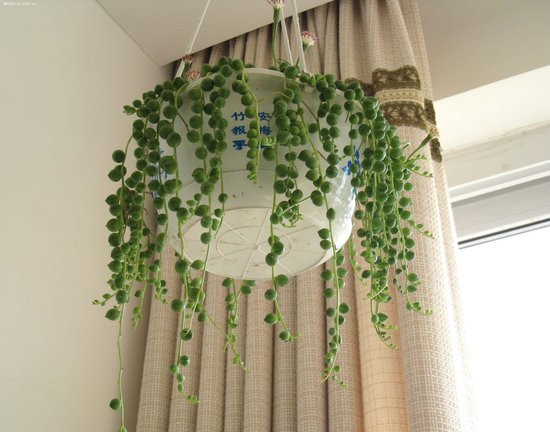
String of beads, also called jade beads, is a very common succulent plant. Apart from the variegated "variegata" types, there are generally two kinds on the market: one is round, and one is teardrop-shaped. Because names differ from place to place, the three most common names are "string of pearls", "string of beads", and "lover's tears".
String of pearls likes soil rich in organic matter that is loose and fertile. It grows best in a warm environment with relatively high air humidity and strong diffused light. In summer, high temperatures and high humidity should be avoided, otherwise the stems rot very easily and the plant dies. The potted plant can be placed in a rain-sheltered, shaded spot for cultivation. After autumn arrives, the plant resumes growth, so light should be increased and a liquid fertilizer applied as a top dressing.
Cultivation methods for string of beads
1. Propagation methods
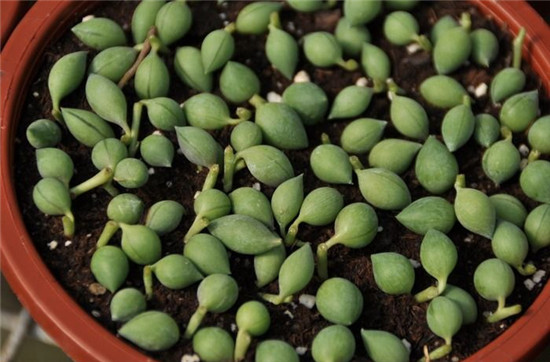
String of beads is mostly propagated by cuttings. The stems and leaves can be trimmed into sections of 8-10 cm each, then inserted into the potting soil, half-buried, with humidity kept between 50% and 60%. They root in 10 days to half a month, and only with careful attention will they survive. At this time, watering must be strictly controlled, keeping the potting soil in a state between dry and moist, which is most beneficial for plant growth.
2. Cultivation management
"Better dry than wet" is a key point in growing string of beads. In addition, "light fertilizer applied frequently" is also an extremely important point. The saying "better dry than wet" comes from the fact that string of beads, which originates from southern Africa, likes a warm environment and is relatively drought-tolerant but cannot tolerate waterlogging. So it is better to place it in a dry environment than to cause poor development through overwatering. "Light fertilizer applied frequently" means that fertilizer should be applied often, but each time as a dilute fertilizer; too much fertilizer at once will cause problems in its growth.
3. Pest prevention
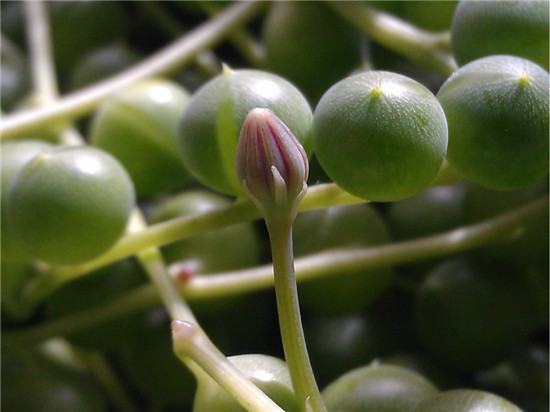
String of beads actually rarely suffers from pests, but such cases still occur. Generally speaking, the most common disease of string of beads is aphids, which occur in spring. When this happens, use omethoate at 500 times dilution to kill them. In summer, mites appear, and dicofol at 1000 times dilution can be used to kill them. When pests occur, pay attention to increasing leaf humidity, which can reduce pests; in addition, ventilation must also be well provided.
Notes on growing string of beads
1. Because the leaves of string of pearls are very fleshy and juicy, it is relatively drought-tolerant. During cultivation, remember the principle that watering should be "better dry than wet"; this is one of the keys to successfully growing string of pearls. In dry weather, you can spray water on the leaves and vines more often to make up for the lack of moisture and to keep the beads green and plump. Since string of pearls likes partial shade, direct blazing sun may very likely scorch it, and under overly strong light its growth is poor.
2. String of pearls has a very shallow root system, so it can be planted in a shallow pot. Generally, we can use a piece of tile to cover the bottom hole and also spread a layer of cinder or coarse sand to increase the soil's air permeability and drainage. For the soil, it is best to use leaf mold mixed with a certain amount of sand.
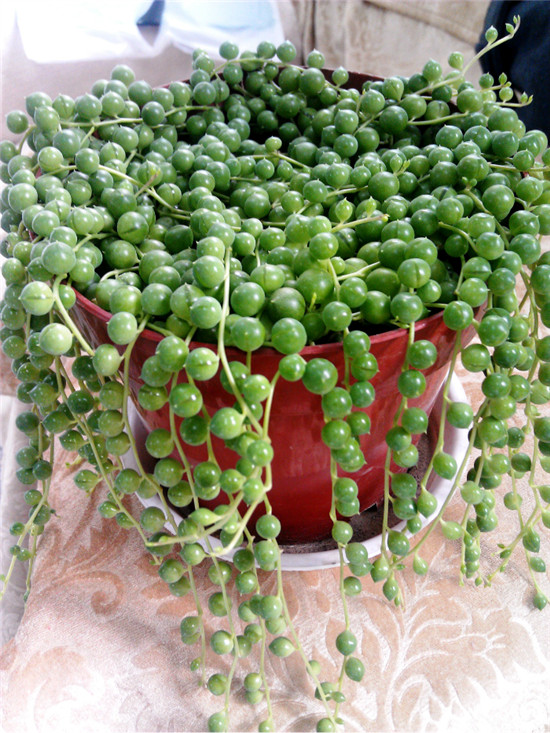
3. This plant, which likes warmth and moisture, grows best at temperatures between 20-28 degrees. Its growth slows at both high and low temperatures. Especially when the high temperature reaches 30 degrees, the plant is almost in a dormant state. At this time, remember to give it less fertilizer and less water, otherwise its roots will rot very easily.
4. During the peak growing season, light fertilizer should be applied frequently. Spraying on the leaf surface often will help the beads become greener and plumper, better enhancing their ornamental value.
5. Actually, string of pearls rarely suffers from pests and diseases, though aphids do appear in spring. Generally, as long as ventilation is maintained and leaf humidity is increased, mite infection can be greatly reduced.
The above is the full content of the introduction to growing string of beads that I have summarized for everyone. I hope this article can help you. Please also keep following us.