The Benefits and Effects of Goji Berry and Chrysanthemum Tea, and What Side Effects It Has
Goji berry and chrysanthemum tea is one of the most commonly drunk teas. Many people know that goji berry and chrysanthemum tea has great benefits and effects and is very good for the body, but few people have an in-depth understanding of it, such as the side effects of goji berry and chrysanthemum tea and its composition.
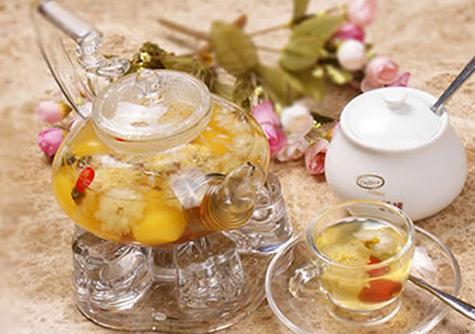
The Benefits of Goji Berry and Chrysanthemum Tea
1. Goji berry and chrysanthemum tea can improve eyesight and refresh the mind. Chrysanthemum is rich in vitamin A, an important substance for maintaining eye health. Chrysanthemum tea can make people clear-headed and bright-eyed, and it has a relatively good effect especially on dry eyes caused by excessive liver fire and overuse of the eyes. People who use computers and often feel their eyes are dry will benefit greatly from drinking some chrysanthemum tea.
2. Goji berry and chrysanthemum tea can strengthen the constitution. The vitamin C, vitamin E, and especially the tea polyphenols contained in chrysanthemum tea have strong antioxidant activity, can clear oxygen free radicals from the human body, and can resist radiation and enhance the body's immunity.
3. Goji berry and chrysanthemum tea can ease the aftereffects of using computers. Long-term computer use affects health; the eyes remain in a tense state, and excessive visual fatigue can also cause blocked circulation of aqueous humor, making glaucoma more likely. At the same time, dry eye syndrome, cataracts, corneal ulcers, and retinal detachment are also eye diseases that long-term computer users are prone to. Drinking chrysanthemum tea can improve eye discomfort and relieve the above symptoms.
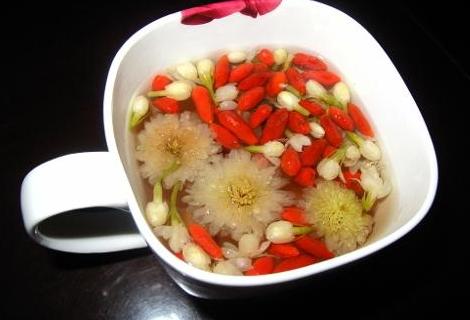
a. It has a very good effect of tonifying essence and qi and lowering blood sugar, and is especially beneficial for the treatment of diabetes.
b. At the same time, goji berry has the effect of inhibiting fat deposition and promoting the regeneration of liver cells, so to a certain extent it can protect the liver.
c. It has the effect of lowering blood cholesterol and can prevent the formation of atherosclerosis.
d. It can enhance human immunity, promote hematopoietic function, and prevent anemia.
e. Goji berry can improve eyesight, so among the people it also has the name "bright-eye grass seed."
f. It has the effect of dispelling wind and clearing heat, detoxifying, and improving eyesight.
j. Chrysanthemum can lower blood pressure, and has a very good effect on chest tightness, palpitations, shortness of breath, dizziness, headache, numbness of the limbs, and so on.
h. Chrysanthemum has the effects of resolving stasis and reducing fat, cooling and lowering blood pressure, and reducing weight and lightening the body, and is suitable for patients with obesity, hyperlipidemia, and hypertension.
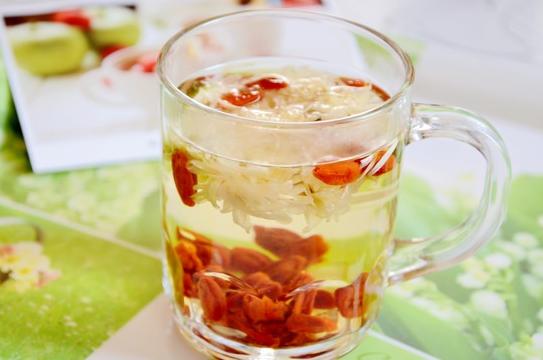
1. People with hypertension should not drink goji berry and chrysanthemum tea. Goji berry has a fairly strong effect of warming the body. People with hypertension or who are too irritable had best not eat goji berry. If a person has a weak constitution, often catches colds, and has poor resistance, then it is best to eat it every day.
2. People who are currently ill should not drink goji berry and chrysanthemum tea. People with a weak constitution and poor resistance should usually eat a bit more goji berry, but people who are currently suffering from a cold and fever, have inflammation in the body, or have diarrhea had best not eat it.
3. Do not mix goji berry and chrysanthemum tea with other beverages. Different constitutions should choose different herbal teas. Drinking them randomly will not only fail to achieve a health-care effect, but sometimes may instead cause side effects. For internal heat, one must distinguish deficiency from excess. Prunella vulgaris, chrysanthemum tea, and so on have the effects of clearing heat and reducing fire and clearing the liver and improving eyesight, and they have a targeted fire-extinguishing effect on both types of excessive fire. But note that because their nature tends to be bitter and cold, people with a weak body should not drink much.
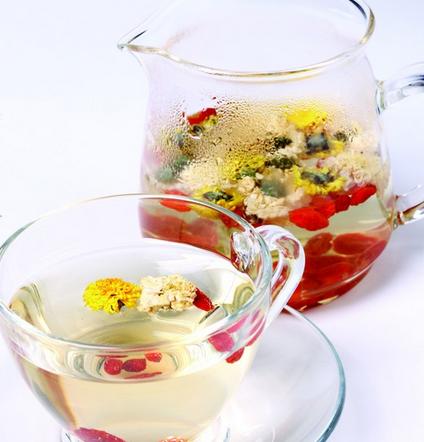
How to Make Goji Berry, Red Date, and Chrysanthemum Tea:
A small handful of goji berries, three to four red dates, and a few chrysanthemum flowers
Preparation: Wash clean, put into a cup that has been warmed, pour in hot boiled water, cover tightly, and steep for 10-15 minutes before drinking.
Effects: Red dates are warm in nature and sweet in taste, tonify the middle and benefit qi, and nourish blood and calm the mind; goji berry is sweet and neutral in nature and taste, nourishes the liver and kidneys, nourishes the liver and improves eyesight, and eliminates fatigue; chrysanthemum is sweet and bitter in nature and taste and cool, clears heat and dispels wind, improves eyesight and detoxifies, and strengthens the constitution.
Note: People with severe damp-heat should not eat red dates. They can instead steep only goji berries and chrysanthemum, or replace the red dates with black tea, which can also produce the effects of improving eyesight, nourishing the liver, benefiting blood, and resisting fatigue. The red dates should be pitted so they are not too drying and heating, and the tea can be drunk regularly. If it tastes too bland, an appropriate amount of rock sugar or honey can be added.
How to Make Goji Berry and Chrysanthemum Tea:
Ingredients: 10 grams of goji berries, 10 grams of Hangzhou chrysanthemum.
Method: Brew the above ingredients with boiling water.
Consumption: Drink as tea, taken regularly.
Effects: Improve eyesight and prevent eye diseases.
As the saying goes: "Three parts treatment, seven parts nourishment, ten parts prevention." This shows the importance of health preservation. In many people's minds, only the elderly need health preservation, but in fact this is not so. Health preservation is a long road, and the earlier one sets out on it, the more one benefits.
Drink Some Goji Berry and Chrysanthemum Tea for Autumn Dryness
Traditional Chinese medicine believes that dryness is the dominant qi of autumn. Dryness is dry in nature and easily damages body fluids, such as dry mouth and nose, dry and itchy skin, and dry and lusterless hair, which is very much related to autumn dryness. The Chinese herb goji berry is sweet and neutral in nature and taste and non-toxic, enters the liver and kidney meridians, and has a very good effect of nourishing the kidneys, moistening the lungs, and improving eyesight. Chrysanthemum can very well help the human body supplement qi, supplement strength, remove dryness, and detoxify. Modern medicine has proven that chrysanthemum has a very good regulating effect on chronic diseases of modern people such as high blood lipids, hypertension, and sub-health.
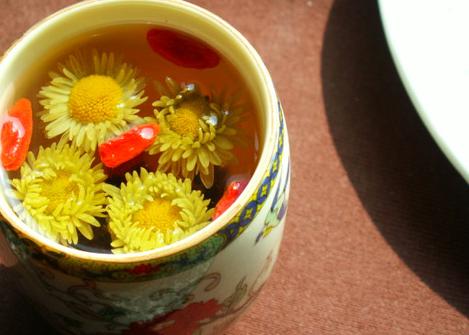
Chrysanthemum and goji berry tea is made by steeping chrysanthemum and goji berry together. Each time use 10 grams each of Hangzhou white chrysanthemum and goji berry, add them to a large teapot, add hot boiled water, and it can be drunk after 10 minutes.
Although goji berry and chrysanthemum tea has very good nourishing and therapeutic effects, it is not suitable for everyone to take. People with a weak constitution and poor resistance should usually eat a bit more goji berry; but goji berry has a fairly strong effect of warming the body, so people who are currently suffering from a cold and fever, have inflammation in the body, or have diarrhea had best not eat it.
No tonic should be eaten in excess, and goji berry is no exception. Generally speaking, it is more appropriate for a healthy adult to eat about 20 grams of goji berries per day; if one wants to achieve a therapeutic effect, it is best to eat about 30 grams per day. Now, many animal experiments on the toxicity of goji berry have proven that goji berry is a very safe food, contains no toxins at all, and can be eaten over the long term.
Unsuitable groups: Not everyone is suited to taking goji berry. Because it has a fairly strong effect of warming the body, patients who are currently suffering from a cold and fever, have inflammation in the body, or have diarrhea, and people with hypertension, had best not eat it.
Dryness is dry in nature and easily damages body fluids, such as dry mouth and nose, dry and itchy skin, and dry and lusterless hair, which is very much related to autumn dryness. The Chinese herb goji berry is sweet and neutral in nature and taste and non-toxic, enters the liver and kidney meridians, and has a very good effect of nourishing the kidneys, moistening the lungs, and improving eyesight. Chrysanthemum can very well help the human body supplement qi, supplement strength, remove dryness, and detoxify. Modern medicine has proven that chrysanthemum has a very good regulating effect on chronic diseases of modern people such as high blood lipids, hypertension, and sub-health.
Chrysanthemum and goji berry tea is made by steeping chrysanthemum and goji berry together. Each time use 10 grams each of Hangzhou white chrysanthemum and goji berry, add them to a large teapot, add hot boiled water, and it can be drunk after 10 minutes.
Although goji berry and chrysanthemum tea has very good nourishing and therapeutic effects, it is not suitable for everyone to take. People with a weak constitution and poor resistance should usually eat a bit more goji berry; but goji berry has a fairly strong effect of warming the body, so people who are currently suffering from a cold and fever, have inflammation in the body, or have diarrhea had best not eat it.
No tonic should be eaten in excess, and goji berry is no exception. Generally speaking, it is more appropriate for a healthy adult to eat about 20 grams of goji berries per day; if one wants to achieve a therapeutic effect, it is best to eat about 30 grams per day. Now, many animal experiments on the toxicity of goji berry have proven that goji berry is a very safe food, contains no toxins at all, and can be eaten over the long term.
Unsuitable groups: Not everyone is suited to taking goji berry. Because it has a fairly strong effect of warming the body, patients who are currently suffering from a cold and fever, have inflammation in the body, or have diarrhea, and people with hypertension, had best not eat it.