Detailed Explanation of the Key Points of High-Grafting Technique for Camellias
Grafting is one of the artificial vegetative propagation methods for plants. That is, the branch or bud of one plant is grafted onto the stem or root of another plant, so that the two joined parts grow into a complete plant. Grafting methods are divided into bark grafting and bud grafting.
The branch or bud that is grafted on is called the scion, and the plant body being grafted onto is called the rootstock or stock. The scion generally uses a seedling with 2-4 buds, and after grafting it becomes the upper part or top of the plant body; after grafting, the rootstock becomes the root system part of the plant body.
1. Enhance the disease resistance of the plant. Cucumbers grafted onto black-seed squash can effectively prevent and control cucumber Fusarium wilt, and can also delay the occurrence period of downy mildew; after using CRP (spiny eggplant) and tomato as rootstocks to graft eggplants, the occurrence of Verticillium wilt can basically be controlled.
2. Improve the low-temperature tolerance of the plant. Because the rootstock root system is well developed and has strong stress resistance, grafted seedlings are noticeably tolerant to low temperatures. For example: cucumbers grafted onto black-seed squash have good root elongation at low temperatures, and the root system can still grow normally when the soil temperature is 12-15°C and the air temperature is 6-10°C.
3. It helps overcome the harm of continuous cropping. The cucumber root system is fragile and continuous cropping is taboo. Cultivation in solar greenhouses is extremely susceptible to damage from soil salt accumulation and harmful substances. After switching to black-seed squash roots, the harm from soil salt accumulation and harmful substances can be greatly reduced.
4. It expands the absorption range and capacity of the root system. After grafting, the plant root system grows several times more than that of self-rooted seedlings. On the same area, it can absorb about 30% more nitrogen and potassium and more than 80% more phosphorus than self-rooted seedlings, and it can also utilize phosphorus in deeper soil layers.
5. It helps increase yield. Grafted seedlings have thicker stems and larger leaves, which can increase yield by more than 40%. When tomato uses a late-maturing variety as the rootstock and an early-maturing variety as the scion, it not only retains early maturity, but can also greatly shorten the fruiting period and increase total yield.
Below, the editor will introduce the high-grafting technique for camellias.
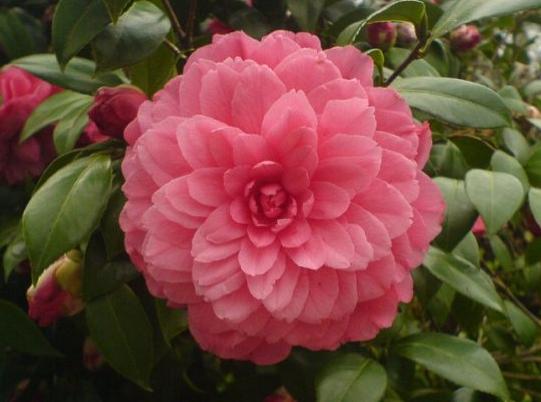
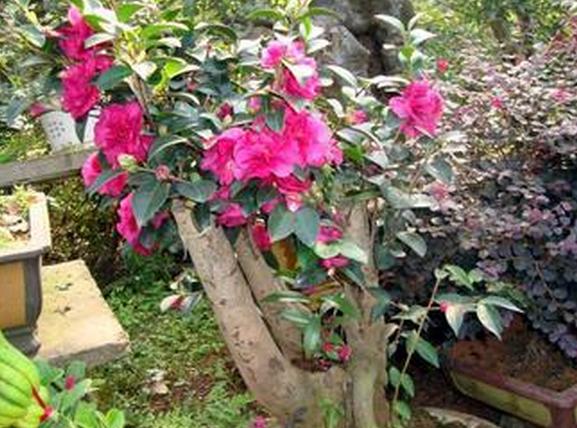
Camellia belongs to the Theaceae family and is an evergreen shrub, but whether propagated by cuttings or air layering, its growth rate is relatively slow. Generally, even potted plants need three to four years at the fastest to take shape for viewing. In recent years, southern regions have used high grafting onto oil tea, with a survival rate of more than 90%. In the same year, new shoots of the grafted seedlings reach more than 50 cm, and they can bloom within two years. The grafting technique is introduced as follows:
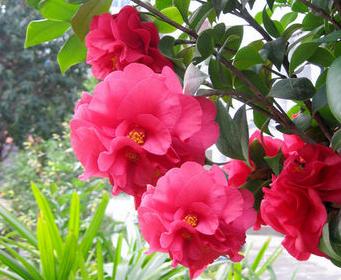
1. Rootstock selection: Camellia and white-flowered oil tea are plants of the same family and have strong compatibility. Moreover, white-flowered oil tea has strong adaptability, fast growth, and strong sprouting ability. Therefore, it is best to choose white-flowered oil tea that grows vigorously, is free of pests and diseases, and has many branches as the rootstock.
2. Scion selection: The scion should be selected from superior clones and branches from the middle and upper periphery of the canopy. For camellias, branches from the desired variety tree that grow vigorously, have plump axillary buds, normal leaf color, and are free of pests and diseases should be selected. In summer, use the current year's spring shoots; in autumn, use the current year's spring shoots or summer shoots as the scion. Collect in the early morning and place in a basin or cup filled with water to avoid dehydration and drying out. It is best to use the scion as soon as it is collected. Avoid taking shaded branches, old branches, and pest- or disease-infested branches.
3. Grafting time: To improve the survival rate of grafting, it must be done during the period when the rootstock's water and nutrients are flowing and being absorbed vigorously. Generally, grafting can be done from May to September. According to experimental results, June to July is the best grafting time. At this time the temperature is suitable, the current year's camellia scion has become lignified, and the transplanted oil tea rootstock seedlings have survived, so the grafting survival rate can reach more than 90%.
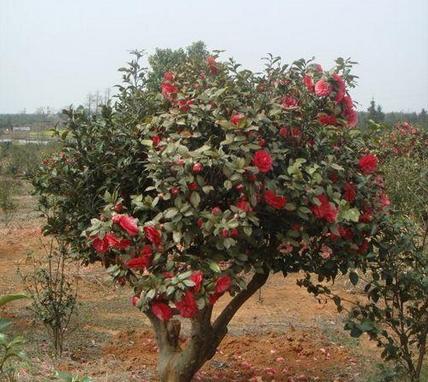
4. Grafting method: First, cut the rootstock. For each oil tea tree, select 2-4 main branches in different directions that are straight, smooth-barked, and free of pests and diseases as grafting rootstocks. Cut the rootstock at 40-80 cm above the ground. When cutting the rootstock, prevent the rootstock from tearing. After cutting, slightly smooth the cut surface. Keep 2-3 branches per tree as nutrient branches and for shade, and saw off most branches. Second, cut the rootstock. According to the size and length of the scion, use a single-edged knife to cut downward at the rootstock cut, slightly into the xylem. If more than 2 scions are to be grafted onto one rootstock, cut two parallel downward cuts on both sides of the rootstock. The orientation of the rootstock cuts should consider the growth direction of new branches after successful grafting, so as to favor the formation of a superior camellia tree shape. Third, whittle the scion. Place the branch for whittling the scion on a wooden board; hold the branch with one hand, and with the other hand take a single-edged blade and cut straight downward from 3-5 mm below the base of the bud on the opposite side of the bud, with a cut surface of 2 cm, slightly exposing the xylem, slanting inward, and slanting to the pith at the base of the scion. On the other side of the scion base, make a short cut at a 20-30 degree slant. Cut off 5 mm above the bud to make a 1-bud 1-leaf scion. Leave 1 leaf on the scion (for large leaves, leave 1/2-2/3 of a leaf). After whittling the scion, place it in clean water for later use. Fourth, insert the scion. With the long cut surface facing inward, insert the scion into the rootstock cut bark-to-bark (cambium to cambium), then cover the opened bark of the rootstock over the short cut surface of the scion so that both bark surfaces fit well. Fifth, tie the scion. Use a plastic film strip 1-1.5 cm wide to tie the interface from top to bottom, and take care to prevent the scion from moving and to provide shade and retain moisture.
5. Management after grafting
(1) Trunk cutting: 20-30 days after grafting, promptly observe the healing condition. For well-healed plants, use a small saw to cut off 1/2-2/3 of the rootstock's originally retained main trunk at 2-3 cm from the scion, and lower it. Generally, do not cut off the main trunk immediately, because the scion does not yet have the ability to absorb nutrients. Keep part of the main trunk to continue absorbing water and nutrients to supply the scion's growth. After 70 days, the scion's axillary buds begin to sprout and grow, and at this time the main trunk can be completely cut off.
(2) Loosening the binding: When the scion's axillary buds grow out, the originally sealed and wrapped film can be untied. After about another 20 days, cut the tightened binding strip so that it can grow and develop normally.
(3) Removing sprouts: On high-grafted rootstocks, there are many sprouting branches and they grow quickly, so they must be removed promptly; otherwise they will affect the growth of the scion, causing slow growth in mild cases and yellowing, wilting, and drying in severe cases. Remove sprouts until the scion's growth becomes dominant.
(4) Shaping: After the graft survives, it should be properly shaped. According to the needs of the camellia tree shape and branch positions, use rope binding for directional shaping.
The above is the grafting technique introduced to everyone by the editor.
On the other side of the scion base, make a short cut at a 20-30 degree slant. Cut off 5 mm above the bud to make a 1-bud 1-leaf scion. Leave 1 leaf on the scion (for large leaves, leave 1/2-2/3 of a leaf). After whittling the scion, place it in clean water for later use. Fourth, insert the scion. With the long cut surface facing inward, insert the scion into the rootstock cut bark-to-bark (cambium to cambium), then cover the opened bark of the rootstock over the short cut surface of the scion so that both bark surfaces fit well. Fifth, tie the scion. Use a plastic film strip 1-1.5 cm wide to tie the interface from top to bottom, and take care to prevent the scion from moving and to provide shade and retain moisture.
5. Management after grafting
(1) Trunk cutting: 20-30 days after grafting, promptly observe the healing condition. For well-healed plants, use a small saw to cut off 1/2-2/3 of the rootstock's originally retained main trunk at 2-3 cm from the scion, and lower it. Generally, do not cut off the main trunk immediately, because the scion does not yet have the ability to absorb nutrients. Keep part of the main trunk to continue absorbing water and nutrients to supply the scion's growth. After 70 days, the scion's axillary buds begin to sprout and grow, and at this time the main trunk can be completely cut off.
(2) Loosening the binding: When the scion's axillary buds grow out, the originally sealed and wrapped film can be untied. After about another 20 days, cut the tightened binding strip so that it can grow and develop normally.
(3) Removing sprouts: On high-grafted rootstocks, there are many sprouting branches and they grow quickly, so they must be removed promptly; otherwise they will affect the growth of the scion, causing slow growth in mild cases and yellowing, wilting, and drying in severe cases. Remove sprouts until the scion's growth becomes dominant.
(4) Shaping: After the graft survives, it should be properly shaped. According to the needs of the camellia tree shape and branch positions, use rope binding for directional shaping.
The above is the grafting technique introduced to everyone by the editor.