A Detailed Guide to the Cultivation Methods and Care Points of Alocasia macrorrhizos
Alocasia macrorrhizos, also known as Dishuilian and Foshoulian, also has medicinal value. Next, let us take a look at the cultivation methods of Alocasia macrorrhizos and the key points for growing it.
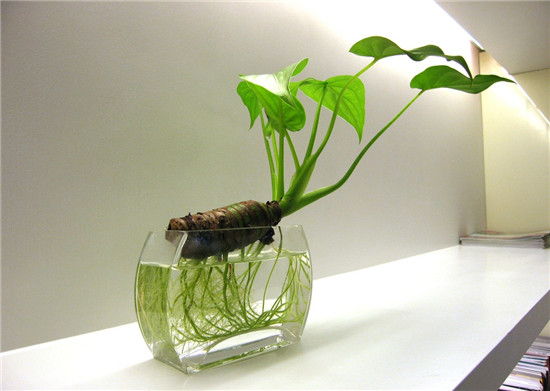
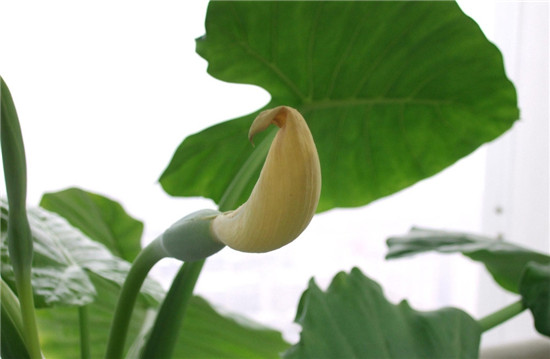
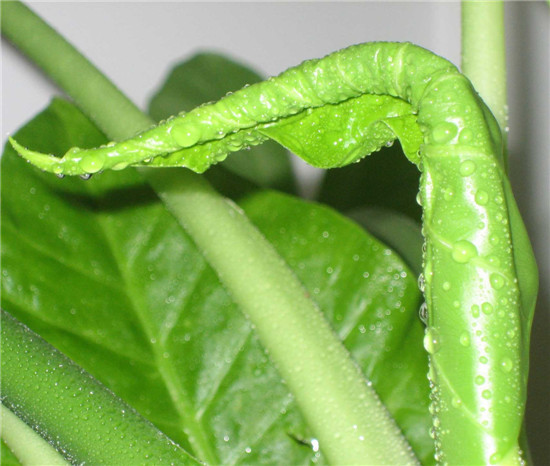
Alocasia macrorrhizos, of the Araceae family and Alocasia genus, also known as Dishuilian, Foshoulian, and so on, is a perennial evergreen herbaceous plant with medicinal value; under warm and humid conditions with sufficient soil moisture, water will drip down from the leaf tips or leaf edges; moreover, its flowers resemble Guanyin, hence the name Dishuilian (Dripping Guanyin).
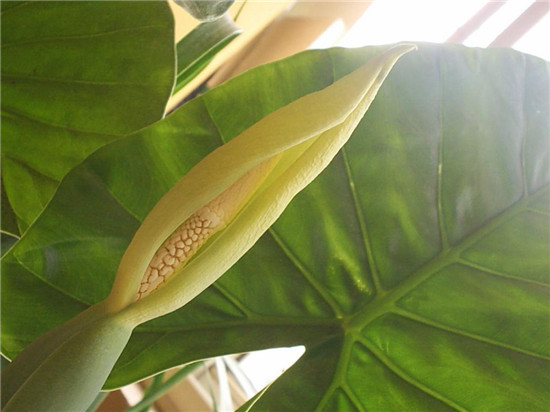
Alocasia macrorrhizos is a perennial erect herb, with plants reaching up to 2 m tall, underground fleshy rhizomes, long petioles, broad leaf sheaths, and large leaves that are peltate, broadly arrow-shaped, clustered at the top of the stem, with pointed tips, slightly wavy edges, and obvious main veins. The spathe is yellow-green, with a spadix inflorescence.
Propagation of Alocasia macrorrhizos
(1) Sowing: Wild plants often bear seeds. Sow in spring. The suitable germination temperature is 25-28°C, and germination occurs 20-25 days after sowing.
(2) Cuttage: Carry out in April. Cut thick stems into stem sections about 10 cm long with several buds to serve as cuttings. After drying slightly, insert them obliquely or lay them flat in the seedbed; when laying flat, the depth should be just enough to bury the stem section; the cuttings can also be inserted directly into pots. After insertion, keep the substrate moist and the ambient temperature at 25-2TC, and roots will form and they will survive after 4-5 weeks.
(3) Division: Potted plants easily produce many small plantlets at the base. In April, division can be carried out together with repotting, separating the small plantlets from the mother plant and planting them separately. Division should be carried out when the temperature reaches 20C or higher. On the basis of keeping the substrate moist, new shoots will emerge in about 20 days.
Cultivation Methods of Alocasia macrorrhizos
1. Temperature: It likes warmth and grows rapidly when the temperature is above 25°C. The most suitable temperature for growth is 25-30C. It has a certain cold resistance, and the overwintering temperature only needs to be maintained above 2°C.
2. Light: It likes semi-shade and cannot tolerate exposure to strong sunlight. From May to September, shading should be carried out, blocking about 50% of the sunlight. At other times, it should be given sufficient sunlight. It cannot tolerate excessive shade, otherwise the petioles become thin and long, and not only is the plant shape unattractive, but it also breaks easily.
3. Watering: Because the leaves are large and consume more water, it is afraid of drought. It likes a slightly moist soil environment. During the growing period, watering should follow the principle of "alternating dry and wet while leaning moist." Water thoroughly; even watering a little more is harmless. Especially in the hot, sunny summer, even more attention should be paid to supplying water to meet the plant's water requirements.
4. Environmental humidity: It likes a humid environment and avoids dry air. During the growing season, when it is sunny and dry, water should often be sprayed on the branches, leaves, and surroundings to maintain a relatively high air humidity.
5. Fertilization; It likes fertilizer. Because of its large growth volume, nutrients need to be supplemented in time so that the stems can grow thick and strong and the leaves can be large, deep green, and glossy; when lacking fertilizer, the leaves are small and yellow. During the growing period, a nitrogen-based fertilizer should be applied about once every 10 days. After the beginning of autumn, stop applying nitrogen fertilizer and apply 2-30 phosphorus and potassium fertilizer. Stop fertilizing in winter.
6. Pruning: Yellow leaves should be cut off at any time. Because the petioles are long, when moving, placing, and caring for the plant, avoid breaking the petioles. If they are broken, they should be cut off in time.
7. Repotting: Repot once every 1-2 years. It does not have high requirements for soil, but it likes fertile, loose, and well-drained sandy loam. The substrate can be prepared from materials such as leaf mold, garden soil, peat soil, and river sand. If sufficient base fertilizer is applied, the leaves can grow large and thick. Because the leaves are large but few in number and the petioles are long, when moving the plant and caring for it, avoid damaging the leaves, otherwise the ornamental value will be reduced.
The above is the complete content of the cultivation methods of Alocasia macrorrhizos and the key points for growing it that I have summarized for everyone. I hope this article can help everyone. Please also continue to follow us.