Detailed Guide to Chinese Toon Cultivation: Growing Methods and Management Points
Chinese toon (Toona sinensis) is a woody vegetable whose tender leaves are edible. The young buds only begin to stir and unfurl new leaves when the ten-day average temperature reaches 15°C. Therefore, open-field Chinese toon in the central part of our province is harvested in mid-April. Greenhouse production of Chinese toon involves moving the stems of 1- to 2-year-old defoliated Chinese toon into the greenhouse, planting them at high density and providing a certain temperature and moisture to make them sprout, then harvesting the unfurled tender leaves successively. Below, let's share the specific methods of Chinese toon cultivation with you!
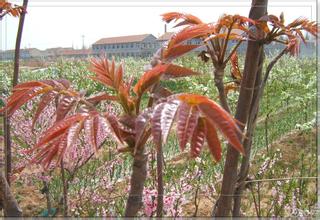
Cultivation Techniques for Chinese Toon
① Seed Preparation:
There are many varieties of Chinese toon; those commonly eaten include red-oil Chinese toon, purple-oil Chinese toon and green Chinese toon. Among them, purple-oil Chinese toon has large, plump seeds and a high germination rate, making it the best variety for producing sprout Chinese toon. Chinese toon seeds are triangular, semicircular or diamond-shaped, reddish-brown, with a membranous long wing at one end. The thousand-seed weight is 10-11 grams. The germination rate of Chinese toon seeds is closely related to the age of the tree; seeds from trees over 30 years old have very weak vitality, with a germination rate of only 5%-10% and an even lower survival rate. For sprout production, seeds from 10- to 25-year-old Chinese toon trees are preferable. Chinese toon seeds have a short storage life; at room temperature the germination rate begins to decline after half a year and is completely lost within one year. Therefore, when producing sprout Chinese toon, the amount of seed needed should be purchased all at once according to production capacity and one's own needs. To maintain a high germination rate, the reserved seeds should be stored in a cold store at 4-5°C or in a cool, ventilated place, so that seed use is guaranteed in all four seasons. The membranous long wing of Chinese toon seeds is an important part for maintaining seed life and must not be removed during storage, otherwise the germination rate will be affected. Therefore, in Chinese toon sprout production, new seeds that have not gone through the summer should be selected, and old seeds from the previous year must be avoided. Before soaking, Chinese toon seeds should be cleaned: put the seeds in a cloth bag and rub gently, then blow or fan away the membranous long wings, sieve out fruit stalks and fruit shells, and pick out various impurities mixed in with the seeds. Calculate the amount of seed needed according to production requirements; after cleaning, rinse 2-3 times before soaking. The water temperature is 20-30°C, and the water volume is 2-3 times the volume of the seeds. The optimal soaking time for Chinese toon seed germination is 24 hours, with a relative water absorption of 120.2%. During soaking, it is best to change the water once to wash off the mucus on the seed coat, which helps increase germination speed. After soaking, remove the seeds, drain off excess water and wait for sowing.
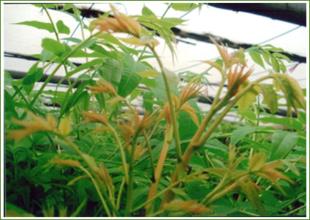
② Sowing and Germination Acceleration:
Sowing and germination acceleration are key steps in sprout cultivation for reducing seed rot, improving sprout uniformity and ensuring product quality. Sowing should be even, and the sowing amount per tray should be consistent. Because Chinese toon seeds germinate slowly, germination acceleration must be carried out in two stages, so sowing must also be done twice. The sowing amount for the first stage of germination acceleration is 750-1000 grams per tray, the germination temperature is 20-23°C, and the germination time is 3-4 days. The method and management of germination acceleration are similar to those for pea shoots. When the young sprouts show white and reach 1-2 mm in length, carry out the second sowing and stacked-tray germination acceleration promptly, entering the second stage of germination acceleration. Note that the sprouts must not be too long, otherwise they are easily damaged during the second sowing. Before sowing, the seeds can be rinsed clean again with clear water to reduce mildew during the second stage of germination acceleration. The method and management of the second stage of germination acceleration are similar to those for pea shoots; during this period the temperature should be 20-23°C, the germination time is 5-6 days, and the sowing amount per tray is 40-50 grams. When the Chinese toon sprouts reach 0.5-1.0 cm, take them out of the trays promptly and place them on the growing racks for production management.
The substrate used for Chinese toon sprout production can be clean perlite, or white cotton cloth or newsprint can be used directly. If perlite is used as the substrate, first wash the seedling trays, lay down a layer of newsprint, sow the Chinese toon seeds evenly, then spread a layer of perlite about 3 cm thick on top. When perlite is used as the substrate for Chinese toon sprout production, management requires reducing the amount of watering.
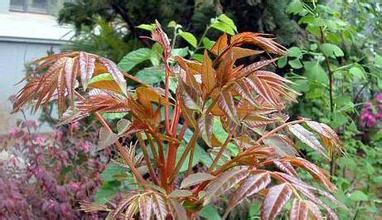
Greenhouse Chinese Toon Cultivation and Management Techniques
1. Select Chinese toon with thick stems and plump terminal buds and plant it in sections
Chinese toon with thick stems, large plump buds and sufficient stored nutrients will produce more new leaves. Therefore, seedlings should be selected before planting Chinese toon in the greenhouse. When heavy frost arrives, the open-field Chinese toon leaves fall naturally; after the nutrients flow back to the stems, dig them out and grade them. One-year-old seedlings are 0.6-1 m tall with a stem diameter above 1 cm; two-year-old seedlings are 1-1.5 cm tall with a stem diameter above 1.5 cm. After lifting the seedlings, grade them by height. Those 1-1.5 m tall are grade one, 0.8-1 m are grade two, and 0.5-0.8 cm are grade three. When planting, according to the greenhouse's characteristic of being lower in the south and higher in the north, plant grade-three seedlings toward the south, and plant grade-one and grade-two seedlings in the middle and north respectively.
2. Make full use of the greenhouse space for high-density planting
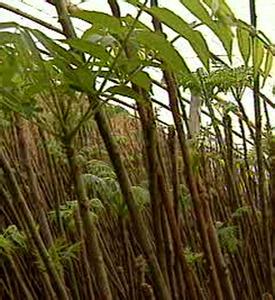
Planting Chinese toon in a greenhouse is actually a form of "heeling in". Only with high density will leaf yield increase and benefits be good. Depending on seedling size, 80,000-100,000 seedlings are required per mu. Seedlings from more than 10 mu of land are needed to supply 1 mu of greenhouse. When planting, open trenches 30 cm deep in an east-west direction, stand the Chinese toon bundles upright in the trenches and backfill soil to cover the root systems. Every 3-4 trenches, leave a 45 cm wide walkway for leaf harvesting and management. After planting, water once to settle the roots. The planting site generally does not need base fertilizer, because the sprouting and growth of Chinese toon buds mainly rely on nutrients stored in the stems, and after leaves unfold they are harvested promptly, basically not using nutrients from the soil; it is enough for the soil to be moist and the air humidity to be around 90%. During the growth period, no topdressing or foliar spraying is needed.
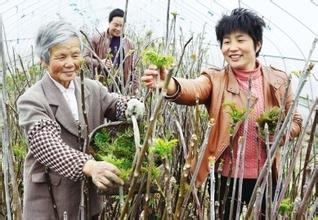
3. Do a good job of cold protection and heat preservation in the greenhouse
For defoliated Chinese toon, the buds need a temperature of about 25°C to begin sprouting, and this temperature must be maintained steadily for no less than 10 hours a day; an ordinary greenhouse can hardly meet this requirement. Therefore, a heating flue must be added in the middle of the greenhouse in an east-west direction for heating. In addition, to save coal, a layer of corn stalks 50 cm thick should be placed on the outer side of the greenhouse wall. The back slope of the greenhouse should also be covered with old straw mats to reduce heat loss. In addition, the thickness of the straw mats on the front roof should not be less than 4 cm; when covering, adjacent mats should overlap by 15-20 cm in width, and after laying the mats at night, a layer of rainproof film should also be added over the straw mats. This not only provides heat preservation but also prevents rain and snow from soaking the straw mats and affecting their insulating performance.
4. High-temperature germination acceleration and variable-temperature management
To promote faster stirring of the terminal buds, heating is required all day after planting, keeping the room temperature at 25°C-30°C. After the terminal buds stir, lower the temperature appropriately: keep the daytime temperature at 23°C-25°C and the nighttime temperature at 12°C-15°C, with a day-night temperature difference of no less than 10°C, to prevent the stems and leaves from growing too fast, which would lead to thin leaves, pale color, bland taste and reduced quality.
5. Make full use of greenhouse facilities to change one crop a year into two or three crops
The harvest season for greenhouse Chinese toon is mainly in winter, that is, from January to mid-March of the following year. At this time, dig out the Chinese toon stems and plant them at 6,000-8,000 plants per mu; after they survive, promptly cut the stock 10-15 cm above the ground to promote sprouting of buds below the cut, strengthen management after the weather warms, and after leaf fall in winter move them into the greenhouse to continue harvesting leaves. In general production, the leaf-harvesting period is often extended to the end of April, which exhausts the nutrients stored in the stems. If the seedlings are moved out of the greenhouse in early March and base fertilizer is applied promptly, an early-maturing vegetable crop such as cucumber, tomato, pepper or snap bean can also be planted in time.
That is all the editor will share with you about Chinese toon cultivation for now; I hope the above content can be of some help to you.
Stand the Chinese toon bundles upright in the trenches and backfill soil to cover the root systems. Every 3-4 trenches, leave a 45 cm wide walkway for leaf harvesting and management. After planting, water once to settle the roots. The planting site generally does not need base fertilizer, because the sprouting and growth of Chinese toon buds mainly rely on nutrients stored in the stems, and after leaves unfold they are harvested promptly, basically not using nutrients from the soil; it is enough for the soil to be moist and the air humidity to be around 90%. During the growth period, no topdressing or foliar spraying is needed.
3. Do a good job of cold protection and heat preservation in the greenhouse
For defoliated Chinese toon, the buds need a temperature of about 25°C to begin sprouting, and this temperature must be maintained steadily for no less than 10 hours a day; an ordinary greenhouse can hardly meet this requirement. Therefore, a heating flue must be added in the middle of the greenhouse in an east-west direction for heating. In addition, to save coal, a layer of corn stalks 50 cm thick should be placed on the outer side of the greenhouse wall. The back slope of the greenhouse should also be covered with old straw mats to reduce heat loss. In addition, the thickness of the straw mats on the front roof should not be less than 4 cm; when covering, adjacent mats should overlap by 15-20 cm in width, and after laying the mats at night, a layer of rainproof film should also be added over the straw mats. This not only provides heat preservation but also prevents rain and snow from soaking the straw mats and affecting their insulating performance.
4. High-temperature germination acceleration and variable-temperature management
To promote faster stirring of the terminal buds, heating is required all day after planting, keeping the room temperature at 25°C-30°C. After the terminal buds stir, lower the temperature appropriately: keep the daytime temperature at 23°C-25°C and the nighttime temperature at 12°C-15°C, with a day-night temperature difference of no less than 10°C, to prevent the stems and leaves from growing too fast, which would lead to thin leaves, pale color, bland taste and reduced quality.
5. Make full use of greenhouse facilities to change one crop a year into two or three crops
The harvest season for greenhouse Chinese toon is mainly in winter, that is, from January to mid-March of the following year. At this time, dig out the Chinese toon stems and plant them at 6,000-8,000 plants per mu; after they survive, promptly cut the stock 10-15 cm above the ground to promote sprouting of buds below the cut, strengthen management after the weather warms, and after leaf fall in winter move them into the greenhouse to continue harvesting leaves. In general production, the leaf-harvesting period is often extended to the end of April, which exhausts the nutrients stored in the stems. If the seedlings are moved out of the greenhouse in early March and base fertilizer is applied promptly, an early-maturing vegetable crop such as cucumber, tomato, pepper or snap bean can also be planted in time.
That is all the editor will share with you about Chinese toon cultivation for now; I hope the above content can be of some help to you.