How to Grow the Succulent Aeonium tabuliforme? A Detailed Guide to Basic Care Methods
Aeonium tabuliforme, also known as the flat-topped aeonium, is a perennial succulent herb in the Crassulaceae family, genus Aeonium. Let's take a look at the key care points for Aeonium tabuliforme.
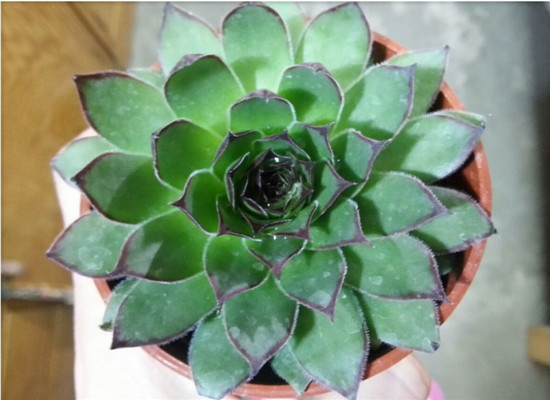
Aeonium tabuliforme, also known as the flat-topped aeonium, is a perennial succulent herb in the Crassulaceae family, genus Aeonium; it originates from Tenerife in the Canary Islands.
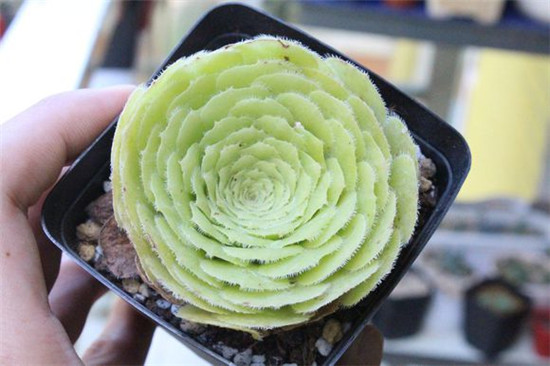
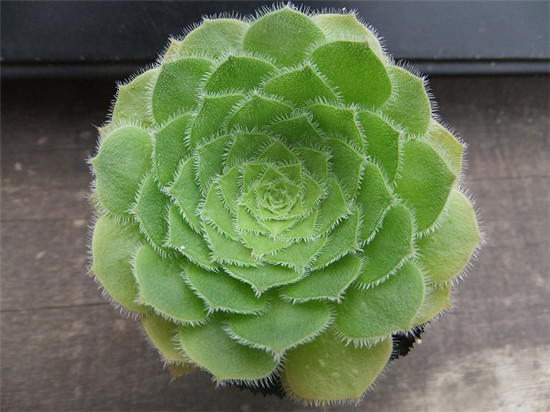
Plant characteristics: The plant is low-growing, consisting of 100-200 fleshy leaves arranged in a rosette-shaped leaf disc, whose maximum diameter can reach 50 cm. The leaves are sessile, spoon-shaped, and range in color from grass green to gray-green and dark green, with white fine hairs along the leaf margins; all the leaves radiate outward from the center, making the entire leaf disc as flat and even as a mirror, without a single gap; because the leaf margins are slightly darker in color and bear white fine hairs, and the outer leaves are large while the inner leaves are small, the mirror-like leaf disc resembles an exquisitely beautiful geometric pattern, very peculiar indeed.
When it blooms, the leaves at the center of the disc gradually separate from the rosette and become alternate in arrangement, while a cylindrical flower stalk emerges from the middle, eventually developing into a huge terminal panicle 60 cm tall, with small yellow flowers; after flowering it sets seed, and then the entire plant dies.
Cultivation points: It prefers cool conditions, and autumn through spring is its vigorous growth period. It requires fertile, well-draining, and airy potting soil; the pot should be large rather than small, and light should be sufficient. In winter it is best to keep the temperature above 10°C; if it drops below this temperature, watering must be restricted. Fertilization should be mainly nitrogen-based.
Propagation methods: Apart from collecting seeds, you should prevent it from flowering; if you notice the growing point elongating, promptly pinch it out to force side shoots for propagation.
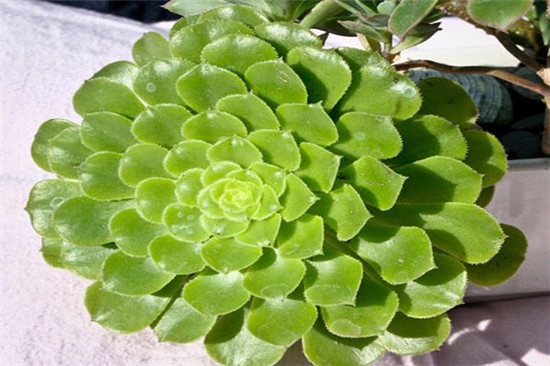
The cristate form of Aeonium tabuliforme, also called "Aeonium tabuliforme crest," is a cristate mutation variety of Aeonium tabuliforme. The growing point develops laterally, and the leaves are smaller, positioned on both sides of the growing point, giving the plant a flat, ribbon-like form; plants grown for many years gradually grow taller, with the lower leaves dropping off and becoming woody and brown, like steep mountain peaks. Sometimes the cristate plant also produces original rosette-shaped leaf clusters of Aeonium tabuliforme, which is also quite interesting.
Aeonium tabuliforme is native to the Canary Islands in the Atlantic Ocean. This region has a Mediterranean climate, with dry, hot summers and little rain, and mild, humid winters. Therefore, Aeonium tabuliforme is suited to growing in a cool, dry, and sunny environment; it tolerates partial shade and drought, and fears waterlogging. Its main growth periods are spring and autumn. During the growing season it should be given sufficient light; if the light is insufficient, the plant will become leggy, with a messy shape, larger spacing between leaves, and leaf clusters that do not form a disc shape, seriously affecting its ornamental value.
The above is the complete content of the basic care for the succulent Aeonium tabuliforme that I have summarized for everyone. I hope this article can help you. Please also continue to follow us.