How to Grow Haworthia fasciata? A Detailed Guide to Cultivation Methods
Haworthia fasciata, also known as zebra plant or pheasant's tail, is a perennial succulent herbaceous plant in the Liliaceae family. Next, let's take a look at the cultivation methods for Haworthia fasciata.
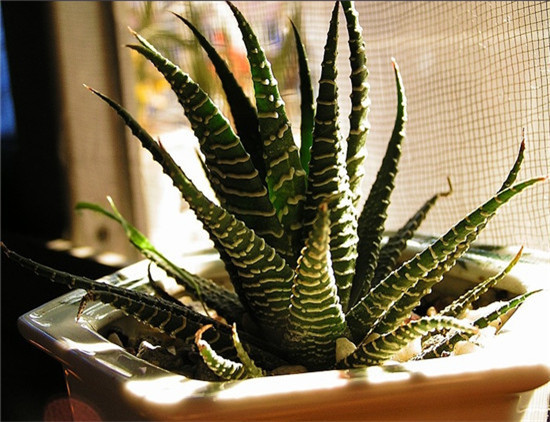
The leaves of Haworthia fasciata grow in dense whorls on the stem axis, forming a rosette shape; the leaves are triangular-lanceolate with sharp tips; the leaf surface is smooth and dark green; the leaf underside is green with relatively large white tubercle-like protrusions, which are arranged in horizontal stripes, forming a striking contrast with the dark green of the leaf surface. It has good ornamental value.
Division Propagation of Haworthia fasciata
Division time: It is best to do this in early spring (February or March) after the soil has thawed.
Division method: Take the mother plant out of the flower pot, shake off the excess potting soil, separate the tangled root system as much as possible, and use a sharp knife to cut it into two or more plants. Each divided plant must have a considerable amount of roots, and its leaves should be properly trimmed to help it survive.
Potting and disinfection: Soak the divided small plants in a 1500-fold dilution of chlorothalonil for five minutes, then take them out and let them dry, and they are ready for potting. Alternatively, immediately after potting, drench the roots with chlorothalonil.
Management after division: After the divided plants are potted, drench the roots or water thoroughly once. Since its root system is severely damaged and its water absorption capacity is very weak, it takes about 3-4 weeks to recover and sprout new roots. Therefore, within 3-4 weeks after division, watering should be controlled to avoid root rot. However, the transpiration of its leaves is not affected. In order to maintain the water balance of the leaves, the leaf surface needs to be misted 1-3 times a day (mist more when the temperature is high, and mist less or not at all when the temperature is low). Do not apply fertilizer during this period either. After division, also be careful of excessively strong sunlight; it is best to keep it in a shade shed for care.
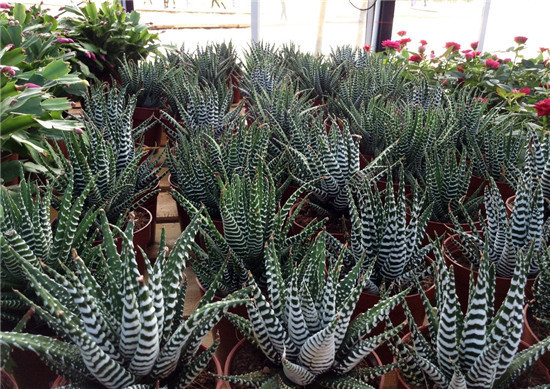
Growing Methods for Haworthia fasciata:
1. Soil: Haworthia fasciata has low soil requirements, and fertile, loose sandy loam is suitable. When potted, because its root system is shallow, shallow planting is preferable. Cultivate it with fertile, well-drained leaf mold mixed with coarse sand.
2. Watering: During the growing period, Haworthia fasciata only needs the potting soil kept moist. During the semi-dormant periods in winter and midsummer, it should be kept dry, with watering strictly controlled. If the potting soil is too wet in winter, it easily causes root rot and leaf shrinkage.
3. Sunlight: In summer, keep Haworthia fasciata in a semi-shaded place for care, or shade it by 50%, and the leaf color will become more beautiful. In spring and autumn, since the temperature is not very high, give it direct sunlight to help it carry out photosynthesis and accumulate nutrients. In winter, keep it indoors in a place with bright light.
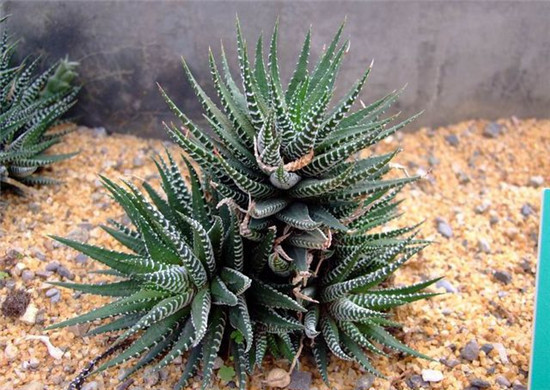
4. Temperature: The optimum growth temperature for Haworthia fasciata is 15°C-32°C. It fears high temperatures and stuffiness, and enters a dormant state when the summer heat exceeds 33°C. It is averse to cold and frost, and the overwintering temperature needs to be kept above 10°C. It also enters a dormant state when the winter temperature drops below 7°C. If the ambient temperature approaches 4°C, it will die from frostbite.
5. Fertilizing: Haworthia fasciata does not particularly like fertilizer. Applying 1-2 light fertilizations each spring is enough to meet its needs.
6. Pests and diseases: Haworthia fasciata is sometimes harmed by root rot and brown spot disease, which can be sprayed with a 1500-fold dilution of 65% zineb wettable powder. Pests include whiteflies and scale insects, which can be killed by spraying with a 1000-fold dilution of 40% omethoate emulsifiable concentrate.
The above is the complete content of the cultivation methods for Haworthia fasciata that I have summarized for everyone. I hope this article can help you. Please also continue to follow us.