A Detailed Guide to the Introduction and Cultivation of Echeveria purpusorum
Echeveria purpusorum is a succulent plant of the genus Echeveria in the family Crassulaceae, with fleshy leaves arranged in a tight rosette. Let's take a look together at the introduction and cultivation methods of Echeveria purpusorum.
Morphological Characteristics of Echeveria purpusorum
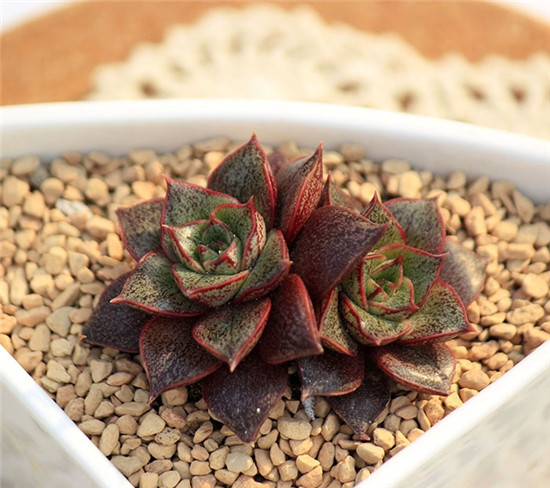
The leaves of Echeveria purpusorum are broadly ovate to scattered triangular-ovate, with the back protruding in a keel shape. The leaves are 3 to 4 cm long and about 3 cm wide, with an acute apex. The leaf color is grayish-green, with reddish-brown markings on them. By using leaf cuttings, you can see the entire process of a single leaf sprouting and growing into a plant, which is very interesting.
The keel-like triangular leaves are covered with beautiful reddish-brown markings. Under conditions of sufficient sunlight, the leaves are compact and thick. The red patterns also become more pronounced.
Echeveria purpusorum is a succulent plant of the family Crassulaceae. Its thick triangular leaves overlap layer upon layer like petals, and the dark green leaves have purple-brown spots. There is also a variegated cultivar called "Echeveria purpusorum f. variegata," which is even more beautiful.
Ecological Habits of Echeveria purpusorum
Echeveria purpusorum prefers a warm, well-ventilated environment and has no obvious dormant period. For cultivation, fertile, well-drained sandy soil should be used. During the growing season, a certain amount of air humidity is required. In winter, watering should be restricted, and it can tolerate low temperatures of 5°C.
Propagation Process of Echeveria purpusorum
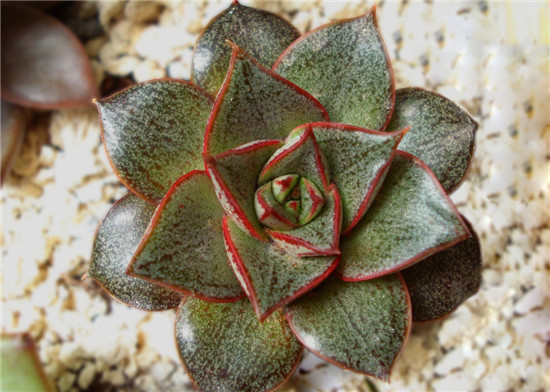
The propagation of Echeveria purpusorum is generally done by beheading to produce offsets for cuttings and by leaf cuttings. The beheaded plant can be directly stuck into dry granular soil, and after rooting, a small amount of water can be given. It is a very easy-to-grow variety. The leaf cutting method involves taking a complete, plump leaf, placing it in a cool place to let the wound dry, and then placing it on slightly moist soil. It will slowly grow roots and then sprout. The process takes a bit long, but you can get many small offsets. Once the offsets grow larger, remove them and stick them in soil to propagate.
Take leaves from Echeveria purpusorum. Twist off the leaves, let them dry for 1 to 2 days, then place them flat or insert them at an angle in coarse sand or vermiculite, making sure the wound is in contact with the soil. Place in partial shade, keep the soil slightly moist, and after 15 to 20 days, small shoots will grow from the wound. As time goes on, the small shoots grow larger and larger, gradually forming a small rosette-shaped leaf cluster. When the plant grows to a certain size, take it out and plant it in a small pot, and it becomes a new plant.
Cultivation Key Points:
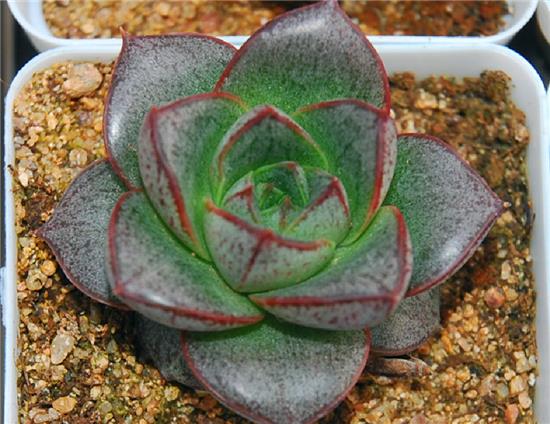
Echeveria purpusorum needs a sunny, cool, and dry environment. It tolerates partial shade, fears waterlogging, and avoids stuffy heat and humidity. It has the habit of growing in cool seasons and going dormant in high summer temperatures. Each year from September to June of the following year is the plant's growing season (the growing season may be longer or shorter depending on the grower's environment). If there is insufficient light, the plant's leaves will become leggy, and the red leaf margins will gradually fade; while plants grown in sufficient sunlight have a short, sturdy shape and compact leaf arrangement.
For the soil, cinder mixed with peat and a small amount of perlite can be used, at a ratio of roughly 5:4:1.
Winter and Summer Care:
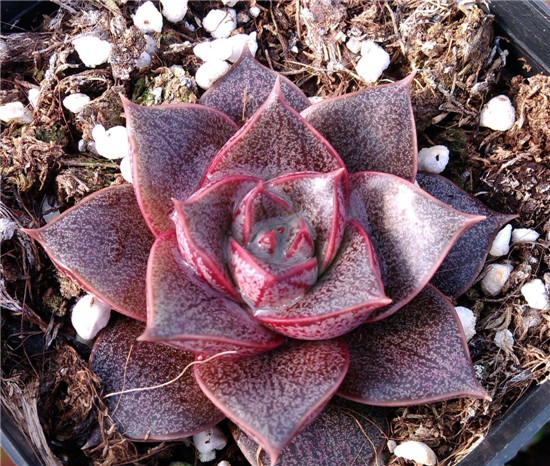
Echeveria purpusorum can tolerate low temperatures of around -4°C, which refers to indoor temperatures, not outdoor conditions. Any lower, and the growing point at the tip of the leaves will suffer frost damage, dry up, and die. Basically no water is given throughout winter, and watering should gradually stop once temperatures fall below 5°C. In high summer temperatures, the entire plant grows slowly or stops growing completely. At this time, good ventilation and appropriate shading are needed, avoiding exposure to strong sun, restricting watering, and not allowing prolonged rain, so as to prevent the plant from rotting.
The above is all the content I have summarized for you on the introduction and cultivation methods of Echeveria purpusorum. I hope this article can help everyone. Please also continue to follow us.