[Crassulaceae Hen and Chicks] How to Grow Crassulaceae Hen and Chicks
Hen and Chicks, also known as Houseleek, Guanyin Lotus, or Buddha's Lotus, is a perennial succulent plant of the genus Sempervivum in the Crassulaceae family, grown mainly for its foliage. Many people are quite interested in growing Crassulaceae Hen and Chicks, so let's take a look together!
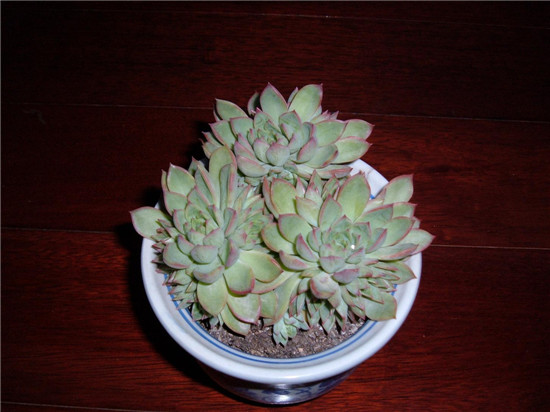
Crassulaceae Hen and Chicks, also known as Houseleek, Guanyin Lotus, or Buddha's Lotus, is a small succulent plant grown mainly for its foliage, and is also one of the succulents with relatively large sales volume in recent years. Its plant form is dignified, like a blooming lotus, with foliage colors that are rich in variation, and its purplish-red leaf tips are extremely distinctive, making it suitable for small to medium-sized potted plants or combination plantings. Growing it in flower pots of different styles also produces very different ornamental effects: planted in cartoon-shaped flower pots, it is lively and cute, and very popular with children; planted in purple clay pots or blue-and-white porcelain pots, it is dignified and elegant, and quite favored by middle-aged and elderly people; while planted in small wooden flower pots, it is fashionable and natural, and very popular with young people.
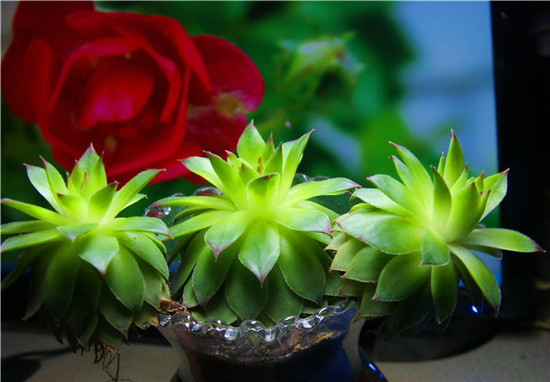
There are two kinds of plants called Hen and Chicks: one is Crassulaceae Hen and Chicks, and the other is Araceae Hen and Chicks. Of these two kinds of Hen and Chicks, one is toxic and one is non-toxic: Crassulaceae Hen and Chicks is non-toxic, while Araceae Hen and Chicks is toxic.
Crassulaceae Hen and Chicks is non-toxic; if it is Araceae, then it is toxic. The "Hen and Chicks" that flower enthusiasts buy to keep at home for viewing actually includes many kinds; "Hen and Chicks" is merely a common name for many kinds of plants. Generally speaking, they mainly belong to two families, Crassulaceae and Araceae. Crassulaceae plants are non-toxic, but Araceae plants are basically all toxic.
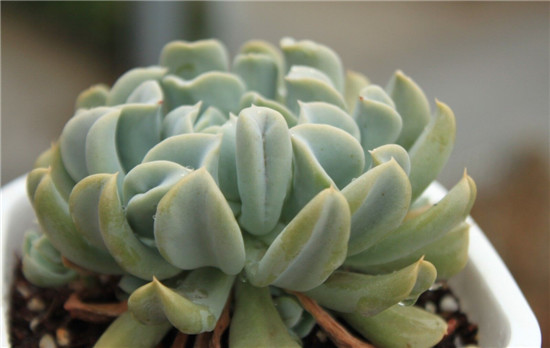
Growing Conditions for Crassulaceae Hen and Chicks
Growing the Crassulaceae plant Hen and Chicks is easy to succeed with. During the growing season, except for shading needed from June to September, it is best to give it half a day of light at other times. If kept indoors for viewing, it is best placed near a south-facing window. After being placed indoors for 1 month, it should be moved to a humid spot under a shed for a period of care. Water frequently to keep the soil moist, but also prevent excessive moisture, over-wet conditions, or water accumulation in the pot, otherwise the tuberous roots will rot. Therefore, when potting, a layer of coarse sand or the like should usually be placed at the bottom of the pot as a drainage layer to enhance drainage. When it is hot and dry, spray water to increase humidity, so that it can obtain external conditions for vigorous growth. During the growing season, fertilizing 2-3 times a month is sufficient. After being brought indoors in winter, watering should be reduced, and the temperature should not be lower than 5°C.
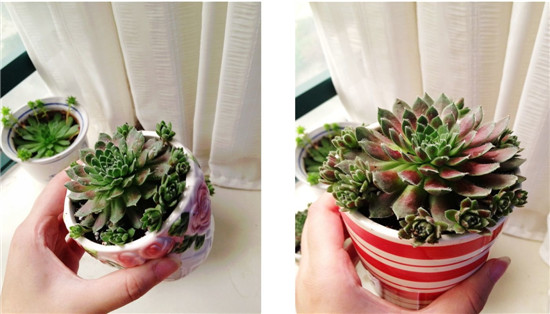
Propagation Methods for Crassulaceae Hen and Chicks
Leaf cuttings: Lay a complete mature leaf flat on moist sandy soil, with the leaf surface facing up and the leaf back facing down; there is no need to cover it with soil. Place it in a cool, shady spot. After about 10 days, small leaf clusters and new roots can grow from the base of the leaf. Bury the root system in the soil. After that, let it get more sunlight, water and fertilize appropriately, and gradually it will grow into a robust new plant.
Stem cuttings: Single leaves, tiller branches, or top shoots can be used. There is no limit to the length of the cuttings taken, but after the cut surface has dried, remove the lower leaves and insert into a sand bed. After insertion, roots generally form in about 20 days. The cutting medium must not be too wet, otherwise the cut surface is prone to yellowing and rotting. When the roots are 2-3 cm long, pot them up. Leaf cuttings can also be used.
Division: It is best done in spring. Cuttings are commonly used for propagation. Indoor cuttings can be done in all four seasons, with August to October being better, as rooting is fast and the survival rate is high. For cuttings, single leaves, tiller branches, or top shoots can be used. There is no limit to the length of the cuttings taken, but after the cut surface has dried, insert into a sand bed. After insertion, roots generally form in about 20 days.
The above is all the content I have summarized for everyone on how to grow Crassulaceae Hen and Chicks. I hope this article can help everyone. Please also continue to follow us.