A detailed guide to growing Burro's tail (Sedum morganianum) - beginners can master it at a glance
Burro's tail (Sedum morganianum) belongs to the genus Sedum in the family Crassulaceae. It is a perennial herb that grows in sunny subtropical regions and is distributed in many countries. Next, let's take a look at how to grow Burro's tail.
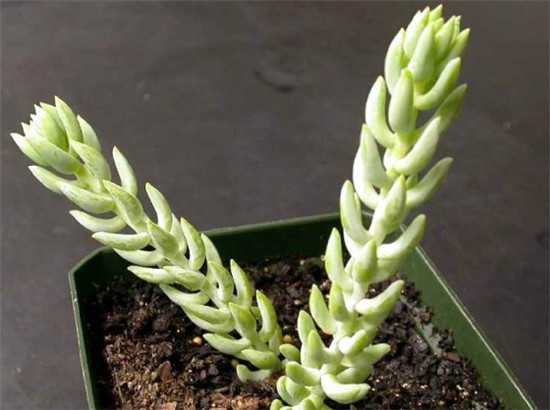
As an indoor potted plant, Burro's tail can beautify the home environment. It is usually grown for hanging display and placed by a sunny window. The fleshy leaves of Burro's tail grow clasping the stem, and the whole plant shape closely resembles a string of handmade agate beads. It is a beautiful indoor hanging plant.
The leaves of Burro's tail are fleshy, long spindle-shaped, 1 cm long and 0.2 cm wide, and light green in color. The fleshy leaves grow densely overlapping, and the spike bends downward like a squirrel's tail. It first grows upright, then droops. The flowers are small, bloom in spring, and are deep rose red.
The leaves of Burro's tail are alternate, oblong-lanceolate, slightly pointed at the tip, 1-2 cm long and 0.2 cm wide, juicy, and easy to fall off. The leaves are crystal-clear and glossy, blue-green in color, and tightly arranged. The corymb is terminal, with more than 10 small flowers that are dark purple.
The whole plant is light green. As long as it is cultivated properly, the bead-like stems and leaves hang and spread around the flower pot, looking especially elegant.
Cultivation of Burro's tail
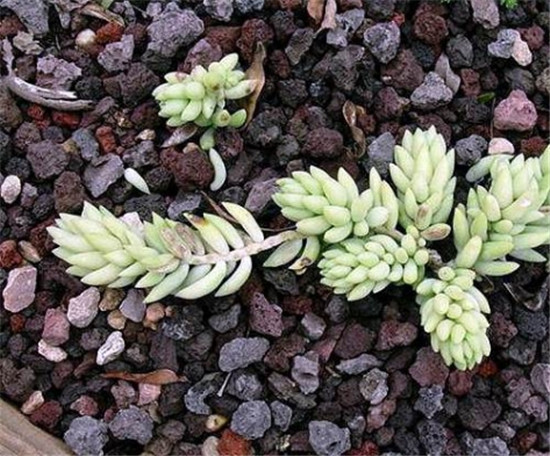
The fleshy stems grow prostrate, and the stems can reach 50 cm in length. The fleshy leaves grow clasping the stem, and the whole plant shape closely resembles a string of handmade agate beads. It is a beautiful indoor hanging plant.
It is a perennial succulent plant. It prefers a warm, semi-shaded environment, avoids direct strong light, and is suitable for growing in loose sandy loam. For indoor potting, a growing medium mixed with equal parts peat soil and fine sand is often used. It is native to Mexico and is widely cultivated in countries around the world.
As an indoor potted plant, it can beautify the home environment. It is usually grown for hanging display and placed by a sunny window.
Propagated by cuttings. Cut tender branches and insert them directly into a plain sand hotbed. At 25°C and under humid conditions, they will take root and sprout in 25 days. Cultivation and management are relatively simple. With insufficient sunlight, the stems and leaves tend to grow leggy, affecting the ornamental effect.
How to care for Burro's tail
During the high-temperature period in summer, Burro's tail generally stops or slows its growth. To prevent leaf rot and leggy growth, attention should be paid to ventilation. It should not be planted too densely, and thinning the branches helps make the leaf arrangement denser and increases its ornamental value.
Burro's tail sometimes develops root and stem rot, which may be caused by overly wet potting soil or poor ventilation. In addition, Burro's tail is easy to propagate by cuttings; cut off a section of branch and insert it into the soil and it will survive. Once growth is stable, it can be transplanted into another pot. Because the leaves of Burro's tail break off when touched, it is best not to touch them with your hands. However, leaves that fall into the potting soil will also take root and sprout.
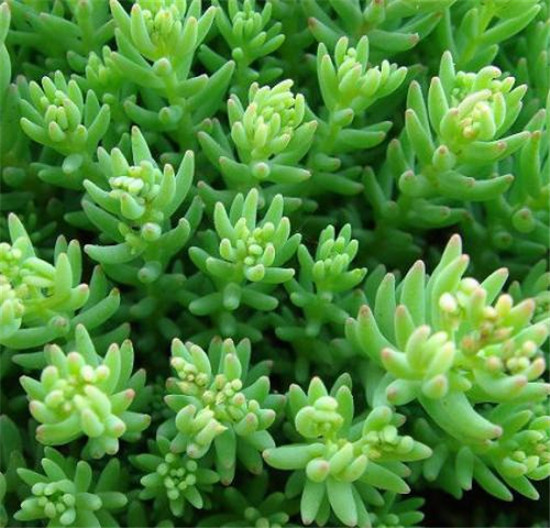
Burro's tail also has a great advantage: it can release oxygen at night. Its long, graceful branches are elegant and unrestrained, making it just right for placing in the bedroom. However, during the seedling stage, it grows upright.
The above is the full content of my summary on how to grow Burro's tail and Burro's tail growing methods. I hope this article can help everyone. Please also continue to follow us.