What is the meaning and symbolic significance of the four-leaf clover?
The four-leaf clover generally refers to the four-leafed wood sorrel, alfalfa, or clover. Also known as the lucky clover, it is a perennial herbaceous plant. Legend has it that finding a single four-leaf clover among 100,000 three-leaf clovers is an enormous stroke of luck, which is why the four-leaf clover is internationally recognized as a symbol of good fortune. So what does the four-leaf clover represent? What is the meaning of the four-leaf clover? Let us learn about it together.
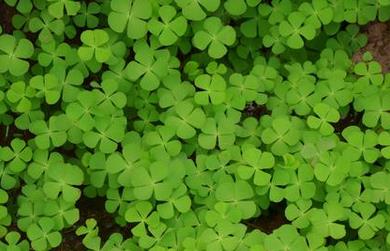
What does the four-leaf clover represent
Legend has it that among 100,000 alfalfa plants, perhaps only one four-leaf clover may be found, because the probability is about one in 100,000. Therefore, the four-leaf clover is internationally recognized as a symbol of good fortune, but in fact this is not entirely so; each leaf of the four-leaf clover has a different meaning: fame, wealth, love, and health. If one possesses these, that is the greatest good fortune of all.
In Taiwan, China, what people call the four-leaf clover generally refers to the four-leafed wood sorrel. In Irish folk tradition, the four-leaf clover can bring good luck and is Ireland's most well-known national symbol, regarded as the national flower of Ireland. The four-leaf clover is the flower offered to Ireland's patron saint, St. Patrick. In order to win independence, Ireland once fought a bloody war of resistance against Britain. Therefore its flower meaning is patriotism.
In Germany, the four-leaf clover is regarded as a symbol of freedom, unity, solidarity, and peace. People believe that possessing it will prevent bad things from happening, and thus its flower meaning represents luck and happiness. In Europe, children always take pleasure in searching for four-leaf clovers, which has become the most popular game among children. They generally believe that as long as they find a four-leaf clover, they will be able to obtain happiness.

The meaning of the four-leaf clover
Regarding the legendary four-leaf clover, its four leaves have different meanings, and there are multiple interpretations of its meaning. Below we will look at the different interpretations of the meaning of the four-leaf clover.
1. The first leaf represents hope; the second leaf represents faith; the third leaf represents love; and the extra fourth leaf represents luck.
2. The first leaf represents love; the second leaf represents health; the third leaf represents fame; the fourth leaf represents wealth.
3. The first leaf represents true love; the second leaf represents hope; the third leaf represents fame; the fourth leaf represents happiness.

The symbolism of the four-leaf clover in different countries
In addition, in different countries, the meaning of the four-leaf clover differs.
Irish folklore holds that the four-leaf clover can bring good luck and is Ireland's most well-known national symbol. At traditional Irish weddings, the bride's bouquet and the groom's boutonniere must both include the lucky clover. The lucky clover is considered an indispensable third person at the wedding.
In Switzerland, every Christmas, real four-leaf lucky clover potted plants can be bought in shopping malls. The lucky clover is considered the most creative Christmas gift. The good luck of the lucky clover, given to loved ones, means the recipient will from then on begin a life of happiness and everything will go smoothly in this world.
In Germany, the four-leaf clover is regarded as a symbol of freedom, unity, solidarity, and peace.
Perhaps it is precisely because of the special nature of the four-leaf clover that the game of searching for four-leaf clovers is popular in Europe. If you find a four-leaf clover, you can obtain happiness.

The legend of the four-leaf clover
Legend of the four-leaf clover, part one
The legendary four-leaf clover is said to have been brought to the earth from the Garden of Eden in heaven by Eve. Its flower meaning is happiness, and it is also known as the three-leaf clover. Usually it has only 3 leaflets, and the probability of finding a 4-leaflet one is very small; the probability of finding a 5-leaflet one is even smaller; and the probability of finding a 6-leaflet one is only one in 100,000. This implies obtaining happiness and the favor of heaven.
Legend of the four-leaf clover, part two
It is said that the name "lucky clover" originated with Napoleon. Once, while leading his troops across a grassland, he discovered a four-leaf clover and found it very strange. When he bent down to pick it, he just happened to dodge a bullet fired at him and escaped disaster. From then on he called the four-leaf clover the lucky clover. After being passed down and spread, the four-leaf clover has been internationally recognized as a symbol of good fortune. Its four leaves respectively represent love, health, fame, and wealth, and possessing it will bring good luck.
Legend of the four-leaf clover, part three
The four-leaf clover originated first in Europe, and was especially prevalent in the regions of Britain and Ireland. To this day, the four-leaf clover has become a folk tradition in Western countries. Children always take pleasure in searching for four-leaf clovers on grasslands, and every March at the St. Bede's Day held in New York, people will wear green clothing and bring so-called mascots, namely four-leaf lucky clover ornaments, to participate in the parade.

Four-leaf clover - Cultivation methods
Soil and tillage
The four-leaf clover has strong stress resistance and wide adaptability, and does not have strict soil requirements. As long as there is sufficient precipitation, a humid climate, and good drainage, it can grow normally in various soils that are not strongly saline-alkaline; it can even be planted under garden trees. The seeds are tiny, the seedlings are slender and weak in emerging from the soil, and growth at the seedling stage is extremely slow. To ensure a full stand of seedlings, land preparation must be meticulous. Whether spring sowing or autumn sowing, the land must be prepared in advance: first shallow plowing to remove stubble, clearing debris, storing water and preserving soil moisture; after 10-15 days, deep plowing and harrowing again, leveling the ground, making the soil clods fine and the sowing-layer soil loose, in preparation for sowing.
Fertilization
In combination with deep plowing, apply sufficient base fertilizer: apply 1500-2000 kg of organic fertilizer per mu, mix in 15-20 kg of superphosphate, pile it in a humid environment to ferment and decompose for 20-30 days, then apply it. Before sowing, shallowly plow the soil again and apply 5-8 kg of ammonium nitrate etc. per mu to promote seedling growth and give full play to production potential.
Sowing
Seed fields should be sown with Grade I seeds as stipulated by national or provincial herbage seed quality standards; artificial grasslands may be sown with Grade I, II, or III seeds. White clover seeds have a relatively high hard-seed rate. Before sowing, mechanical methods should be used to abrade the seed coat, or concentrated sulfuric acid should be used to soak and corrode the seed coat, and other methods should be used to treat the seeds before sowing. The sulfuric acid soaking method is: soak for 20-30 minutes, remove and rinse clean with clear water, then dry and sow. Seed fields are sown at 5 kg per mu. Artificial grasslands are sown at 8 kg per mu; in humid areas the sowing rate should be smaller, and in dry areas the sowing rate should be larger. Sowing depth is 1-2 cm. Sowing too deep makes it difficult for seedlings to emerge, so it should be controlled appropriately according to soil texture and dry-wet conditions. Sowing period: spring, summer, and autumn are all acceptable, but in relatively cold high-altitude areas, sowing in spring and summer is preferable. If autumn sowing is carried out, it should be done early so that the seedlings have more than one month of growth time to facilitate overwintering. There are various sowing methods: it can be sown alone or mixed, drilled or broadcast.

Field management
After sowing and before emergence, if the soil becomes compacted, it should be harrowed and smoothed in time to break the compacted layer and facilitate emergence. Seedling growth is slow, so to prevent weed damage, intertillage, loosening, and weeding should be done 1-2 times; if pest damage is found, it should be controlled in time. For grasslands growing for more than two years, the soil layer is compact and poor in aeration. Before greening in spring and autumn and before regrowth after grazing or mowing, harrowing and soil loosening should be carried out, and fertilization should be applied along with soil loosening: apply 20-25 kg of superphosphate per mu, or 5-8 kg of diammonium phosphate, to facilitate the growth and development of new buds and new roots. The four-leaf clover has relatively high soil moisture requirements. Where irrigation conditions exist, irrigate when the soil is dry or in combination with topdressing. In mixed-sowing grasslands, because the growth rates of herbage differ in early and late stages, when uncoordinated growth occurs due to competition for light, water, and fertilizer, or when growth is inhibited due to biased application of nitrogen fertilizer, phosphorus and potassium fertilizer should be applied in a biased manner and grazing used to adjust growth, control the growth of gramineous herbage, and avoid inhibition or disappearance from the mixed-sowing grassland.
To this day, the four-leaf clover has become a folk tradition in Western countries. Children always take pleasure in searching for four-leaf clovers on grasslands, and every March at the St. Bede's Day held in New York, people will wear green clothing and bring so-called mascots, namely four-leaf lucky clover ornaments, to participate in the parade.
Four-leaf clover - Cultivation methods
Soil and tillage
The four-leaf clover has strong stress resistance and wide adaptability, and does not have strict soil requirements. As long as there is sufficient precipitation, a humid climate, and good drainage, it can grow normally in various soils that are not strongly saline-alkaline; it can even be planted under garden trees. The seeds are tiny, the seedlings are slender and weak in emerging from the soil, and growth at the seedling stage is extremely slow. To ensure a full stand of seedlings, land preparation must be meticulous. Whether spring sowing or autumn sowing, the land must be prepared in advance: first shallow plowing to remove stubble, clearing debris, storing water and preserving soil moisture; after 10-15 days, deep plowing and harrowing again, leveling the ground, making the soil clods fine and the sowing-layer soil loose, in preparation for sowing.
Fertilization
In combination with deep plowing, apply sufficient base fertilizer: apply 1500-2000 kg of organic fertilizer per mu, mix in 15-20 kg of superphosphate, pile it in a humid environment to ferment and decompose for 20-30 days, then apply it. Before sowing, shallowly plow the soil again and apply 5-8 kg of ammonium nitrate etc. per mu to promote seedling growth and give full play to production potential.
Sowing
Seed fields should be sown with Grade I seeds as stipulated by national or provincial herbage seed quality standards; artificial grasslands may be sown with Grade I, II, or III seeds. White clover seeds have a relatively high hard-seed rate. Before sowing, mechanical methods should be used to abrade the seed coat, or concentrated sulfuric acid should be used to soak and corrode the seed coat, and other methods should be used to treat the seeds before sowing. The sulfuric acid soaking method is: soak for 20-30 minutes, remove and rinse clean with clear water, then dry and sow. Seed fields are sown at 5 kg per mu. Artificial grasslands are sown at 8 kg per mu; in humid areas the sowing rate should be smaller, and in dry areas the sowing rate should be larger. Sowing depth is 1-2 cm. Sowing too deep makes it difficult for seedlings to emerge, so it should be controlled appropriately according to soil texture and dry-wet conditions. Sowing period: spring, summer, and autumn are all acceptable, but in relatively cold high-altitude areas, sowing in spring and summer is preferable. If autumn sowing is carried out, it should be done early so that the seedlings have more than one month of growth time to facilitate overwintering. There are various sowing methods: it can be sown alone or mixed, drilled or broadcast.
Field management
After sowing and before emergence, if the soil becomes compacted, it should be harrowed and smoothed in time to break the compacted layer and facilitate emergence. Seedling growth is slow, so to prevent weed damage, intertillage, loosening, and weeding should be done 1-2 times; if pest damage is found, it should be controlled in time. For grasslands growing for more than two years, the soil layer is compact and poor in aeration. Before greening in spring and autumn and before regrowth after grazing or mowing, harrowing and soil loosening should be carried out, and fertilization should be applied along with soil loosening: apply 20-25 kg of superphosphate per mu, or 5-8 kg of diammonium phosphate, to facilitate the growth and development of new buds and new roots. The four-leaf clover has relatively high soil moisture requirements. Where irrigation conditions exist, irrigate when the soil is dry or in combination with topdressing. In mixed-sowing grasslands, because the growth rates of herbage differ in early and late stages, when uncoordinated growth occurs due to competition for light, water, and fertilizer, or when growth is inhibited due to biased application of nitrogen fertilizer, phosphorus and potassium fertilizer should be applied in a biased manner and grazing used to adjust growth, control the growth of gramineous herbage, and avoid inhibition or disappearance from the mixed-sowing grassland.