How to grow Sedum rubrotinctum (Jelly Bean Plant)? Detailed guide to cultivation methods
The Jelly Bean Plant (Sedum rubrotinctum) is a modern ornamental succulent with remarkable vitality that can grow in all four seasons. Let's take a look at the characteristics of the Jelly Bean Plant.
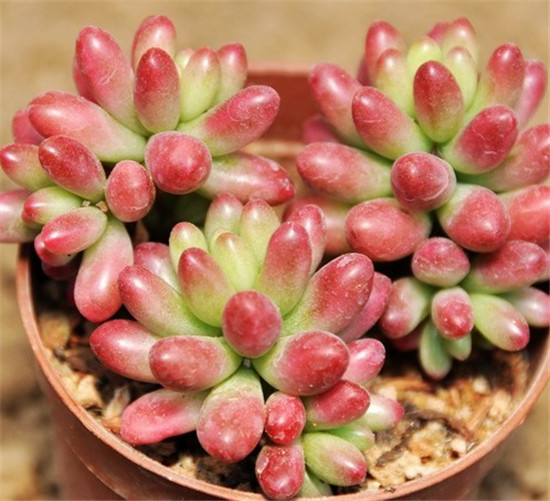
Also called the Earring Plant or Corn Kernel Plant (commonly known in the market as Grape Palm), the Jelly Bean Plant is a succulent in the Crassulaceae family, genus Sedum. It prefers warmth and is not cold-tolerant. It likes sunlight and has fairly strong drought tolerance. It is highly adaptable and not demanding about soil.
The Jelly Bean Plant prefers environments with a pronounced temperature difference between day and night. It adapts well to temperature and grows well between 10°C and 28°C. In autumn and winter, as temperatures drop and light intensity increases, the fleshy leaves gradually turn red, so artificially lowering the temperature during cultivation can enhance its ornamental value.
In winter, room temperature should not fall below 5°C. The Jelly Bean Plant loves light, and it should receive full light throughout the growing period. However, intense exposure in summer can cause sunburn on the leaves, so appropriate shading or half-day sun is advisable, and direct midday sun should be avoided. The Jelly Bean Plant grows slowly and tolerates drought, so heavy fertilizer and heavy watering are not suitable. Water when the soil is dry and water thoroughly, while in winter when room temperature is lower, reduce both the amount and frequency of watering.
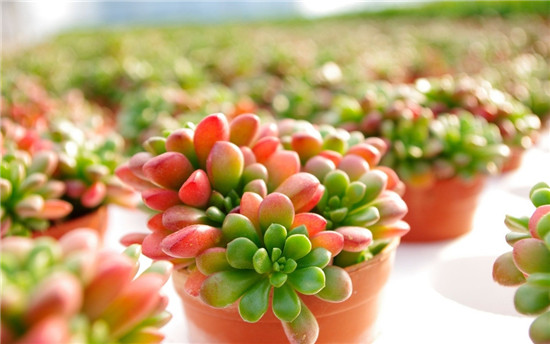
In summer, take care to maintain good ventilation for the Jelly Bean Plant. After about 3 years of cultivation, the plant's shape typically begins to become straggly, so pruning should be done in advance.
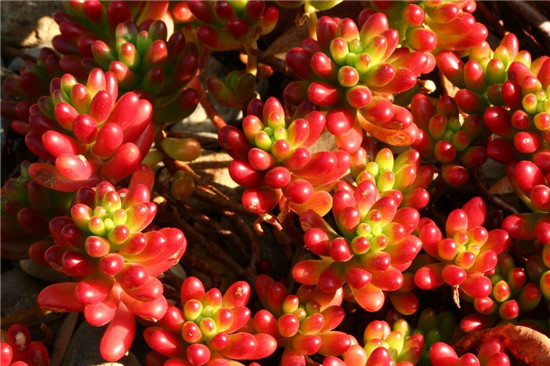
The leaves of the Jelly Bean Plant are fleshy, oblong-elliptical, about 1 cm long, and alternately arranged. The flowers are yellow and star-shaped. In autumn and winter or under strong light, some or all of the leaves turn bright red. The leaf tips are slightly translucent, and at this point the leaves are a mix of red and green with vivid coloring, like a rainbow or jade, which is why it is also called the Jelly Bean Plant.
The Jelly Bean Plant is a perennial succulent herb, 10-20 cm tall, with many branches. Its fleshy leaves are swollen and alternately arranged, cylindrical to ovate, 2 cm long, green, with a glossy surface and no white powder, turning reddish-brown under conditions of ample sunlight. The small flowers are pale yellow-red.
The Jelly Bean Plant is grown mainly for its foliage. Its leaves turn bright red under the low temperatures and strong sunlight of autumn, but it generally does not bloom; the flowering period is in autumn.
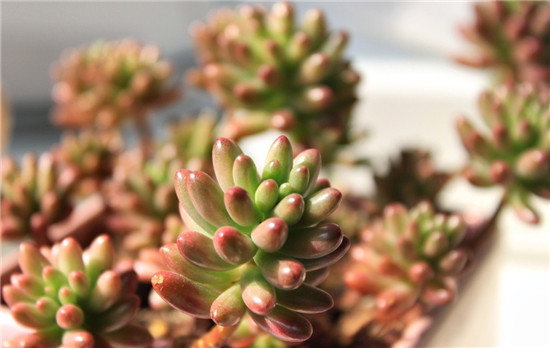
Temperature: The Jelly Bean Plant has very strong temperature adaptability; it prefers environments with large day-night temperature differences, and a growing temperature of around 10°C-28°C allows it to thrive well. In autumn, artificial cooling can be used to maintain the emerald green color of the Jelly Bean Plant's leaf surface, effectively enhancing its ornamental value. At the same time, in winter, the temperature can be kept above 5°C.
Light: The Jelly Bean Plant loves sunlight. In winter, it can be placed on a balcony to absorb sunlight. In summer, it can be given half-day sun or partial shade; at midday in summer, avoid direct sunlight to prevent sunburn damage to the leaves. During the growing period, ensure the Jelly Bean Plant receives enough sunlight.
Ventilation: The Jelly Bean Plant needs a certain amount of ventilation to ensure good growth.
Soil: The Jelly Bean Plant is not demanding about soil; generally, soil that is loose and has good drainage is sufficient.
Watering: The Jelly Bean Plant has a certain degree of drought tolerance, but during its growing period it needs a certain amount of moisture for better growth. Generally, if the Jelly Bean Plant grows slowly or its leaves take on a sun-red color, it indicates a lack of moisture. At this time, water according to the plant watering principle of "don't water if not dry, water thoroughly when you do."
Fertilizing: The Jelly Bean Plant has no great demands for fertilizer; applying a light fertilizer once or twice during the growing period is sufficient.
Pruning: The Jelly Bean Plant generally begins to become straggly after more than 3 years of planting, so pruning should be done in advance to maintain its shape.
The above is the complete content I have summarized for you on how to grow the Jelly Bean Plant. I hope this article can help everyone. Please also continue to follow us.