A Complete Guide to the Care Methods for Potted Winter Red Fruit
Winter Red Fruit is a deciduous shrub or small tree in the Rosaceae family and the Malus genus. Next, let us take a look at the care methods for potted Winter Red Fruit.
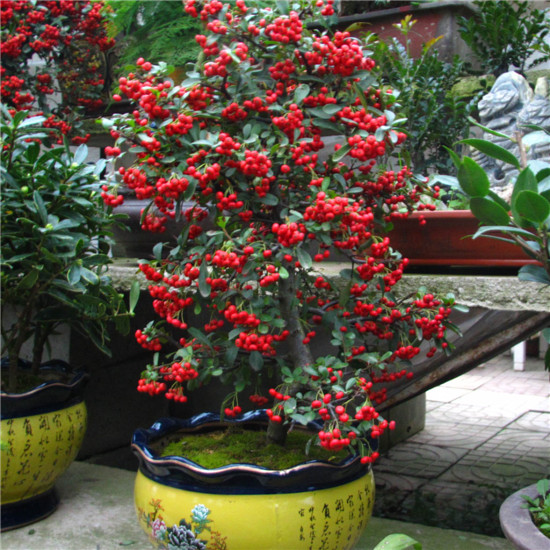
The Winter Red Fruit plant is short, with grayish-brown branches. Its fruit is oval-spherical, with a single fruit weighing 10 grams to 20 grams. It is initially green, gradually turns yellow later, and becomes bright red when mature. The skin is smooth, and it does not fall through winter, remaining on the tree until it gradually drops from February to March of the following year. For propagation of Winter Red Fruit, seedlings of crabapple, Malus baccata, or apple can be used as rootstock, and robust branches or plump buds slightly above the middle can be used as scions, grafted by cleft grafting, cut grafting, or bud grafting.
For propagation of Winter Red Fruit, seedlings of crabapple, Malus baccata, or apple can be used as rootstock, and robust branches or plump buds slightly above the middle can be used as scions, grafted by cleft grafting, cut grafting, or bud grafting.
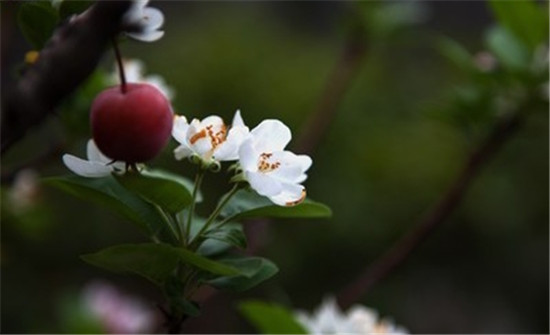
Winter Red Fruit is a variety of apple. Its tree form is compact. In spring, light pink flowers bloom all over the branches, and in autumn and winter the tree is covered with delicate, lovely fruits. Its fruit shape closely resembles an apple, making it suitable for garden planting or potted ornamental viewing and for making bonsai.
Winter Red Fruit prefers a sunny, cool, and dry environment. It is cold-resistant and afraid of damp heat, and is suitable for growing in sandy soil rich in humus, loose and fertile, and well-drained. It is generally transplanted or potted in spring each year. During the growing period, it requires sufficient sunlight. If light is insufficient, it will affect the color of the fruit, the plant shape, and fruiting, so when planted in the ground it can be placed in a sunny, ventilated spot in the courtyard, while potted plants should be placed in a place with sufficient sunlight.
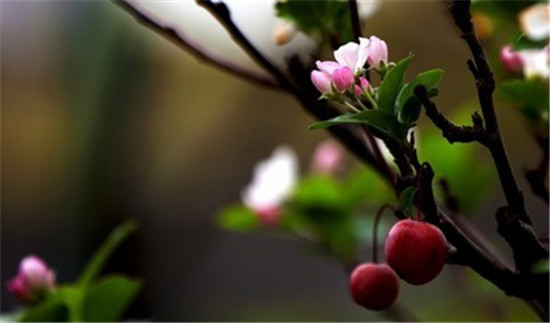
During the growing period of Winter Red Fruit, keep the soil moist but not waterlogged. June each year is the flower bud differentiation period, and watering should be controlled for 2 weeks to 3 weeks, watering again only when the young leaves wilt, in order to promote the formation of flower buds. In the early stage of plant growth, nitrogen fertilizer can be appropriately increased. After June, control or stop applying nitrogen fertilizer, and increase the application amount of phosphorus and potassium fertilizers as well as trace elements such as calcium and magnesium, so as to improve fruit quality and ornamental effect, and make the branches develop fully, which is favorable for flower bud formation. Also promptly remove the tender tips at the ends of the branches to prevent the branches from extending, so that nutrients are redistributed, which is favorable for fruit development.
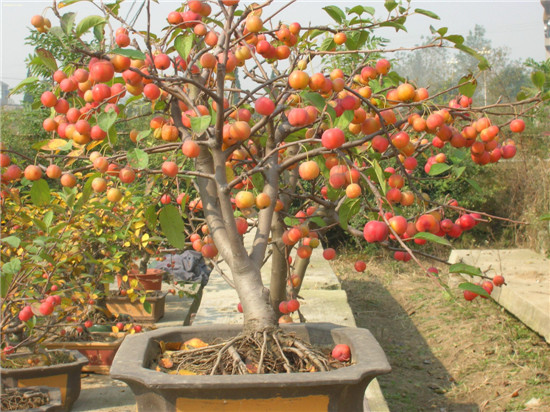
Winter Red Fruit is not tolerant of high temperatures. In summer, if the temperature is above 35°C for a long time, appropriate shading and ventilation can be provided to lower the temperature. In winter, potted plants can have their pots buried outdoors in a wind-sheltered, sunny place or placed in a cold room at 0°C to 10°C to overwinter. Before spring germination, prune and shape the plant once, cutting off diseased and dead branches, crossing branches, overly dense branches, and leggy branches, and shortening overly long branches, so as to facilitate ventilation and light penetration and maintain a beautiful tree shape.
Winter Red Fruit belongs to the Rosaceae family. Its flowers are borne in clusters of 5-12, light pink, opening in spring. The skin is smooth, and the fruit does not fall through winter.
The above is the complete content of the care methods for potted Winter Red Fruit that I have summarized for everyone. I hope this article can help everyone. Please also continue to follow us.