How to grow daffodils? A detailed guide to daffodil cultivation methods
Daffodils originate from Europe and have relatively high ornamental value, and many people also grow them at home. Next, let's take a look at how to cultivate daffodils.
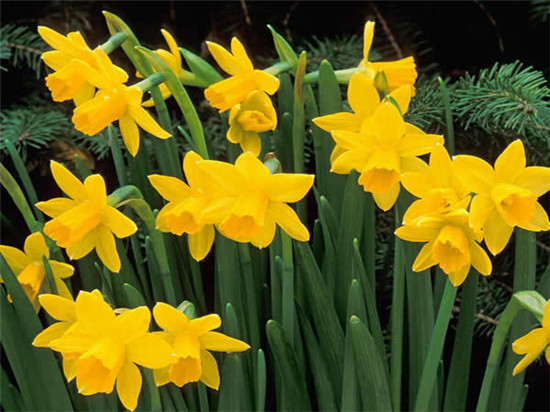
Daffodil, also known as garden narcissus and trumpet narcissus, is a plant of the genus Narcissus in the Amaryllidaceae family. It is distributed in Europe and other places, and has now been introduced and cultivated artificially. It is a perennial herb, with pale yellow petals; the central corona is dark yellow and trumpet-shaped, with irregularly wrinkled edges; the leaves are green, slightly gray, basal, broadly linear, with obtuse tips; it bears 1 flower terminally, and the flowering period is March to April. In addition, the daffodil's flower color is gentle and harmonious, with a delicate, alluring fragrance, and it is a world-famous bulbous flower.
It originates from western Europe and is distributed in Spain, Portugal, Germany, England and Wales, among other places. It grows in many gardens in Europe, and in the wild it grows on forest floors, grasslands and rocky ground. Since the 19th century, daffodils in the UK have decreased greatly, due to the increase in agricultural farmland, deforestation and the large-scale digging of horticultural bulbs.
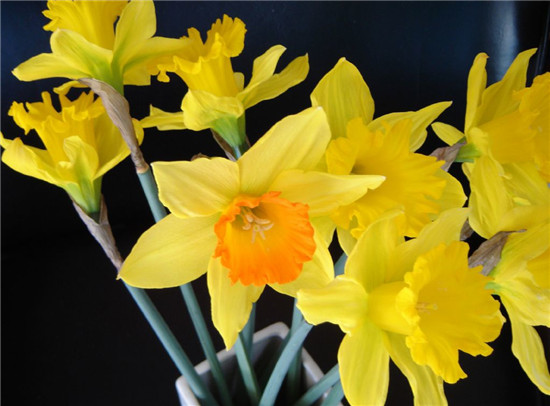
Common cultivated varieties include single-petaled, yellow-flowered ones such as Yellow Sun, Ballade and Bridgeton. Double-flowered ones include Bridal Crown, with a yellow corona and multiple heads; Happy, with multiple heads; Flower Drift, with an orange corona; and White Lion, among others. In its place of origin, the daffodil grows in an environment with moist winters and dry, hot summers. Therefore, potted daffodils need sufficient water during both the autumn and winter root growth period and the spring aboveground growth period, but must not be waterlogged. After flowering, water should be gradually reduced, and the bulbs should be kept dry during the dormant period. Daffodils are not sensitive to light. Apart from needing sufficient sunlight during the leaf growth period, semi-shade is preferable during the flowering period. If light is insufficient for a long time during the growth period, the leaves will elongate, become soft and droop, but this has little effect on flowering. The soil is best as fertile, loose, well-drained, humus-rich sandy loam that is slightly acidic to slightly alkaline. It is commonly propagated by bulb division, sowing and tissue culture.
It is an autumn-planted bulbous plant with a certain ability to resist low temperatures, and can be cultivated in the open field in the East China region; however, it is not tolerant of high temperatures, and after the high temperatures of summer, it must also undergo a low-temperature vernalization process. The dormant period is relatively long, and the vernalization process also takes a relatively long time and has high requirements.
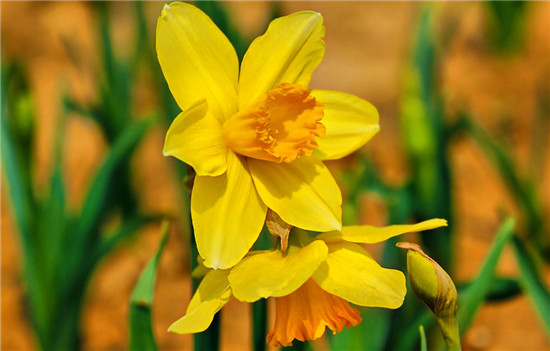
During forcing cultivation, if it encounters a high temperature of 30°C, it will lead to a degeneration phenomenon and affect flowering. Therefore, to prevent degeneration, plant separately in late September to early October. After planting in September to October, the bulbs continuously grow leaves and roots, and growth slows down after winter arrives.
After temperatures warm up in early spring, the leaves then grow rapidly. After 3-5 leaves have grown, a scape is drawn out from the leaf cluster, and the flower stem is almost level with the leaves. After flowering, the underground bulb begins to develop, and by June to July the aboveground part withers and dies, and the plant enters a dormant state. Flower bud differentiation of the new bulb begins around late April and is completed before dormancy.
After the bulbs are dug up in June to July, they can be used for forcing cultivation after a certain period of high temperature, and the earliest they can bloom is by the end of November. Generally, the flowering period of forcing cultivation is from December to March of the following year.
For forcing cultivation, cold-storage vernalization treatment must first be carried out. Cold storage treatment at 8°C-10°C for more than 5 weeks is most effective for promoting flowering. The longer the vernalization treatment time, the more flowering is promoted.
However, because the vernalization time is long, the plant shape will become smaller; if the cold storage time is too long, the flowers will also become smaller. Generally, cold storage at 8°C for 5-8 weeks will not cause abnormal plant growth. If stored at 15°C-18°C before the cold storage treatment, the effect is even better.
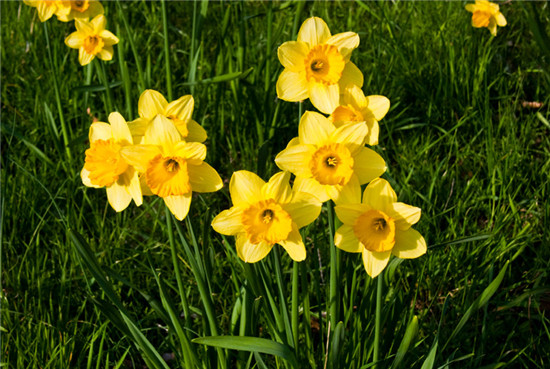
Vernalization treatment should be dry cold storage, and water should not be added during the cold storage process. If low-temperature-treated bulbs encounter a temperature of 25°C after planting, it will seriously affect the vernalization effect. Therefore, they are generally planted in October. If planting in September, a cool place must be found or shading and cooling must be provided on sunny days.
Usually, the bulbs are put into an 8°C cold storage in early August and treated for 8 weeks, and can bloom in November; if low-temperature treatment is carried out in mid-to-late August and then planted after 8 weeks, they bloom in December; if treated at the end of August and planted in late October, they bloom in January of the following year; if treated in early September and planted at the end of October, they bloom in February of the following year; if treated in mid-to-late September and planted in early November, they bloom in March of the following year; if not treated and planted in October-November, they bloom in March-April of the following year.
Although it is established that the English name of the daffodil, Narcissus, comes from the name of a youth in Greek mythology, some people also believe it comes from the Greek word for "numbness." Either way, it is very mysterious, so its flower language is "mystery." People born under the blessing of this flower are full of a mysterious aura. In terms of relationships with the opposite sex, sometimes they are unrestrained, sometimes conservative; in short, they are unpredictable, and this is also where your charm lies!
The daffodil has a wild nature, but it is a very graceful flower, so its flower language is simplicity. People born under the blessing of this flower have a plain appearance and are quite kind and good-hearted. However, a disposition that is too pure sometimes makes it hard for someone with intentions to muster the courage to take a step forward, because purity easily inspires awe. You might as well relax and show a lively and innocent side; perhaps love will then surround you.
You who like this flower are born with a noble temperament, feel that you should not bury your talents, and are very serious about life, believing that there will surely be a day when you rise above others. Although you consider yourself noble, you are very enterprising and face life with a proud attitude. Your behavior is sometimes a bit eccentric, but you are definitely a promising young person.
The above is all the content I have summarized for everyone on how to cultivate daffodils and daffodil cultivation methods. I hope this article can help everyone. Please also continue to follow us.
Sometimes unrestrained, sometimes conservative; in short, unpredictable, and this is also where your charm lies!The daffodil has a wild nature, but it is a very graceful flower, so its flower language is simplicity. People born under the blessing of this flower have a plain appearance and are quite kind and good-hearted. However, a disposition that is too pure sometimes makes it hard for someone with intentions to muster the courage to take a step forward, because purity easily inspires awe. You might as well relax and show a lively and innocent side; perhaps love will then surround you.
You who like this flower are born with a noble temperament, feel that you should not bury your talents, and are very serious about life, believing that there will surely be a day when you rise above others. Although you consider yourself noble, you are very enterprising and face life with a proud attitude. Your behavior is sometimes a bit eccentric, but you are definitely a promising young person.
The above is all the content I have summarized for everyone on how to cultivate daffodils and daffodil cultivation methods. I hope this article can help everyone. Please also continue to follow us.