How to Grow Pothos in Water: A Guide to Water-Cultivating Lush Green Pothos
Everyone wants fresh air and a sense of vitality in their home, and growing pothos in water indoors is a great choice. Its green leaves are always full of boundless vitality, bringing fresh, natural air into the room. So what is the method for growing pothos in water at home? Below, we will open up a whole new way of growing plants for you.
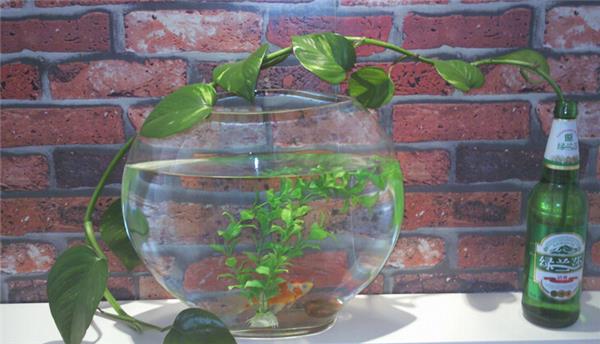
How to Grow Pothos in Water
❉——1. Pothos is mainly propagated in water by cuttings. In late spring and early summer, cut 15 cm to 30 cm stems, remove the leaves from the first 1 to 2 nodes at the base, and plant them directly in potting soil in pots, with 3 to 5 stems per pot. Water thoroughly, place in a cool, ventilated spot, and keep the potting soil moist. Roots and shoots will appear in about one month, and within the same year they can grow into plants with ornamental value. In spring and summer, stem cuttings root easily; for a totem-pole plant, you must use tip cuttings with large leaves, so that it takes shape relatively quickly. Pothos can also be grown in water, but compared with soil-grown plants, the plants are smaller. Newly cut pothos grown in water generally needs about a week before it grows roots.
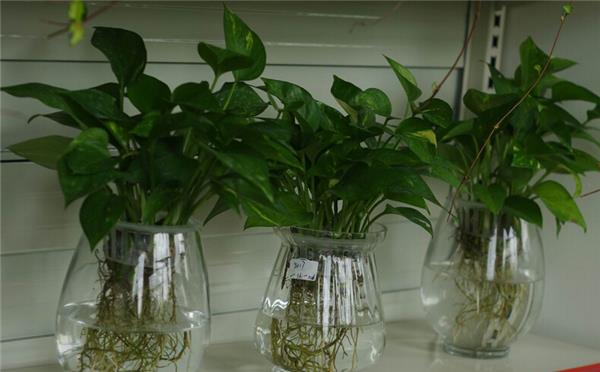
❉——2. In the northern regions during autumn and winter, to make up for the lack of temperature and photosynthesis, you should instead increase its light exposure. The method is to place the water-grown pothos in the brightest spot indoors, or move it to a sealed balcony to sunbathe at noon. At the same time, when the temperature is low, open the windows as little as possible, because the leaves may be frostbitten in a very short time. At a room temperature above 10°C, water-grown pothos can safely overwinter; at a room temperature above 20°C, water-grown pothos can grow normally. For most households, reaching this temperature is not a problem. What needs attention is avoiding too great a temperature difference, and also making sure the leaves do not get close to heating equipment.
❉——3. In autumn and winter, the amount of watering should be strictly controlled according to room temperature. Before heating begins, when the temperature is lower and the soil of the plant evaporates more slowly, watering should be reduced, and the amount of water should be controlled at between 1/4 and 1/2 of the original amount. Even after heating begins, watering should not be too frequent. When watering, pour less into the pot, and water should seep through the coir. In addition, you should also spray water on the places where aerial roots grow on the coir pole, to reduce insufficient water uptake by the roots caused by overly rapid evaporation. In winter, water that has been left to sit for a day after being drawn is better, because water that is too cold easily damages the roots. In autumn and winter, plants mostly grow slowly or even stop growing, so fertilizing should be reduced. Before winter begins, mainly use liquid inorganic fertilizer, about once every 15 days. After winter begins, fertilizing should mainly be foliar spraying, applied mainly through the stomata on the leaves. Fertilizer is absorbed through the stomata on the leaves, and the fertilizer effect can act directly on the leaves. Special fertilizer should be used for foliar fertilizer; ordinary inorganic fertilizer is not easily absorbed by the leaves.
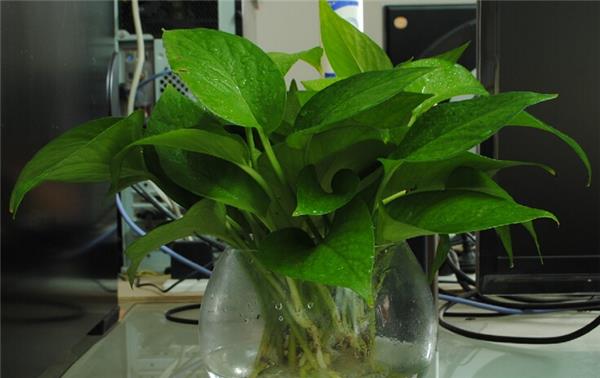
❉——4. Pothos grows relatively quickly in water and is easy to cultivate and manage. During cultivation and management, in summer you should spray water on the plant more often, and add nutrient solution once every 10 days, to keep the leaves green. For potted seedlings, when the seedlings grow 30 cm up the cultivation pole, they should be cut off; when the lower leaves have fallen off by 30%-50%, they should be discarded and replanted. Green-pillar potted plants are ideal plants for courtyard gateposts and wall greening, and their leaves are also excellent foliage for flower arrangements. Plant or directly insert 4-5 plants per pot, and set up a coir pole in the middle of the pot, so that the water-grown pothos can climb upward easily. Shaping and pruning should be done in spring. When the stems have covered the coir pole and the tips extend about 20 cm beyond the coir pole, cut off 40 cm of the stem tips of 2-3 of the plants. After the cut back, when new buds and new leaves sprout, then cut off the stem tips of the remaining plants.
Water-grown pothos is one of the very good water-grown plants for indoor decoration, a climbing vine foliage flower. Its stems are slender and soft, and its leaves are delicate and elegant. Place a nested pot high on top of a cabinet at home, let its trailing stems hang down freely, or after the trailing stems hang too long, coil and hang them into a ring, just like an emerald relief. Water-grown pothos likes warm, humid environments, and requires loose, fertile soil with good drainage. Water-grown pothos is extremely shade-tolerant and can be placed year-round in a sunny spot indoors. In a room with dim light, it should be moved every half month to a brighter environment for a period of recovery, otherwise the internodes tend to lengthen and the leaves become smaller. So, in the process of growing pothos, how should it be cared for to avoid these problems?
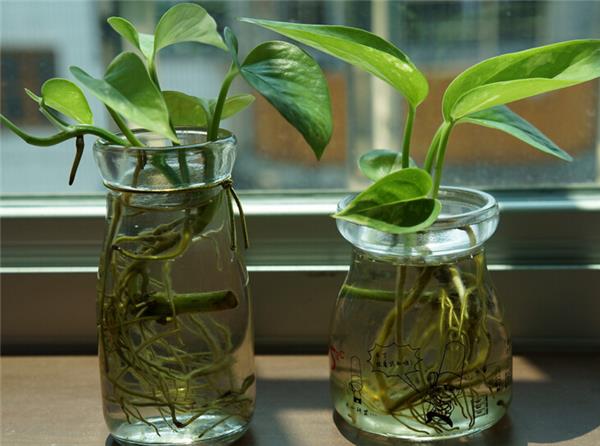
How to Care for Water-Grown Pothos
❉——1. First, choose the stems of the pothos well. Healthy, strong stems with aerial roots are the good material for water cultivation. After such stems with aerial roots are cut and placed in clean water, they can quickly adapt to the water-cultivation environment, and within about ten days they can grow water roots. Note that the part of the stem placed in water must not have leaves, otherwise leaves soaking in the water can easily affect water quality. In addition, you can also select potted plants with a relatively good plant shape, wash the soil off the roots, cut off excess old roots, and place them in clean water; they will also root very easily.
❉——2. In the first few days of water cultivation, pay attention to changing the water. Change it once every two or three days with water at the same temperature as the room. After water roots grow, change the water once a week. After new leaves grow, you can add nutrient solution once about every ten days, and you can also spray some diluted nutrient solution water on the leaves. This can make the leaves green and glossy.
❉——3. The roots of water-grown pothos should be cleaned and trimmed often. If the roots are too long, cut them shorter in time to avoid loss of nutrients. If the roots rot and become sticky, they should also be cleaned in time, the rotten roots cut off, and soaked in potassium permanganate solution for disinfection before resuming care. In the first few days of resuming care, do as at the beginning of water cultivation: change the water once every two or three days, and after growth has fully recovered, change the water once every ten days.
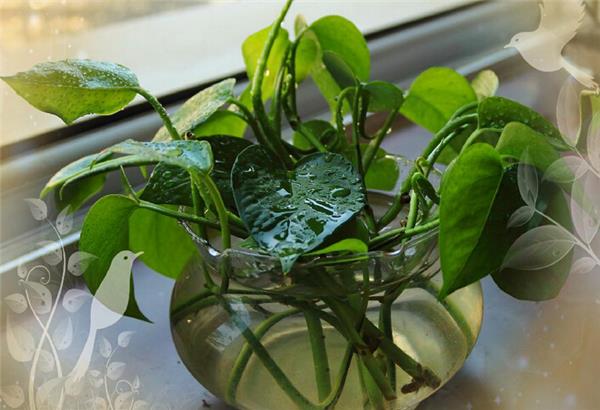
❉——4. Water-grown pothos needs sufficient scattered light for its leaves to spread out and for the leaf color to be green. Usually it is best to place it where there is enough scattered light. If the environment where it is kept is too dark, you can move it about every ten days to a place with enough scattered light to receive a few hours of light, which can also maintain the glossiness of the leaf color.
❉——5. Pothos itself likes a warm, humid environment. In dry seasons, spray water on the leaves often, which increases environmental humidity and also helps clean the leaves. In winter, the place where it is placed should be away from heating, and attention should be paid to preventing frost damage. Water-grown leaves are delicate and very sensitive to temperature changes, so try to keep room temperature normal, and do not allow large temperature differences.
❉——6. Like potted pothos, water-grown pothos also needs frequent pruning. Cut off overly long and tangled stems to maintain an orderly, well-spaced appearance.
 Water-grown plants are a new type of soilless plant cultivation method. Water-grown plants like water-grown pothos, which once existed only in laboratories or enterprises, have gradually entered thousands of households. Here we introduce how households can grow water-grown plants and how to care for water-grown pothos, offering a bit of humble guidance for people who dare to try or like to DIY water-grown pothos and other water-grown plants, and we hope it can help everyone.
❉——2. In the first few days of water cultivation, pay attention to changing the water. Change it once every two or three days with water at the same temperature as the room. After water roots grow, change the water once a week. After new leaves grow, you can add nutrient solution once about every ten days, and you can also spray some diluted nutrient solution water on the leaves. This can make the leaves green and glossy.
❉——3. The roots of water-grown pothos should be cleaned and trimmed often. If the roots are too long, cut them shorter in time to avoid loss of nutrients. If the roots rot and become sticky, they should also be cleaned in time, the rotten roots cut off, and soaked in potassium permanganate solution for disinfection before resuming care. In the first few days of resuming care, do as at the beginning of water cultivation: change the water once every two or three days, and after growth has fully recovered, change the water once every ten days.
❉——4. Water-grown pothos needs sufficient scattered light for its leaves to spread out and for the leaf color to be green. Usually it is best to place it where there is enough scattered light. If the environment where it is kept is too dark, you can move it about every ten days to a place with enough scattered light to receive a few hours of light, which can also maintain the glossiness of the leaf color.
❉——5. Pothos itself likes a warm, humid environment. In dry seasons, spray water on the leaves often, which increases environmental humidity and also helps clean the leaves. In winter, the place where it is placed should be away from heating, and attention should be paid to preventing frost damage. Water-grown leaves are delicate and very sensitive to temperature changes, so try to keep room temperature normal, and do not allow large temperature differences.
❉——6. Like potted pothos, water-grown pothos also needs frequent pruning. Cut off overly long and tangled stems to maintain an orderly, well-spaced appearance.
Water-grown plants are a new type of soilless plant cultivation method. Water-grown plants like water-grown pothos, which once existed only in laboratories or enterprises, have gradually entered thousands of households. Here we introduce how households can grow water-grown plants and how to care for water-grown pothos, offering a bit of humble guidance for people who dare to try or like to DIY water-grown pothos and other water-grown plants, and we hope it can help everyone.