What plant is blue sage? Let us give you a complete overview
Blue sage, also known as pink-calyx sage, grows 30-60 cm tall and blooms every summer. Let us take a look at this blue sage together!
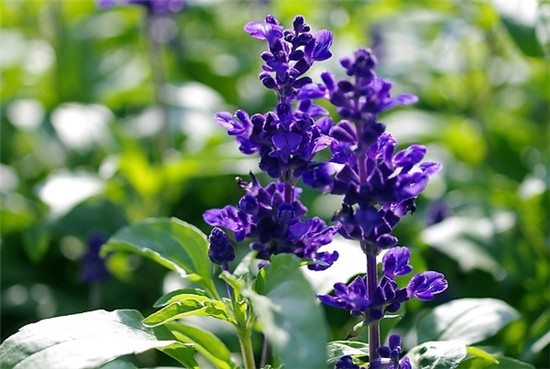
Blue sage, officially named pink-calyx sage, has oval or lance-shaped leaves and bears blue-purple two-lipped flowers, with a small upper lip and a large lower lip marked with obvious white spots. It is actually a variety of sage, and because of its romantic blue-purple flower color, it is often mistaken for lavender during the spring and summer blooming season. At first I always thought they were lavender, but only after carefully comparing pictures did I come to know it. The leaf surface of blue sage has a textured, embossed pattern, is wrinkled, and is grayish white. Potted blue sage is suitable for arranging flowerbeds, flower borders, and garden scenic spots. It can also be used to accent the sides of rocks and gaps at the edge of woods, making them look serene. Placed in front of natural buildings and in small courtyards, it feels even more elegant and tranquil.
Sage leaves have antiseptic, antibacterial, and anti-inflammatory effects. It is an aromatic plant. The plant grows in clumps, and its scent is pungent and strong. Among medicinal herbs it is extremely precious and is known as "the poor man's herb." However, for some unknown reason, I could not smell the fragrance.
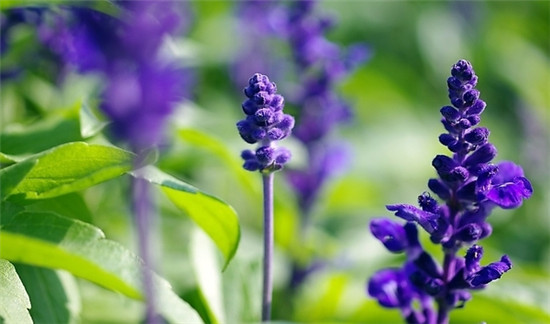
Sage flower meaning: family values. People who like this flower love their families and have an intellectual side; blue sage: rationality; purple sage: wisdom.
Overall characteristics: perennial herb, 30-60 cm tall, plant grows in clumps, and the plant is covered with fine hairs.
Stem characteristics: the stem is four-angled and columnar, and hairy; the lower part is slightly woody and appears subshrub-like.
Leaf characteristics: leaves are opposite, oval, 3-5 cm long, grayish green; the leaf surface has a textured, embossed pattern, is wrinkled, and is grayish white, with a pungent and strong scent.
Flower characteristics: it has long spike-like inflorescences, about 12 cm long; the flowers are small, purple, and produced in large numbers, with the flowering period in summer.
Temperature conditions: it likes warm, humid, and sunny environments, is strongly cold-tolerant, and fears heat and dryness.
Soil conditions: it is best grown in loose, fertile, and well-drained sandy loam.
Place of origin: native to the southern region of North America.
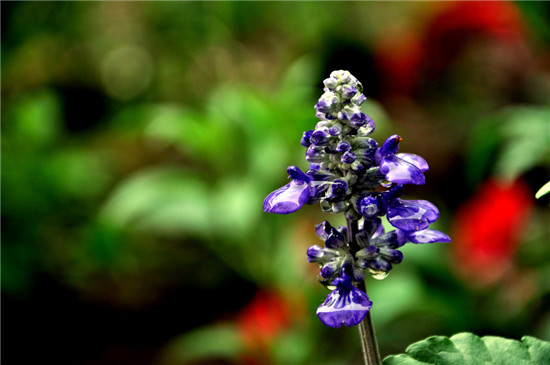
Blue sage is also known as yi chuan lan. Native to southern North America. It likes warm, humid, and sunny environments. It is relatively strongly cold-tolerant, fears heat and dryness, and is best grown in loose, fertile, and well-drained sandy loam or leaf mold. Propagation is mainly by sowing, in spring; the suitable germination temperature is 22-24°C, and germination occurs 20-25 days after sowing.
After sowing, thinning is needed 1-2 times. When the seedlings are 15 cm tall, transplant them into 10 cm pots and pinch off the growing tips. During the growing period, fertilize once every half month and keep the potting soil moist. Apply phosphorus and potassium fertilizer once before flowering; after flowering, remove the inflorescences, and the plant can still send out shoots and continue to bloom. The seeds do not mature uniformly, so they need to be collected as they ripen.
The blue-purple two-lipped shape of blue sage is very fresh and pleasing to the eye: potted plants are suitable for arranging flowerbeds, flower borders, and garden scenic spots. It can also be used to accent the sides of rocks and gaps at the edge of woods, making them look serene. Placed in front of natural buildings and in small courtyards, it feels even more elegant and tranquil.
The above is the full content of the introduction to blue sage that I have summarized for everyone. I hope this article can help you. Please also continue to follow us.