Introduction to the daily planting methods of pink rain lily
The pink rain lily is a plant of the genus Zephyranthes in the amaryllis family (Amaryllidaceae). It is a herbaceous plant native to Mexico and is now widely cultivated around the world. Next, let us take a look at the planting of the pink rain lily.
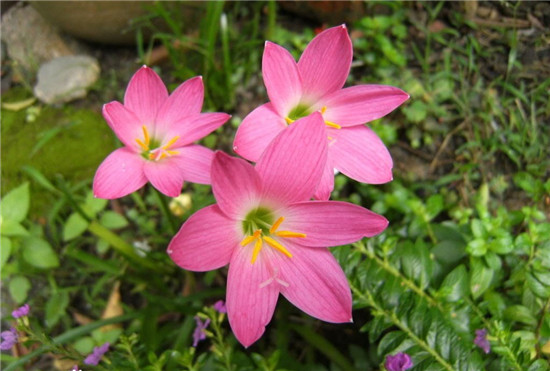
The pink rain lily, also called rain flower and chive lily, is a perennial herbaceous plant of the genus Zephyranthes in the amaryllis family (Amaryllidaceae). Native to Mexico. Perennial bulbous herb. It has a tunicate bulb, ovoid, with a light brown outer skin and a short neck. Basal leaves 5-6, nearly linear, flat, slightly fleshy, bright green, 20-30cm long. The scape is drawn out from the leaf cluster, bearing a single terminal flower, pink, funnel-shaped, with a perianth tube about 2cm long, lobes obovate, apex blunt, and the flower relatively large. Capsule nearly spherical. Seeds flat, black.
The pink rain lily has a low plant cluster, flat leaves, and abundant flowers. The scape is drawn out from the leaf cluster, with more terminal flowers. If planted in patches, it becomes a sheet of rose red when blooming, very beautiful, so it is a very good flowering groundcover plant. The flowering period is relatively long, from June to September, blooming in summer and autumn, and it can bloom 2-3 times a year.
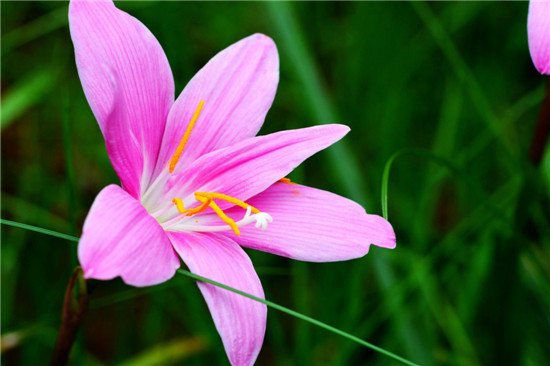
The pink rain lily likes warmth and sunlight, and is also tolerant of semi-shade and moisture. It is suitable for well-drained, humus-rich sandy loam. It is relatively cold-tolerant; in East China, the underground bulbs can overwinter in the open ground.
The pink rain lily is propagated by seeds, and can be planted by division or by bulbs throughout the year, but spring is best. Simply dig up the bulbs, plant 3-5 bulbs at each spot, and water to maintain appropriate moisture; it is very easy to establish. When digging up the bulbs, be careful not to damage them. If there are too many leaves and scapes, cut off the upper parts and keep the intact bulbs and 6-8 cm of leaves for planting. If the bulbs have already sprouted flower buds, after dividing them and watering thoroughly, the pink rain lily can still bloom.
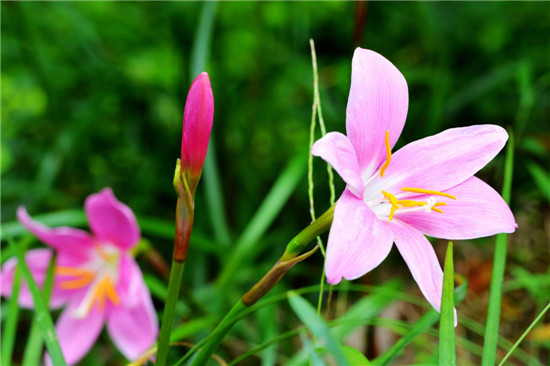
When planting the pink rain lily in gardens, choose a sunny, warm, wind-sheltered location, and apply 3-4 topdressings during the growth and flowering period, and it will have lush leaves and abundant flowers. For open-ground cultivation in the middle and lower reaches of the Yangtze River, after heavy frost in severe winter, the old leaves wither, and the bulbs can remain in the ground to overwinter and bloom as usual the next year. For potting soil, mix 2 parts loam, 1 part leaf mold and peat, add a small amount of fine sand, and add a small amount of bone meal and decomposed compost. During the growth period, the pink rain lily needs sufficient sunlight and water. After one batch of flowers fades, pause watering for 7-8 weeks, then resume watering. With such alternating dry and wet periods, it can bloom 2-3 times a year.
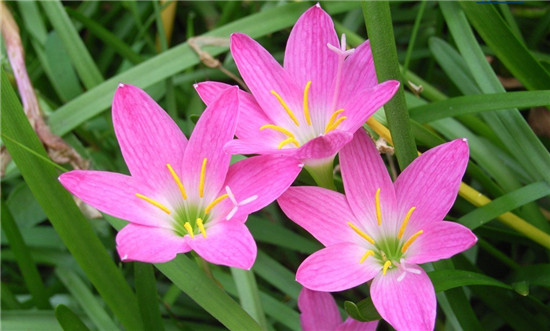
Organic fertilizer can be used, applied once every 2-3 months. Increasing phosphorus and potassium fertilizer in proportion can promote bulb enlargement and good flowering in the pink rain lily. When the plants become crowded in clumps, division must be enforced. It is strong-growing, drought-tolerant and heat-resistant, easy to cultivate, and the suitable growth temperature is 22-30 degrees. The planting depth should be such that the top of the bulb is slightly exposed, and divide the bulbs once every 2-3 years. After one batch of flowers fades, water should be controlled for 50-60 days, then normal watering resumed. Such alternating dry and wet conditions can promote multiple blooms of the pink rain lily, and it can bloom 2-3 times a year.
The above is all the content I have summarized for you on the daily planting of the pink rain lily. I hope this article can help everyone. Please also continue to follow us.