Where is chamomile native to? A detailed explanation of its growing environment conditions
Chamomile is about 30 cm tall, with a yellow center, white petals, and slightly fuzzy leaves. Next, let's take a look at where chamomile originates.

Chamomile is called the "noble flower" in Latin, and was called the "apple fairy" in ancient Greece. The Egyptians dedicated chamomile to the sun and revered it as a sacred herb, using it in rituals to treat nerve pain. In Roman times, treating snake bites with chamomile was already common knowledge among the people. Chamomile is divided into two types based on different places of origin and different effects: Roman chamomile and German chamomile. German chamomile is a beautiful sky blue and is superior to Roman chamomile. Its leaves have a sweet apple flavor and give off a warm grassy fragrance; its flowers have an apple aroma and are bright green; the flower is golden yellow and cone-shaped; the flower center is fragrant and firm. When selecting dried flowers, it is best to choose those whose color is not too dark, with intact leaves and dry, non-moist conditions.
Chamomile is an annual or perennial herbaceous plant, 30-50 cm tall, with the whole plant hairless and fragrant. The stem is erect, with many branches in the upper part. The leaves are bipinnate to tripinnate and fully divided, with the segments narrowly linear and pointed at the tip. The flowering period is April-May, with flower heads terminal or axillary, 1.5-2 cm in diameter. The outer corolla is ligulate and white, and the inner corolla is tubular and yellow. The achene is extremely small, oblong or obovate. The seeds are tiny; 1 gram of seeds contains more than 10,000 seeds. Matricaria is the more commonly cultivated variety. One is pure true chamomile, which is annual. The other is Roman chamomile, which is perennial.
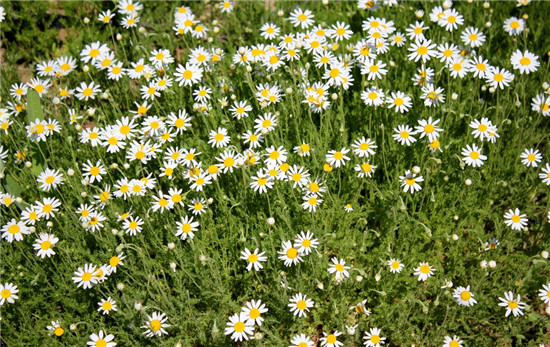
Matricaria, Roman chamomile, and German chamomile share many common characteristics: about 30 cm tall, yellow center, white petals, and slightly fuzzy leaves. German chamomile grows small. The essential oils of all three chamomiles contain azulene (a highly effective anti-allergic substance), but it mainly exists in the essential oil rather than in the whole plant. The azulene content in German chamomile is slightly higher, and its color is dark blue, so it is sometimes called "Hungarian chamomile."
It likes fertilizer, likes moisture, fears waterlogging, and is not tolerant of drought. It can grow in general soil, but grows most robustly in deep, fertile loam and sandy loam. Low-lying, waterlogging-prone land is not suitable for planting. It is not strict about soil requirements and can grow in acidic and saline-alkaline soil. Its root system is well developed and its rooting ability is strong, making it a very good plant for soil fixation and water conservation, and it can be planted on hillsides, riverbanks, and other places. In shaded places, it grows poorly.
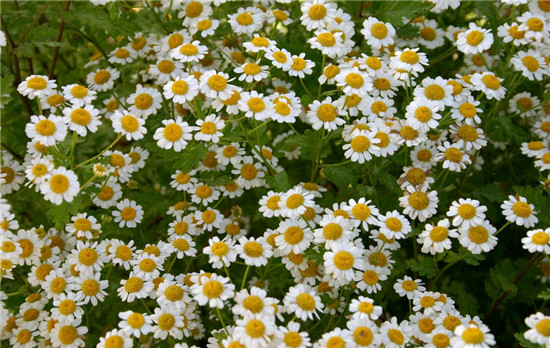
Main distribution: various European countries, such as the United Kingdom, Germany, Rome in Italy, and other countries.
We know that flower tea is made with green tea and black tea, and flower tea is not suitable for everyone. Traditional Chinese medicine suggests that people with qi deficiency and yang deficiency constitutions (pale complexion with spontaneous sweating, low voice, poor appetite, shortness of breath, fatigue, loose stools, etc.) should not drink much of it. This is because people with this constitution need warming tonification, while flower tea is cool in nature and should not be drunk in large amounts.
If you really want to drink it, how can you drink it? 1. You can choose flower tea made with black tea as the tea base, as its nature is milder. 2. Add a little shredded ginger to the tea to remove the cold-cool nature; it has a distinctive flavor. 3. If you have a qi deficiency constitution and drink flower tea, you can add 3-5 jujubes and brew them together. 4. Drink it while hot.

The above is the full content I have summarized for everyone on the origin of chamomile and the growing environment of chamomile. I hope this article can help everyone. Please also continue to follow us.