How to Grow Black-Eyed Susan? Detailed Guide to Growing Methods and Tips
Black-Eyed Susan (Rudbeckia hirta) originates from the eastern United States and is an annual or biennial herbaceous plant. Let's take a look at how to grow Black-Eyed Susan.
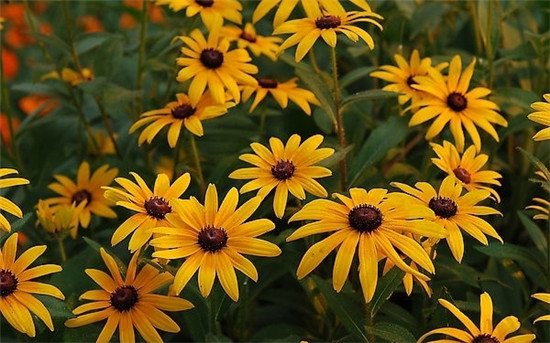
Black-Eyed Susan belongs to the genus Rudbeckia in the Asteraceae family. It is annual or biennial, with a plant height of 60-100cm, flower heads 8-9cm, double flowers, yellow ray florets, sometimes with brownish-yellow bands, and dark brown disc florets. The branches and leaves are rough, with many branches. The leaves are relatively wide, with basal leaves pinnately lobed, 5-7 lobes, and stem leaves 3-5 lobes with sparse serrated edges. The flower heads grow singly or several together on long stalks. Sowing in spring and autumn, flowering from summer to autumn, cold-resistant and drought-tolerant, with extensive management. Suitable for clump planting, mass planting, highway greening, flower beds and borders, and planting along grassland edges. It can also be used as a cut flower, overwinters in open ground, and can self-seed and reproduce. The entire plant is covered with hairs, with leaves emerging near the roots, upper leaves alternate, spoon-shaped and broadly lanceolate, with coarse teeth on the leaf margins. Flower heads. Ray florets in a single row, golden yellow; disc florets dark black-eyed Susan brown, hemispherical in shape.
Stem
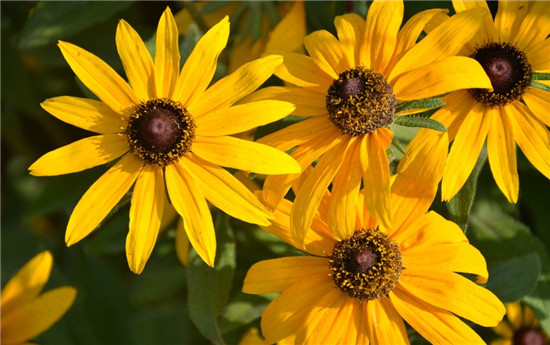
Black-Eyed Susan belongs to the genus Rudbeckia in the Asteraceae family. It is annual or biennial, with a plant height of 60-100cm. The stem is relatively stout, covered with soft hairs, slightly branched, and winged.
Leaves
The leaves of Black-Eyed Susan emerge near the roots, with upper leaves alternate. The leaves are spoon-shaped and broadly lanceolate, with coarse teeth on the leaf margins. Flower heads. The alternate leaves are rough, oblong to narrowly lanceolate, 10-15cm long. The leaf base extends down to the stem forming wings, pinnately lobed, 5-7 lobes, and stem leaves 3-5 lobes with sparse serrated edges.
Flowers
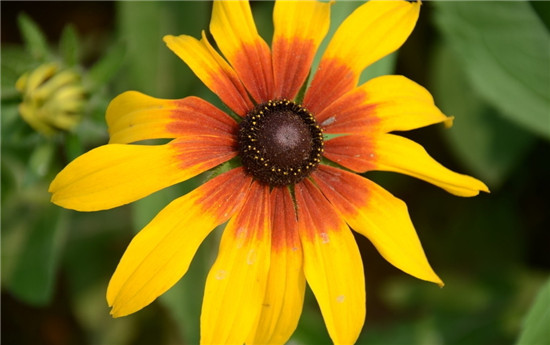
Black-Eyed Susan has flower heads 8-9cm, about 2.5-5cm in diameter, arranged in corymbs with short stalks; double flowers, yellow ray florets, sometimes with brownish-yellow bands, and dark brown disc florets. Flower heads, ray florets neutral, 1.5-2cm long, yellow, brownish-purple, or with two-colored stripes; disc florets brown to purple, densely clustered into a spherical shape; Black-Eyed Susan blooms from June to October.
Propagation Methods for Black-Eyed Susan
Seed Propagation
The sowing time for Black-Eyed Susan is generally in spring and autumn. March in spring and September in autumn are the best sowing times for natural growth. The sowing time is closely related to its natural flowering period. Sowing in March of spring results in flowering from June to July; sowing in September of autumn results in planting out in pots in November and flowering in the following spring (May to June). To ensure robust plants with large and colorful flowers, transplanting should be done once after sowing when 4 to 5 leaves have grown. Plant out in November. Can overwinter in open ground.
Division Propagation
Can be done in both spring and autumn, generally by dividing old perennial plants.
Cutting Propagation
Generally, new shoots sprouting from the roots are selected as cuttings, and this can be done in either spring or autumn. In spring, it should be done when the sprouts have grown to about 15cm; in autumn, it should be done after flowering when new shoots emerge from the root area.
Cultivation Management
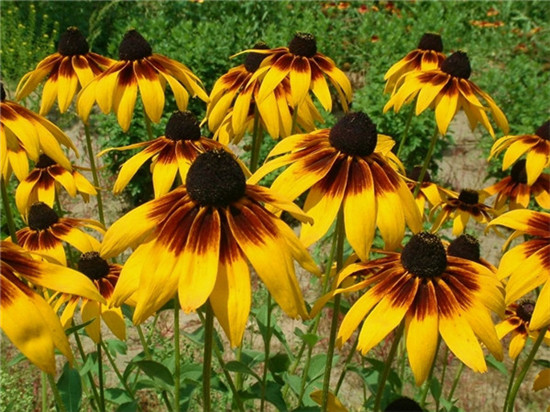
Black-Eyed Susan prefers a sunny and well-ventilated growing environment, is cold-resistant and drought-tolerant, and is not particular about soil. Management is relatively extensive. It is mostly grown in the ground and is suitable for sandy loam soil. It is not demanding regarding water and fertilizer. When the plants are growing well, nitrogen, phosphorus, and potassium fertilizers can be applied as top dressing to make the Black-Eyed Susan flowers even more beautiful and vibrant. Sufficient sunlight is needed during the growing period. Especially for cut flower plants, pinching can be used to extend the flowering period. For perennial plants, division must be enforced, otherwise growth will weaken and flowering will be affected.
Landscape Uses of Black-Eyed Susan
Black-Eyed Susan has abundant flowers and is suitable for courtyard arrangements, as border material, or planted along grassland edges in a naturalistic style.
New Black-Eyed Susan lines are award-winning varieties in Europe, having received AAS Winner and Fleuroselect Awards. These lines offer variety diversity, providing customers with a range of excellent choices. They can be used as windowsill plants, park potted plants, regional plantings, or as background plants, and can also be grown as main flowers or in large concentrated plantings. They have the following outstanding advantages:
1. They have bright colors, greatly enhancing visual appeal.
2. The continuous flowering period is very long, increasing sales opportunities.
3. They are award-winning varieties in European gardens, and their excellent characteristics have been widely recognized.
4. There is a wide choice of growth habits and flowering forms, giving them broad possibilities for use.
5. Heat-resistant and long-lasting, increasing consumer satisfaction.
The above is the complete content of the Black-Eyed Susan growing methods and growing tips that I have summarized for everyone. I hope this article can help you. Please also continue to follow us.