A Detailed Introduction to the Growth Process of Butterfly Bush Flowers
Butterfly bush flowers are the flowers of the plant Buddleja lindleyana of the Loganiaceae family, and they have very high ornamental value. Let us take a look together at the growth of butterfly bush flowers!
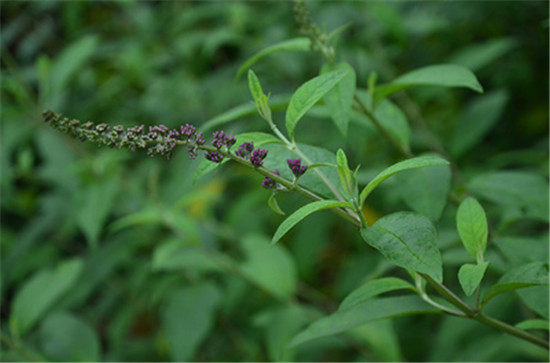
Butterfly bush, also known as: Biyu flower, Yangjianxiao, YuwEi grass, is a shrub of the genus Buddleja in the Loganiaceae family. The stem bark is brown; the branchlets are four-angled, with slight narrow wings on the angles; young branches, the underside of leaves, petioles, inflorescences, bracts, and bracteoles are all densely covered with stellate short tomentum and glandular hairs. The leaves are opposite, while leaves on sprouting branches are alternate or nearly whorled; the leaf blades are membranous, ovate, elliptical to oblong-lanceolate, with persistent calyx often at the base; the seeds are light brown, small, and wingless.
Butterfly bush is a shrub, 1-3 m tall. The stem bark is brown; the branchlets are four-angled, with slight narrow wings on the angles; young branches, the underside of leaves, petioles, inflorescences, bracts, and bracteoles are all densely covered with stellate short tomentum and glandular hairs. The leaves are opposite, while leaves on sprouting branches are alternate or nearly whorled; the leaf blades are membranous, ovate, elliptical to oblong-lanceolate, 3-11 cm long and 1-5 cm wide, with acuminate apex, broadly cuneate to rounded base, entire or wavy-toothed margins, dark green above, covered with stellate short pubescence when young and later becoming hairless, and grayish yellow-green beneath; lateral veins 6-8 on each side, flat above and sunken after drying, slightly raised beneath; petiole 2-15 mm long.
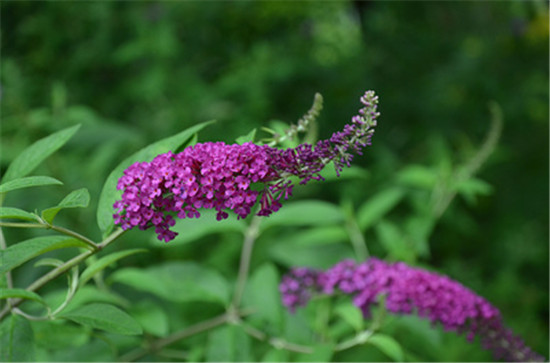
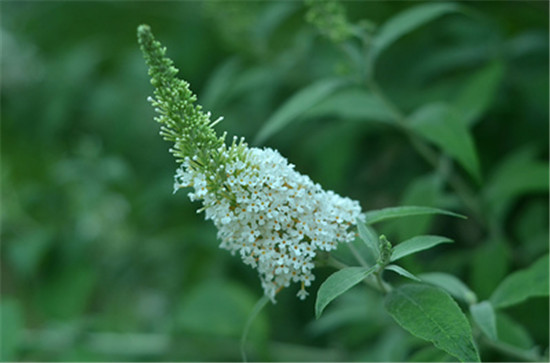
The spicate cyme is terminal, 4-40 cm long and 2-4 cm wide; the bracts are linear, up to 10 mm long; the bracteoles are linear-lanceolate, 2-3.5 mm long; the flowers are purple and fragrant; the calyx is campanulate, about 4 mm long, with the outside, like the outside of the corolla, covered with stellate hairs and small scales, hairless inside, and the calyx lobes are broadly triangular. The infructescence is spicate; the capsule is oblong or elliptical, 5-6 mm long and 1.5-2 mm in diameter, hairless, scaly, and often with a persistent calyx at the base; the seeds are light brown, small, and wingless. The flowering period is from April to October, and the fruiting period is from August to April of the following year.
Cultivation of Butterfly Bush
Before cutting propagation, first set up a shade shed. Disinfect the river sand in the cutting bed with potassium permanganate or carbendazim. Use semi-lignified branches cut into 10 cm sections, remove all the lower leaves, and cut off two-thirds of the upper 2-3 leaves. Make a flat cut at the upper cut end 1 cm from the bud, and make a horseshoe-shaped slanted cut at the lower cut end on the back side of the bud.
Use a wooden strip to open a furrow 5 cm deep in the river sand, place the cuttings dipped in rooting agent neatly, then cover with sand, pat firm, and spray water. The cutting density should be such that the leaves do not touch each other and are evenly distributed. After the whole bed is fully planted, spray water thoroughly once more, then set up an arched frame and cover it with plastic film, sealing all around.
Before rooting, spray water twice a day to lower the temperature and maintain moisture, keeping the temperature inside the shed at about 28°C and the relative humidity above 90%. In May and June, rooting takes about 20 days; in July and August, rooting begins in 2 weeks. After rooting, control moisture, pay attention to ventilation, and remove the arched shed according to the rooting condition. After hardening the seedlings for one week, transplant them.
Transplant the sprouted seedlings after cutting and rooting with bare roots; the nursery land must be carefully plowed and harrowed. To prevent the occurrence of diseases and insect pests, when preparing the nursery land, apply 3 kg-4 kg of phoxim granules and 50 kg of ferrous sulfate per mu. When transplanting, follow the principle of "fast": transport quickly and plant quickly, and irrigate immediately after planting one bed. Because butterfly bush grows fast, the plant and row spacing should not be too small; 35 cm x 50 cm is suitable. After transplanting, directly cover the small seedlings with a shade net for 2-3 days. After 3 days, remove the shade net in the afternoon and water thoroughly once more. When the soil surface is slightly dry, shallowly hoe once to preserve soil moisture. After 7-10 days, the transplanted seedlings can survive, and after 2 months, a scene of brilliant colors will appear before your eyes.
The above is all the content I have summarized for you on the growth of butterfly bush flowers. I hope this article can help everyone. Please also continue to follow us.