A detailed introduction to the characteristics and uses of the sensitive plant (Mimosa pudica)
In our impression, the sensitive plant is a plant whose leaves curl up as soon as it is touched, and that is how it got the name "sensitive plant." I believe many people keep this plant at home, which also shows that the sensitive plant has a certain ornamental value. So, do you know what the characteristics of the sensitive plant are?
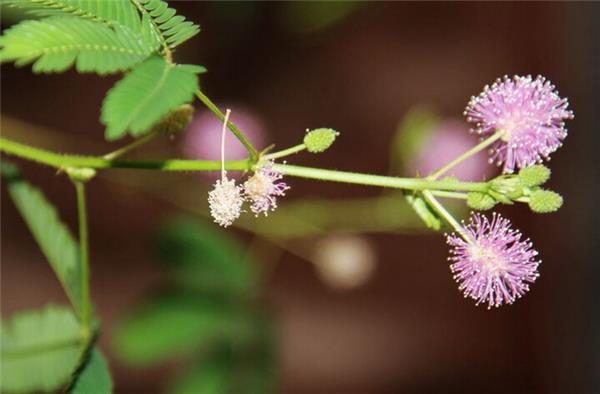
Characteristics of the sensitive plant:
◇——Characteristic 1 of the sensitive plant: Its greatest characteristic is that when it is stimulated (such as by touch), the leaf surface of the sensitive plant contracts and folds together. If the stimulation is strong, this stimulus is quickly passed along in turn to the neighboring leaflets, and even to the leaflets of the entire compound leaf, making the petiole droop. If the stimulation is strong enough, it can even make all the leaflets of the whole plant fold together and the compound leaves droop. But after a period of time, it can return to its original state. The sensitive plant also responds very quickly to vibration; it begins to react 0.1 s after being stimulated and completes the reaction within a few seconds.
◇——Characteristic 2 of the sensitive plant: At night, it also folds its leaflets together and its petiole droops, and during the day, when some leaflets are shaken, they also fold together in pairs. It is more sensitive when the light is weak. Normally, the water in the pulvinus supports the leaf blade; but when it is stimulated by an external force, the water in the pulvinus immediately flows elsewhere, causing the leaves of the sensitive plant to close. In addition, it automatically contracts at night (that is, sleep movement). This unique trait is precisely the source of the name and nickname of the sensitive plant.
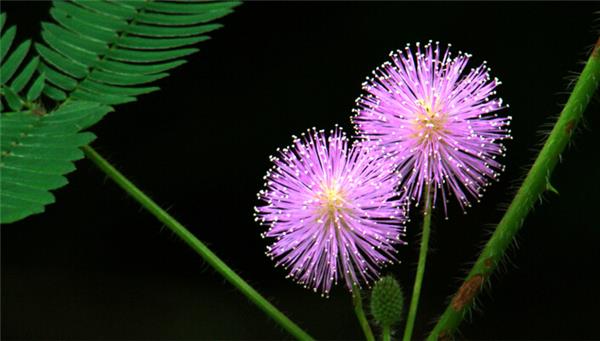
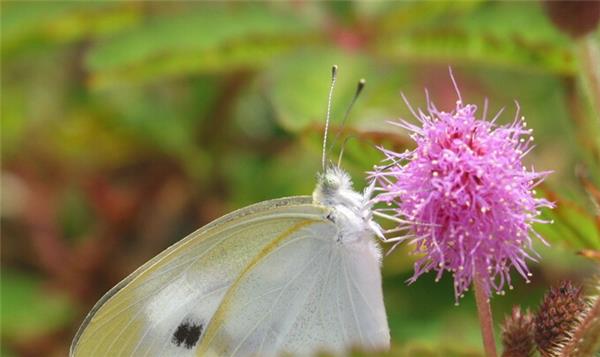
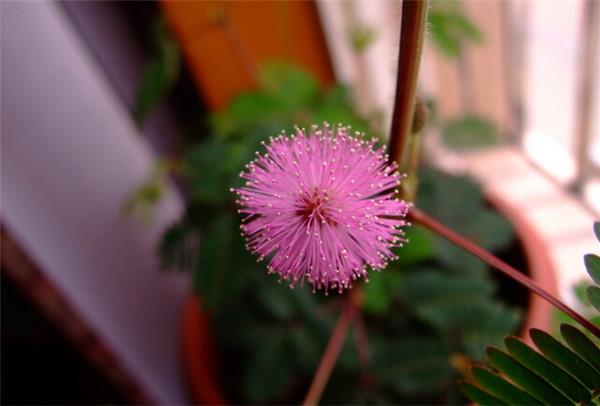
◇——Characteristic 3 of the sensitive plant: Because the sensitive plant has strong vitality and grows in a rather messy way, many places classify it as a type of grass, but in fact it also blooms. The flowering period of the sensitive plant is from July to October each year, but its flowering period is very short; the flowers fade less than two days after blooming. The flowers are pink, and the capitulum is spherical, shaped like a pom-pom. After flowering, it also produces pods, and the fruit is oblate.
What is the flower language of the sensitive plant? In fact, we can learn something from its name. The flower language of the sensitive plant is sensitivity, shyness, and politeness. Gently touching the leaves of this plant makes them immediately close and droop, and even a gust of wind can cause this to happen, just like a shy young girl, so its flower language is - shyness. People born under the blessing of this flower have a very shy and timid personality, and are also very afraid of strangers. They are especially keen in feeling and also have strong self-esteem. So, what role does the sensitive plant play in home life?
The role of the sensitive plant in home life
◇——1. A shy atmosphere spreads throughout the whole home, and the credit goes to the sensitive plant.
Gently touching the leaves of this plant makes them immediately close and droop, and even a gust of wind can cause this to happen, just like a shy young girl. Therefore, its flower language is - shyness. People born under the blessing of this flower have a very shy and timid personality, and are also very afraid of strangers. They are especially keen in feeling and also have strong self-esteem. However, if they are with people who understand them, they will be much more relaxed and at ease. They value quality over quantity in making friends, and like feelings that flow steadily and last.
◇——2. Give family members the same belief and the same warning.
The flower of Saint Vitus, who was martyred in 303 AD after being persecuted by the Romans. Since ancient times, Christianity has had the custom of linking saints with specific flowers. This follows from the fact that when the church commemorates saints, it often decorates the altar with blooming flowers! In medieval Catholic monasteries, all kinds of flowers were even grown like in a horticultural center. Over time, the church paired the 366 days' saints with different flowers, forming the so-called flower calendar. At that time, most monasteries were located in Southern Europe, and Southern Europe has a Mediterranean climate, which is extremely suitable for growing flowers and plants. The sensitive plant, which belongs to the Fabaceae family, commemorates the saint who was martyred in 303 AD after being persecuted by the Romans, Saint Vitus.
From such a historical story, it can be seen that the sensitive plant has a certain role in urging people in their lifestyle, style of living, and personal self-control.
The sensitive plant beautifies the home and fills the whole home with vitality. When the sensitive plant is touched by the outside world, its petiole droops and its leaflets close. Even if you are at home and there is not a single person besides yourself, there is still the sensitive plant. In name it is a plant, but in fact it has a personality and behavior somewhat like an animal, adding a lot of life to your home. Next, let us together discover what home styles the sensitive plant can be paired with.
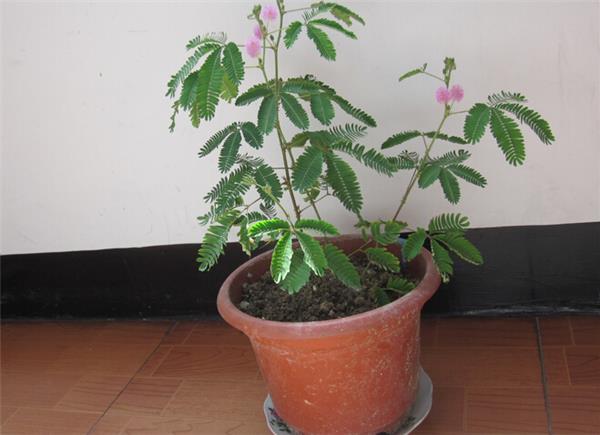
How to pair the sensitive plant in home life
◇——1. Growing the sensitive plant at home reflects a reserved home style.
A research team led by Professor Tsuchiya Takahide of Sophia University in Japan uncovered the mystery of the closing movement of the sensitive plant: the cells of the sensitive plant are supported by a fine network-like protein called "actin."
◇——2. Growing the sensitive plant at home reflects a home style that cherishes affection. Legend says that long ago a young man walked to the riverside, his clothes were torn, and he met a beautiful lotus maiden, who helped him mend his clothes.
◇——3. Placing the sensitive plant in the bedroom expresses a noble and beautiful home style. There is a kind of small and exquisite flower whose compound leaves closely resemble hibiscus branches, symmetrical dot by dot, just like bird feathers.
 What characteristics the sensitive plant has and what its flower language is, and what role the sensitive plant plays in home life - after the above introduction, everyone already has a certain understanding. The sensitive plant looks very nice, so it is very suitable for growing at home, and the sensitive plant also has a very good effect on purifying the home environment. So if you want a good indoor environment, growing the sensitive plant is a good choice.
How to pair the sensitive plant in home life
◇——1. Growing the sensitive plant at home reflects a reserved home style.
A research team led by Professor Tsuchiya Takahide of Sophia University in Japan uncovered the mystery of the closing movement of the sensitive plant: the cells of the sensitive plant are supported by a fine network-like protein called "actin."
◇——2. Growing the sensitive plant at home reflects a home style that cherishes affection. Legend says that long ago a young man walked to the riverside, his clothes were torn, and he met a beautiful lotus maiden, who helped him mend his clothes.
◇——3. Placing the sensitive plant in the bedroom expresses a noble and beautiful home style. There is a kind of small and exquisite flower whose compound leaves closely resemble hibiscus branches, symmetrical dot by dot, just like bird feathers.
What characteristics the sensitive plant has and what its flower language is, and what role the sensitive plant plays in home life - after the above introduction, everyone already has a certain understanding. The sensitive plant looks very nice, so it is very suitable for growing at home, and the sensitive plant also has a very good effect on purifying the home environment. So if you want a good indoor environment, growing the sensitive plant is a good choice.