How to grow tulips? A few simple steps to help you grow healthy tulips
Tulips belong to the genus Tulipa in the lily family (Liliaceae), bulbous herbaceous plants with the scientific name Tulipa gesneriana. They are also known as ocean lotus, dry lotus, grass musk, tulip fragrance, red-blue flower, and purple described fragrance, among others. Tulips can reach 40 to 50 cm in height. Whether arranged in a tall vase, a shallow bowl, or a round jar, they look exceptionally elegant and refined, fresh and timeless, and pleasing to the eye no matter how often you look at them. Everyone is familiar with tulips; they are generally planted in mass blocks of color for people to admire. Medium and dwarf tulip varieties can be grown in pots, and many homes have begun to feature potted tulips. So, how should tulips be grown?
Tulip cultivation methods:
☆1. Soil: Tulips require planting soil that both retains water and drains well, with salinity that is not too high and soil that is not too acidic. The pH value should be no less than 6. Using peat, decomposed soil, and sand mixed at a ratio of 1:1:1 as the growing medium gives better results.
☆2. Sunlight: Sufficient sunlight exposure is essential for tulip growth. Insufficient light will cause poor plant growth, bud drop, weakened plants, paler leaf color, and a shortened flowering period. However, within the half month or so after potting, tulips should be properly shaded to help the bulbs develop new roots. In addition, during germination, the elongation of flower buds is inhibited by light; shading can promote flower bud elongation and prevent excessive early vegetative growth and legginess. After seedlings emerge, light should be increased to promote stem elongation, flower bud formation, and coloring. In the later stage, after the flower buds are fully colored, direct sunlight should be avoided to prolong the flowering time.
☆3. Temperature: Tulips prefer a climate with warm winters and cool summers. The suitable growing temperature is 9-13°C. They are highly cold-tolerant and can withstand low temperatures of -35°C in winter.
☆4. Watering: After planting, water thoroughly so that the soil and bulbs are fully and closely integrated, which helps rooting. After sprouting, watering should be appropriately controlled. Once the leaves gradually extend, water can be sprayed on the leaf surface to increase air humidity. During the flower stalk stage and bud stage, a sufficient water supply must be ensured to promote full flower development. After flowering, watering should be appropriately reduced.
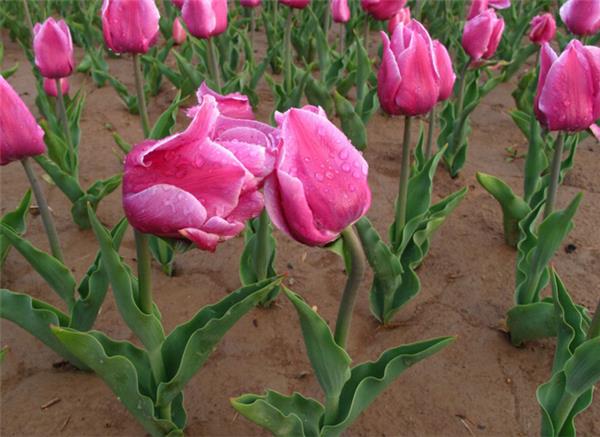
☆5. Fertilizing: Tulips do not have high fertilizer requirements. If growth vigor is weak, some nitrogen fertilizer can be applied. After the root system develops well, apply 2 kg of calcium nitrate per 100 sq m, spread in three applications with an interval of more than one week between each.
☆6. Pests and diseases: The pathogens of tulip pests and diseases can be carried by bulbs or by soil that infects the bulbs. They mostly occur in high-temperature and high-humidity environments. The main diseases include stem rot, soft rot, color breaking, damping-off, and blind buds, while the main pest is aphids. Before planting, carry out thorough soil disinfection, choose virus-free bulbs for cultivation whenever possible, promptly dig out and destroy diseased plants, and during greenhouse growth apply fungicide 1 to 2 times for better results. Good ventilation should be maintained to prevent high temperature and high humidity. When aphids appear, spray with 3% natural pyrethrin at 800 times dilution.
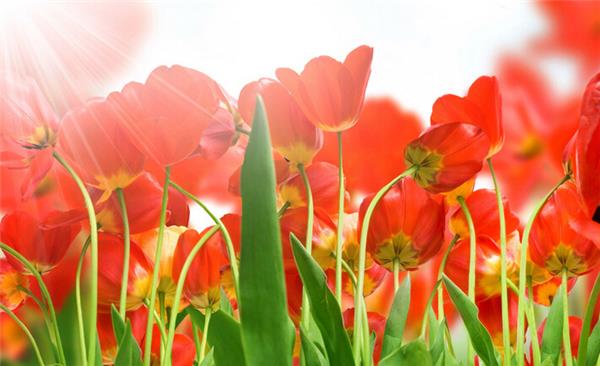
Tulip is a perennial herbaceous plant. Leaves are long elliptically lanceolate or ovate-lanceolate. The flower stem is 6-10 cm tall, with a single flower at the top of the stem, large and upright, forest-like, often black-purple at the base. The perianth is obovate, bright yellow or purplish red, with yellow stripes and spots. Flower colors include white, pink, carmine, purple, brown, yellow, orange, and others, in varying shades, either single-colored or multi-colored. Flower shapes include cup-shaped, ovate, bell-shaped, bowl-shaped, spherical, funnel-shaped, and lily-flowered, among others, with both single and double petals. The flowering period is generally March to May, with early, middle, and late types. There are very many kinds of tulips, so how are tulips classified by color?
Tulips classified by color:
☆1. Tulip (red) Tulipa gesnerianna, Liliaceae Tulipa genus☆
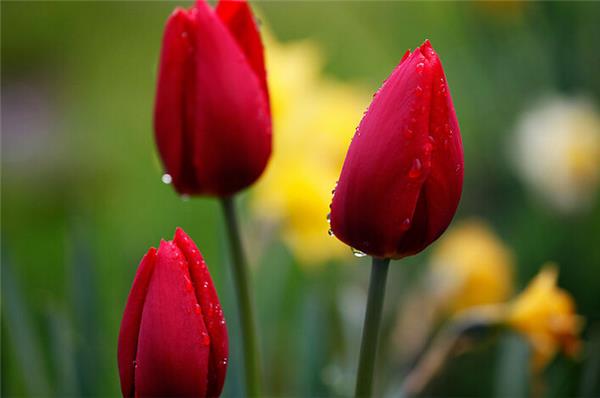
The tulip is the national flower of the Netherlands. From 1634 to 1637, there was a period known in Dutch history as "Tulip Mania." New varieties and rare varieties of tulips were bought and sold at high prices, becoming investment objects that people competed to pursue.
Flower language: confession of love
Flower-giving etiquette: Place several stems of red tulips on square hard backing paper, fix their positions with adhesive tape, carefully wrap them in transparent plastic paper, and decorate the four corners with golden ribbons to add a sense of splendor.
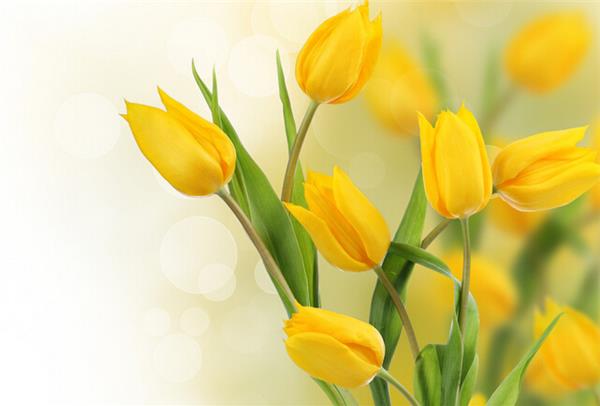
☆2. Tulip (yellow) Tulipa gesnerianna, Liliaceae Tulipa genus☆
In Europe and America, yellow flowers are usually not very popular, and the related flower languages also carry relatively negative meanings. In fact, clear yellow contains the joy of spring; with such eye-catching bright flowers, how could anyone not like them?
Flower language: hopeless love
Flower-giving etiquette: Since tulip stems have a considerable curve beauty, it is appropriate to use slightly larger wrapping paper with a white background and patterns, tie 4 to 5 long stems into a bouquet, and the ribbon must be yellow.
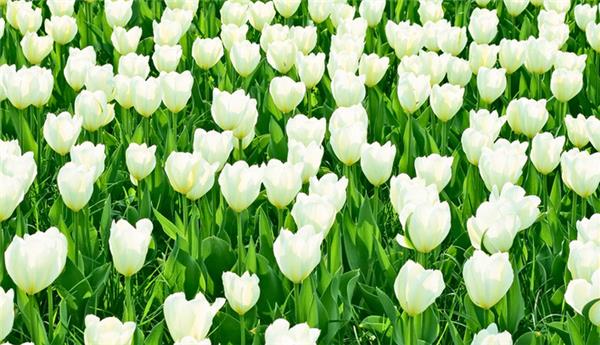
☆3. Tulip (white) Tulipa gesnerianna, Liliaceae Tulipa genus☆
When an Australian ambassador who came to Turkey in the 16th century first saw this flower, he asked the Turk beside him for its name, and the answer was: tulip. In fact, this pronunciation referred to a Turkish turban. That Turk misunderstood the ambassador's meaning, but the flower name came about in this way and has been used ever since.
Flower language: lost love
Flower-giving etiquette: Simply make a bouquet with only a few white tulips; no other embellishments are needed. Wrap the outside with pink gauze, then gently tie it with a few thin red ribbons.
 Tulips are one of people's favorite flowers and a rare and precious floral material. Many people do not hesitate to travel far to garden areas to admire the beauty of tulips. When arranging a home, choosing potted tulips not only lets you often see the flowers you like but also decorates the home, so why not do it? The above is a summary by the editor about how to grow tulips and the classification of tulips. I hope it can help everyone better understand tulips and grow healthy tulips.
☆3. Tulip (white) Tulipa gesnerianna, Liliaceae Tulipa genus☆
When an Australian ambassador who came to Turkey in the 16th century first saw this flower, he asked the Turk beside him for its name, and the answer was: tulip. In fact, this pronunciation referred to a Turkish turban. That Turk misunderstood the ambassador's meaning, but the flower name came about in this way and has been used ever since.
Flower language: lost love
Flower-giving etiquette: Simply make a bouquet with only a few white tulips; no other embellishments are needed. Wrap the outside with pink gauze, then gently tie it with a few thin red ribbons.
Tulips are one of people's favorite flowers and a rare and precious floral material. Many people do not hesitate to travel far to garden areas to admire the beauty of tulips. When arranging a home, choosing potted tulips not only lets you often see the flowers you like but also decorates the home, so why not do it? The above is a summary by the editor about how to grow tulips and the classification of tulips. I hope it can help everyone better understand tulips and grow healthy tulips.