Beautiful succulent plant pictures to enjoy, super healing eye-catching beautiful images
Succulent plants are also called succulents and fleshy plants. In horticulture they are sometimes called succulent flowers, but the name succulent plants is the most commonly used.
Sedum pachyphyllum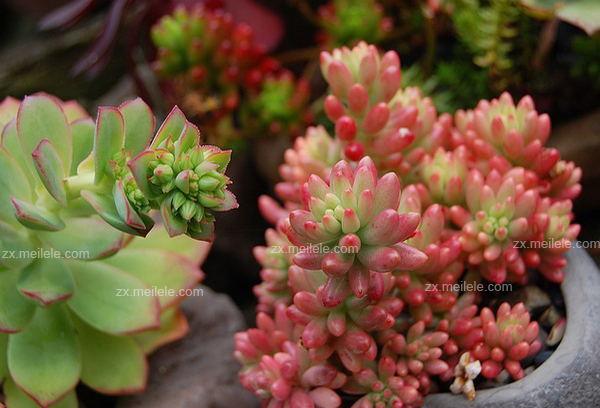
The Sedum pachyphyllum variety is very easily confused with Sedum adolphi, but in fact the Sedum pachyphyllum plant is relatively thicker and easy to propagate. In autumn and winter, the pale green leaves show a gorgeous pink color at the leaf tips and even across the whole leaf, and the color becomes more vivid and beautiful when placed in a dry place with a large temperature difference. The stem of Sedum pachyphyllum is not very thick but can form woody branches, and it gradually forms clusters over time. The leaves are densely arranged at the top of the branches. The leaves are thick and fleshy, and the leaf color ranges from emerald green to pink; new leaves are lighter in color and old leaves are darker. On the oblong leaves, close observation near the branch will reveal that the leaf and the leaf tip form a prismatic shape with faint ridges; a shallow ridge can be seen at the tip of new leaves, and old leaves gradually become rounder.
Haworthia cooperi 'Tears of an Angel'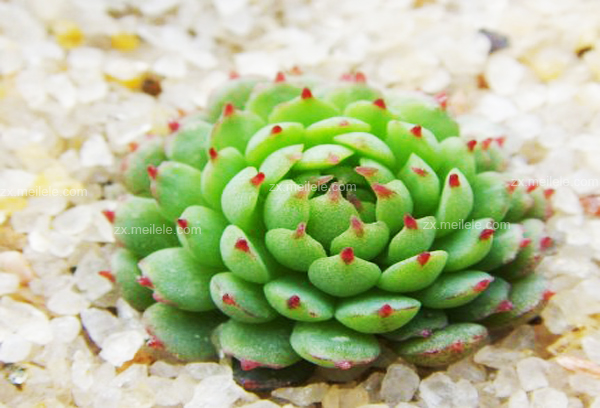
Tears of an Angel, named for the white wart-like protrusions on the leaf surface that look like flowing tears, belongs to the Liliaceae family, Haworthia genus, and is a large hard-leaved subgenus succulent plant. This species is a horticultural cultivar bred by the American horticulturist S.A. Hammer, and its most original parent is the plant native to South Africa known as Haworthia cooperi. The plant has no stem, and a mature plant has 7 to 8 fleshy leaves. The leaves are thick and triangular-conical, arranged spirally in a rosette, dark green, with large raised white porcelain-like wart-like protrusions on the leaf surface. The protrusions on the back of the leaf are more numerous than on the leaf surface, in shapes such as dots and longitudinal stripes. On some plants, the protrusions on the old leaves are translucent green.
Sedum multiceps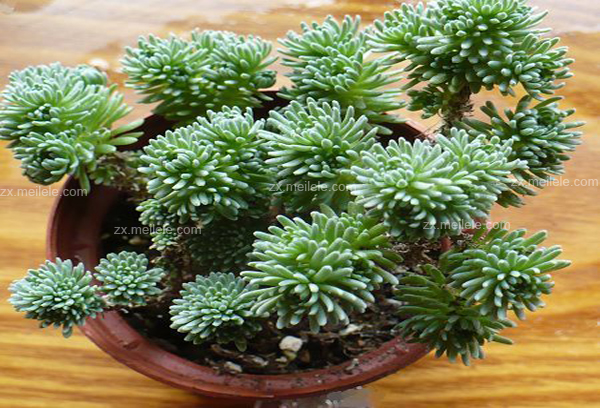
Sedum multiceps, of the Crassulaceae family, with fleshy needle-like leaves, an evergreen herbaceous plant, native to Africa, Algeria. The Sedum multiceps plant is short, with very short branches, and tufts of brown-red hairs grow close to the fleshy stem. The needle-like leaves are about 1 cm long, clustered in groups at the tips of the branches, lush and verdant. The flowers are yellow. Sedum multiceps likes warmth and dryness, can also tolerate half shade, and is afraid of waterlogging.
Kleinia mandraliscae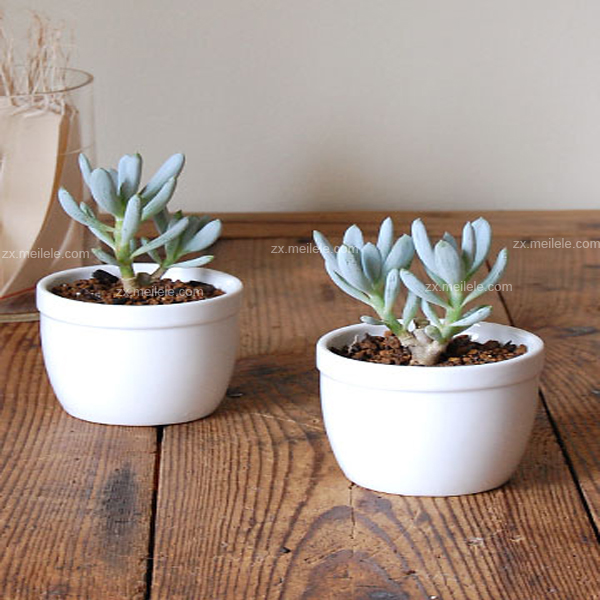
A succulent plant of the Asteraceae family, Senecio genus, native to the Cape of South Africa, with particularly sky-blue leaves that turn a brilliant purple when exposed to strong light. Compared with other succulent varieties, it is more heat-tolerant. It should be planted in a well-aerated growing medium; ordinary soil easily causes root rot. In spring and autumn, water thoroughly only after the soil has completely dried. Summer is the peak growing season, so normal watering is fine. Stop watering in winter to prevent frost damage.
Sinningia leucotricha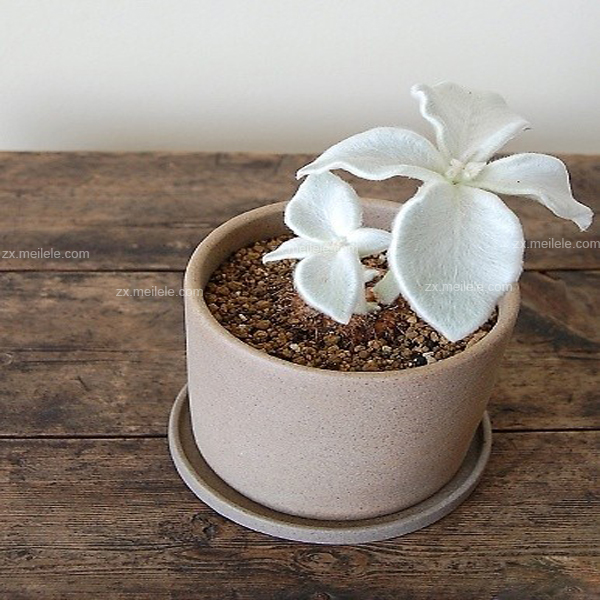
Sinningia leucotricha, also known as Queen of the Cliff. The "Queen of the Cliff" has unusual leaf color; the white fuzz on it is as smooth as animal fur, and also looks like moonlight scattered on the leaf surface, very beautiful; the orange-red flowers are bright and eye-catching; the tuber is simple and elegant. It is a succulent plant excellent in both flowers and leaves. It is suitable for planting in an antique purple clay pot and placing on windowsills, balconies, and indoor plant stands, desks, and other places, naturally fresh with a unique effect.
Other related information >>
| The effects of pothos flowers | How to grow cactus | Serissa bonsai | How to plant bowl lotus | The flower language of lily of the valley |
| Marigold planting | How to grow Christmas cactus | Peace lily | Office feng shui plants | How to care for carnations |