How to Grow Ginger Lily? A Detailed Guide to Ginger Lily Cultivation Methods
Ginger lily, also known as wild ginger lily, is a freshwater herbaceous plant of the genus Hedychium in the family Zingiberaceae. I believe many people are unfamiliar with this plant. Let's take a look at the cultivation methods for ginger lily!
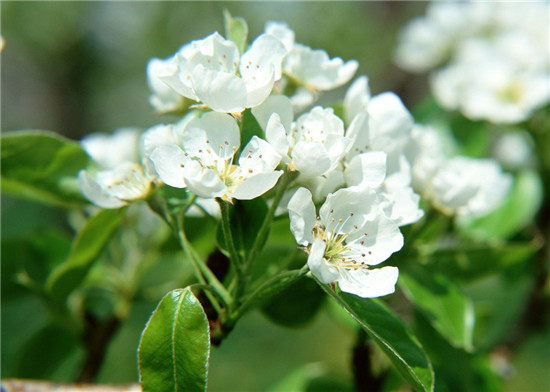
Ginger lily is a freshwater herbaceous plant with a relatively tall stature, generally 1-2 m, and fresh, elegant flowers. It is known as a natural air freshener. Its color is smooth and full, and it can be grown in pots indoors for decoration, while also being planted in courtyards for appreciation. It is a very popular ornamental plant.
Ginger lily originates from tropical regions of Asia, but it is now widely cultivated around the world. It also has other names such as butterfly ginger, wild ginger lily, and white butterfly flower. When its flowers bloom, they are relatively fresh and elegant, and the flower's scent is sweet and fragrant. It can be placed indoors to purify the air.
The leaf shape of golden ginger lily closely resembles that of culinary ginger, and the plant height is about 1.5 m. The underground rhizome is well developed, growing horizontally in a creeping manner, thick and sturdy, pale yellow like culinary ginger. The leaves are green, entire, smooth, long elliptic-lanceolate, 40 cm long and 5-6 cm wide, with a caudate-acuminate apex and a narrowed base; the petiole is short, and the leaf sheath is green.
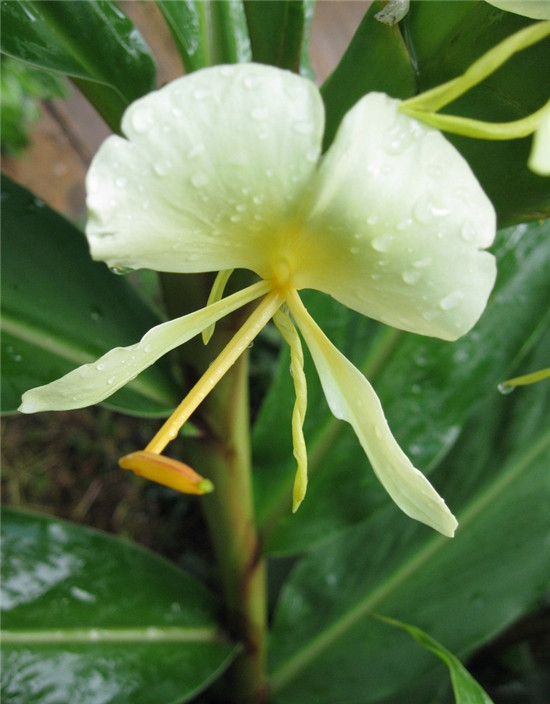
The initial flowering period is in late May, the full flowering period is from June to October, and the flower quantity drops sharply in November. The spike is terminal, with green bracts, ovate or obovate, with a rounded or acuminate apex, and generally 3-5 small flowers in each bract. The small flowers are densely arranged, with 3 petals, the edges pale yellow and the center golden yellow, and the style elongated and exposed; they gradually open from the lower part upward, and each plant can continuously produce as many as 80 small flowers, with the flowering period on the plant lasting more than 1 month.
Its flowers are golden yellow, with a faint, distant fragrance, and its leaves are emerald green, making it truly a new type of fresh cut flower. The cut flower harvest period lasts more than 5 months. In the first year of planting, the yield per mu can reach 12,000 stems, and in the following year it can reach as high as 20,000 stems, making it a cut flower variety with great development prospects. Golden ginger lily has a vase life of 5-7 days, with bright colors, and can give off a fresh and elegant fragrance, making people feel especially relaxed and refreshed.
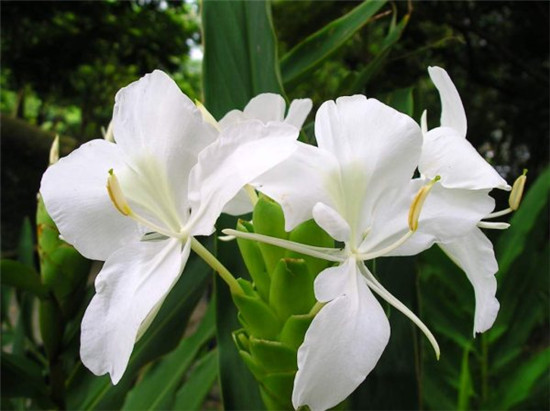
Its flowers are edible and are an emerging green health food vegetable. In addition to being used as cut flowers, golden ginger lily can also be used in gardens, such as planted in masses, or in rows or clumps along roadsides, courtyards, streamsides, and among rockeries. During the flowering period, it resembles a group of beautiful butterflies dancing gracefully and competing in fragrance and beauty, while when not in flower it is lush and full of greenery.
Ginger Lily Cultivation Methods
Growth habits: Ginger lily by nature relatively prefers high-temperature and high-humidity environments, and is not cold-tolerant.
Propagation methods: Its propagation methods are divided into sexual reproduction and asexual reproduction, and division propagation can also be chosen. For ginger lily propagation, as long as the region allows it to overwinter safely outdoors, propagation can be carried out in all four seasons. If division propagation is used, planting can generally be carried out in February or March of the same year, and it can bloom in the same year.
Temperature: Ginger lily likes to survive in high-temperature and high-humidity environments. Generally, only when the winter temperature is maintained above 10°C can it survive well.
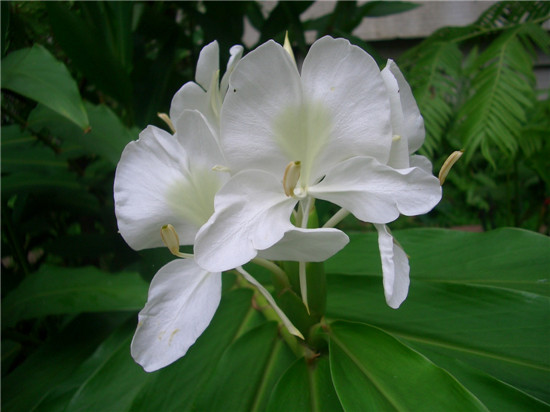
Soil: A fertile sandy soil with good looseness and drainage can be chosen.
Water: Ginger lily is not drought-tolerant, so in summer sufficient humidity in the air must be maintained, and the soil must be kept moist.
Sunlight: Ginger lily relatively prefers sunlight. During its growth period, sufficient light duration can be maintained, so that ginger lily can grow better.
Fertilization: When planting ginger lily, sufficient base fertilizer is needed. Generally, some organic fertilizer, biological bacterial fertilizer, phosphate fertilizer, and other fertilizers can be chosen as base fertilizer. When it enters the growth period, topdressing can be carried out appropriately, generally once every 10 days until the flower buds are about to bloom. At the same time, foliar fertilizer can be sprayed on cloudy days or in the evening.
The main diseases and insect pests of ginger lily include anthracnose, which harms stems and leaves. In the early stage of the disease, spray 50% carbendazim wettable powder at 500 times dilution, once every ten days.
The above is all the content I have summarized for everyone on ginger lily cultivation methods. I hope this article can help everyone. Please also continue to follow us.