What plant is Coreopsis? A complete guide to Coreopsis
Coreopsis, also known as tickseed, is a genus in the Asteraceae family, consisting of annual and perennial herbaceous plants. Let us take a look at this plant together!
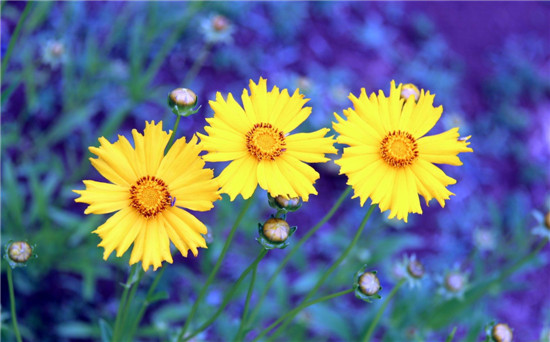
Coreopsis is a perennial herbaceous plant with persistent roots. The leaves are mostly opposite, rarely alternate, entire, shallowly lobed or deeply cut. The flowers are solitary or in loose panicles; the involucre has two rows of 3 bracts each, fused at the base. The ray florets are in 1 row, broadly ligulate, yellow, brown or pink. The disc florets are yellow to brown.
Main species: Coreopsis, with a plant height of 30cm, the whole plant sparsely covered with long hairs; leaves entire or shallowly lobed; stem leaves oblong-spatulate or lanceolate; stem leaves with 3-5 lobes; flower heads 6-7cm in diameter, with long pedicels, flowers golden yellow.
Large-flowered Coreopsis is slightly hairy throughout, with branches; basal leaves lanceolate, entire; upper leaves with 3-5 deep lobes. Flower heads 4-6.3cm, the outer and inner rows of involucral bracts nearly equal in length. 8 ray florets, yellow, 1-2.5cm long, with 3 lobes at the tip; disc florets also yellow.
Large Coreopsis is hairless or sparsely covered with long hairs; leaves mostly clustered at the base or a few opposite, with very few leaves on the stem; flower heads about 5-6cm in diameter; the outer row of involucral bracts usually shorter than the inner row; 8 yellow ray florets with 2-3 lobes at the tip. Disc florets yellow.
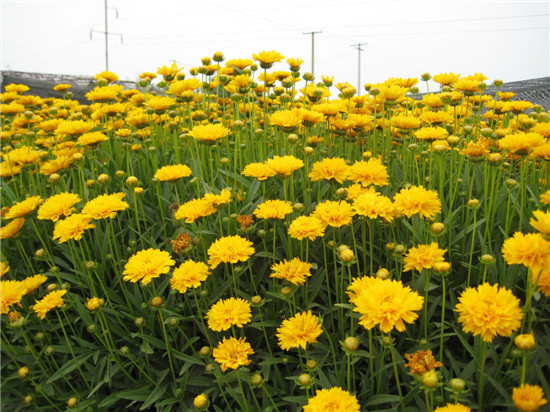
Whorled Coreopsis is hairless, sparsely branched; leaves whorled, sessile, palmately 3-parted, each lobe further finely divided; disc florets yellow to yellow-green.
Origin and distribution: native to the southern United States.
Growth habits: Coreopsis species are cold-tolerant and drought-tolerant, with no strict requirements for soil; they love light but tolerate partial shade, are highly adaptable, and have strong resistance to sulfur dioxide.
Disease control in Coreopsis
The main diseases are phytophthora blight and brown spot. Control methods: first, remove diseased leaves and pull out severely diseased plants, carry them out of the field and destroy them; second, chemical control, spraying with copper hydroxide, applying once every 5-7d, for 3 consecutive sprays. Use a 1000-fold dilution of 75% phoxim emulsifiable concentrate, remove the nozzle from the sprayer, and spray the solution at the stem base in the evening to control cutworms. Use insecticides such as kuai shi shou, dichlorvos and dicofol to control other pests, with good results.
Garden uses of Coreopsis
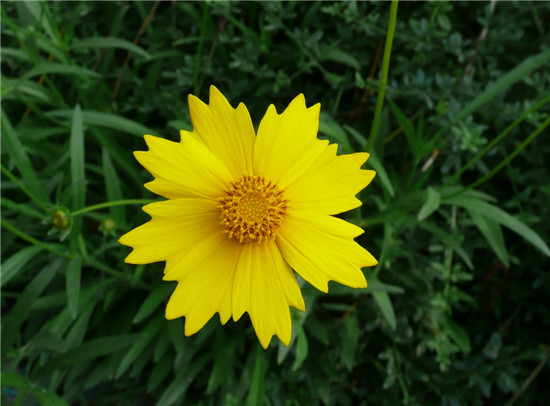
Native to the eastern United States, cold-tolerant, heat-tolerant, growing with minimal care; in Jiangnan it often runs wild as ground cover. Double-flowered varieties require division propagation. When in bloom it forms a sheet of golden yellow, a splendid sight. Flower heads golden yellow. Blooming in summer and autumn. There are double-flowered large-flowered cultivars.
The branches and leaves are dense, especially when young leaves sprout in winter, forming sheets of fresh green. Between spring and summer, the flowers are large and brightly colored, often blooming continuously. It can also self-propagate, making it excellent ground cover for open woodland. It can be enjoyed for both foliage and flowers. It works extremely well as a covering material in rooftop greening and can also be used as a flower border material.
The flower language of Coreopsis: competitive spirit, desire to advance
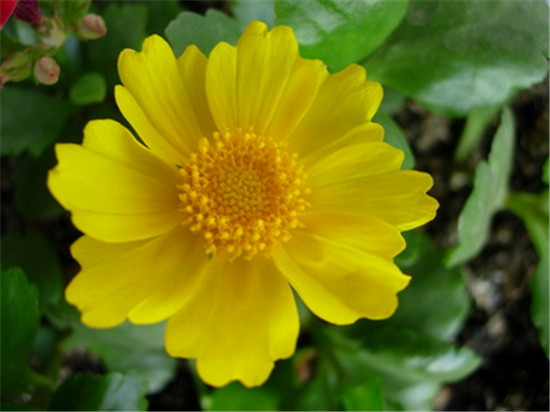
The golden rooster crowing at dawn and rising at the sound of the rooster express auspiciousness and praise for diligence.
Coreopsis is full of spirit, actively and bravely displaying its beauty, and is not particular about its environment. This is not only a reflection of youth, but also subtly matches the idea that young people should strive for self-improvement and improve their ability to withstand setbacks. Therefore, it is very suitable for encouraging young people to advance.
The above is the full content of the introduction to Coreopsis that I have summarized for everyone. I hope this article can help you. Please also continue to follow us.