A Detailed Guide to Planting and Caring for Mahonia Leaves
Mahonia is a plant in the genus Mahonia of the family Berberidaceae, and can be grown as a potted plant, in gardens, or used medicinally. Next, let us take a look at how to grow Mahonia!
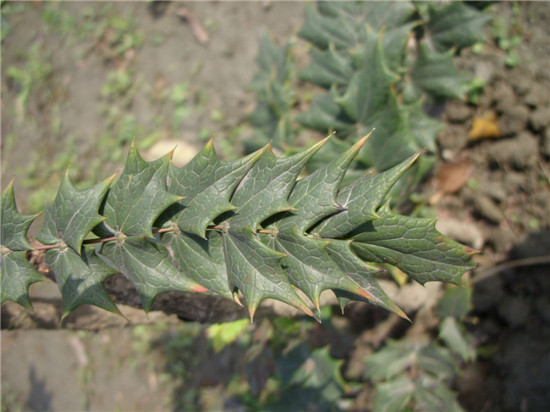
Mahonia can be grown as a potted plant, in gardens, and used medicinally. Aliases: narrow-leaved mahonia, fine-leaved mahonia, yellow heavenly bamboo, soil phellodendron, cat's thorn, soil coptis, eight-horn thorn, thorny phellodendron, cat's head (a common name in southern Anhui, cat-thorn leaf), thorny scutellaria. Mahonia wood, mahonia, mountain scutellaria, west wind bamboo, thorny coptis. It grows on hillside forest floors and in shrub thickets or in relatively shady, damp places at an altitude of 350-2000 m; it is a shade plant and is propagated by seed. It can be used as medicine to clear heat and detoxify, reduce swelling, stop diarrhea, and treat dysentery, jaundice hepatitis, burns, scalds, and sores and toxins.
The leaves of Mahonia are uniquely shaped, elegant and beautiful. Potted plants can be displayed indoors, and because of their good shade tolerance, they can be grown indoors under diffuse light for a long time. In courtyards, they can also be planted beside rockeries or in stone crevices, though it is best to have shade from a large tree. Mahonia has straight, upright branches and stems, unusual leaf shapes, and clusters of yellow flowers. It can be used as an accent on rockeries or in rock crevices and beside streams. It can also be planted at the north entrance, under windows, and in shaded woodland plantings. Potted plants can be used for venue arrangements and indoor decoration. The roots and stems can be used as medicine.
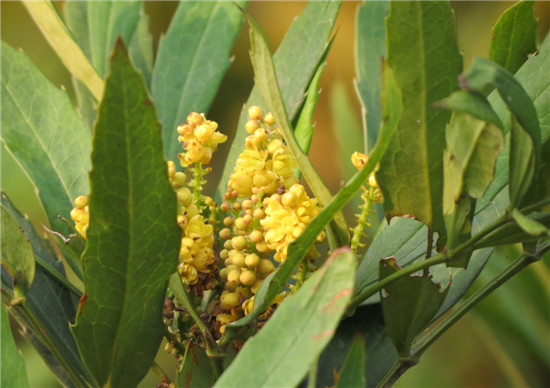
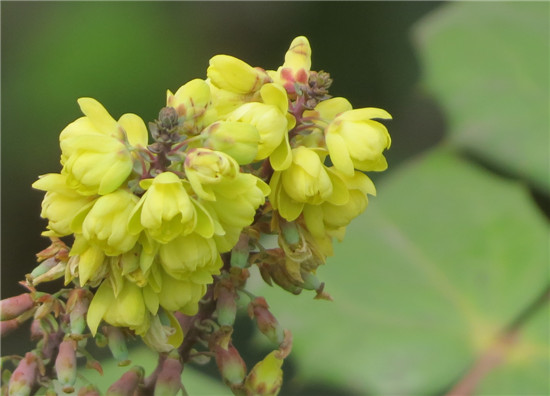
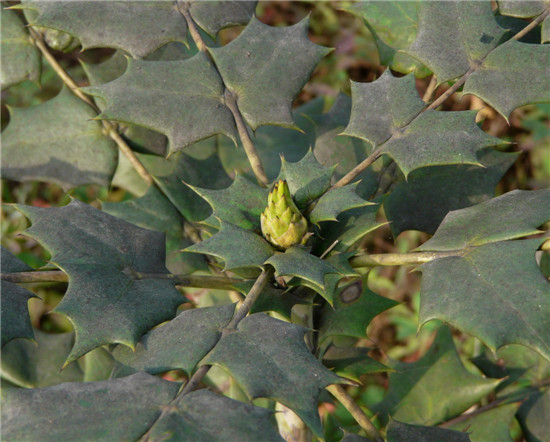
Mahonia is an evergreen shrub, 1-2 m tall. The stems are erect, the bark is gray, and it is much branched. Leaves are alternate; odd-pinnately compound; the base of the petiole is swollen; leaves are leathery, with 5-13 leaflets, narrowly lanceolate to lanceolate, 6-12 cm long and 0.7-1.5 cm wide, the apex long-pointed and with sharp spines, the base wedge-shaped, the margin with 6-13 spiny serrations on each side, the upper surface dark green and glossy with inconspicuous veins, the lower surface yellow-green; veins arise in 3 from the base. Racemes emerge from the axils of the bud scales at the top of the branches, 3-6 cm long, the pedicel base with an involucre, the bracts ovate-triangular; sepals 9, petal-like; petals 6, yellow, oblong, entire; stamens 6, filaments linear, anthers opening by valves; ovary ovate, without style, stigma head-shaped. Berries ovate; ripe fruit ovate, blue-black when ripe, covered with a white bloom. Flowering period July-August, fruiting period August-10.
Propagation Methods of Mahonia
(1) Seed propagation: The fruit ripens in late November. Harvest the fruit in December, but do not thresh it first; pile it up for a period of after-ripening, then rub off the fruit skin, clean the seeds thoroughly, dry them in the shade, and store them mixed with moist sand for the winter. After the seeds are collected, they need to be stored in moist sand, placed in a certain container, or treated by digging a pit. Store until March-April of the following year, then begin sowing. On a prepared seedbed, open shallow furrows 25 cm apart and 7 cm deep, sow the seeds evenly in the furrows, and cover lightly with soil. In some places, hole sowing is used. The hole spacing is about 20 cm. Sow about 4 seeds per hole and cover with about 6 cm of soil. The sowing rate is 20 kg per 0.067 hm2. Hole sowing saves seeds. After sowing, keep the soil moist, and seedlings can emerge in about 2 weeks.
(2) Cutting propagation: Outdoor cuttings should be taken in late March. Use healthy stems that have not yet dropped their leaves in winter as cuttings, cut them into 15 cm sections, insert them into loose sandy soil to a depth of 10 cm, and set up reed curtains for shade. In the north, softwood cuttings should be taken in June-July. The cuttings are 10-12 cm long, retaining 1 compound leaf at the tip, and the leaflets at the tip of the compound leaf are cut off. Keep only the 2 basal leaflets and cut off 1/2 of them, insert into plain sandy soil in a large flower pot to a depth of 5 cm. Keep shaded for care; new roots can grow after the Beginning of Autumn, and before winter, divide the seedlings and pot them, then move them into a cold room to overwinter.
(3) Division propagation: The stems of Mahonia grow upright in clumps, with weak branching ability. When propagating by cuttings, stems must be cut to take material, temporarily making the mother plant unable to be enjoyed as an ornamental. Therefore, it is often combined with repotting and changing soil: separate the entire clump of plants, pot and plant them, and after they survive, shorten the original stems to encourage the root system to sprout new suckers and form new clumps.
(4) Transplanting: Seedlings need to be cultivated in the seedbed for 2-3 years. When the seedlings are 30-40 cm tall, they can be transplanted. Generally, transplanting is done in March-April each year; in arid and semi-arid areas, transplanting in September-October in autumn is better. Before planting, dig out the seedlings and cut off some leaves to reduce the evaporation area, prepare the land well, and make beds 130 cm wide; the length of the beds is specifically determined according to the number of seedlings and the terrain. Dig holes at 30 cm between rows and plants and plant one plant per hole, fill with soil and firm it to ground level, water to settle the roots, and after the water seeps in, cover with a layer of soil to conserve moisture.
The Effects and Functions of Mahonia
1. Antibacterial effect: A 10% Mahonia decoction has an inhibitory effect on Staphylococcus aureus, alpha-hemolytic streptococcus, Salmonella typhi, Shigella dysenteriae, and Staphylococcus.
2. Blood pressure-lowering effect: Both Mahonia decoction and berberine have the effect of lowering blood pressure and dilating the coronary arteries.
3. Anticancer effect: Isotetrandrine has an inhibitory effect on Ehrlich ascites carcinoma; berberine can enhance the phagocytic ability of leukocytes and the reticuloendothelial system, and also has an inhibitory effect on cancer cells in test tubes.
[Traditional applications] Nature, flavor, and meridian entry: bitter, cold; enters the liver, stomach, and large intestine meridians. Functions: reduce fire and purge heat, resolve phlegm and stop coughing, nourish yin and treat steaming, clear dryness and drain dampness. Indications: pulmonary tuberculosis with hemoptysis, bone-steaming tidal fever, dizziness and tinnitus, soreness and weakness of the waist and legs, vexation and red eyes, febrile disease with fever, etc.
The above is the complete content I have summarized for everyone on planting Mahonia leaves and growing Mahonia leaves. I hope this article can help everyone. Please also continue to follow us.