What plant is the firecracker flower? A comprehensive guide to the firecracker flower
The firecracker flower is a plant that can accent indoor spaces and can be placed on flower arbors, open-air restaurant areas, and at courtyard gates. Let's learn about this plant together!
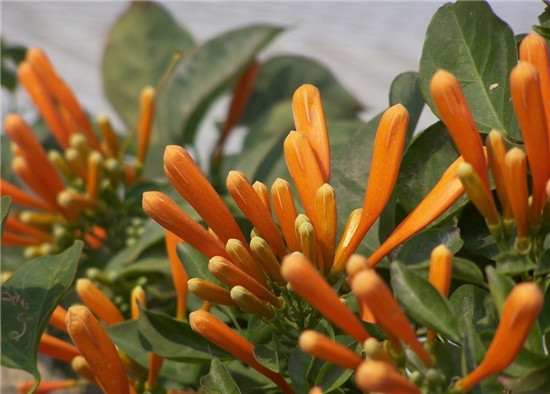
The firecracker flower (Pyrostegia venusta) is mostly planted around courtyard buildings and climbs over shade arbors. In early summer, its red-orange flowers hang in dense clusters, shaped like firecrackers, which is why it is called the firecracker flower. It loves light and prefers a warm, high-humidity climate and acidic soil. It naturally favors sunny environments and fertile, moist, acidic soil, and grows quickly. In South China, it can remain evergreen and overwinter outdoors. It can be used to cover the walls of low-rise buildings or as vertical greening material for trellises, flower corridors, balconies, and more.
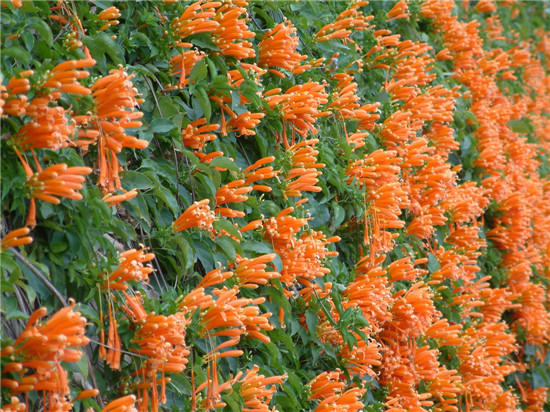
The firecracker flower gets its name because its flowers resemble firecrackers. Whenever spring arrives and it blooms, golden-yellow little flowers dot the green wall like strings of firecrackers, and also like a spark bursting into a whole patch, adding a great deal of festive color to gardens and surroundings.
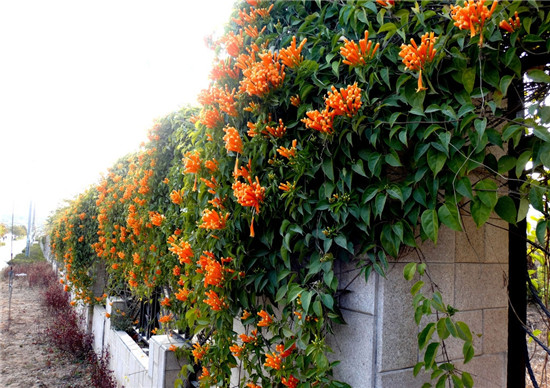
The firecracker flower is native to Central America and is commonly cultivated in warm regions around the world. It is an evergreen woody large vine with linear, 3-lobed tendrils and can climb up to 7-8 m high. It has 2-3 leaflets, ovate to ovate-oblong, 4-10 cm long, with acuminate tips and a broad cuneate to rounded base; the petiole is pubescent. The flowers are orange-red, about 6 cm long. The calyx is bell-shaped with glandular dots. The corolla is thick and reflexed, with obvious white hairs, and many flowers are closely arranged into drooping panicles. It naturally favors sunny environments and fertile, moist, acidic soil, and grows quickly. In South China, it can remain evergreen and overwinter outdoors.
The firecracker flower is also known as firecracker flower, yellow eel vine, Buddleja officinalis, and others, and is named for its firecracker-like flowers; it is a vine with 3-forked thread-like tendrils. Firecracker flower, alias: yellow eel vine, Bignoniaceae, Pyrostegia, a vine with 3-forked thread-like tendrils. Leaves opposite; stamens inserted at the middle of the corolla tube, filaments thread-like, anthers divergent. Ovary cylindrical, densely covered with fine soft hairs, style slender, stigma lingulate and flat, both style and filaments extending beyond the corolla tube. Capsule valves leathery, boat-shaped, with seeds in many rows inside, seeds winged, membranous. The flowering period is long. It is native to Brazil in South America and has been widely cultivated in tropical Asia as a garden ornamental trellis plant. It is mostly planted around courtyard buildings and climbs over shade arbors. In early summer, its red-orange flowers hang in dense clusters, shaped like firecrackers, which is why it is called the firecracker flower.
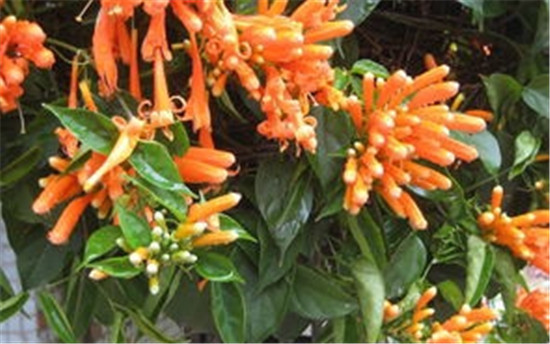
Firecracker flower, a vine with 3-forked thread-like tendrils. Leaves opposite; leaflets 2-3, ovate, apex acuminate, base nearly rounded, 4-10 cm long, 3-5 cm wide, hairless on both surfaces, with very tiny scattered glandular pits beneath, margin entire; leaf axis about 2 cm long; petiolules 5-20 mm long.
Propagation methods for the firecracker flower
1. Layering propagation: The firecracker flower can be propagated by layering. Layering mainly uses trailing vines that touch the ground, wounding the bark at the leaf axils and covering it with soil. It can be done in spring, autumn, or summer, with summer being preferable. Roots can form after 20-30 days, and after one and a half months it can be cut off as a new plant, which may bloom the same year. It is often grown as a potted plant. Alternatively, layer directly into a container without moving it to a nursery bed for seedling cultivation.
2. Cuttage propagation: For firecracker flower cuttings, choose vigorous, pest-free branches, preferably about 10 cm long. Each cutting needs 3-4 nodes and 2 buds, and should be cut 0.5 cm below a node to encourage rooting. After inserting, press the base of the cutting gently with your fingers so that the base fits closely with the medium, then water thoroughly with a fine watering can. Afterward, spray the leaves once every 1-2 days to keep them moist. After 3 weeks, if the stems and leaves have not shriveled and remain tender green, it means the cut has healed well and roots have formed. After about another 10 days, it can be transplanted into a pot. Newly potted seedlings need thorough watering and should be kept in a semi-shaded place for care.
The above is the full content of my summary and introduction to the firecracker flower. I hope this article can help everyone. Please also continue to follow us.