A Detailed Guide to the Benefits and Cultivation of Elderflowers
Elderflower is a small white flower that grows in clusters. Besides its ornamental value, it also has medicinal value. Let's take a look at the benefits and cultivation of elderflower.
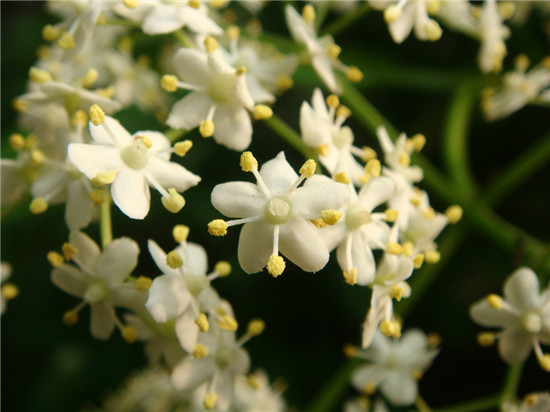
Elderberry (Sambucus) is a deciduous shrub or small tree, 5-6 m tall; the old branches are pale reddish-brown, with obvious long oval lenticels, and the pith is pale brown.
The pinnately compound leaves have 2-3 pairs of leaflets, sometimes only 1 pair or as many as 5 pairs. The lateral leaflets are ovate, narrowly elliptic to obovate-oblong-lanceolate, 5-15 cm long and 1.2-7 cm wide, with tips acute, acuminate to caudate, margins with irregular serrations, sometimes with 1 to several glandular teeth at the base or below the middle, base cuneate or rounded, sometimes cordate, asymmetrical on both sides; the lowest pair of leaflets sometimes has a petiole 0.5 cm long; the terminal leaflet is ovate or obovate, apex acuminate or caudate, base cuneate, with a petiole about 2 cm long. At first the upper surface and midrib of the leaflets are sparsely pubescent, later smooth and hairless; the leaves give off an unpleasant odor when rubbed; stipules are narrowly band-shaped, or reduced to bluish protrusions.
The difference between Sambucus sieboldiana var. miquelii and elderberry is: the odd-pinnate compound leaves have 2-3 pairs of leaflets, the base of the main vein and lateral veins of the leaflets is covered with obvious long stiff hairs, and the petiolules, leaf rachis and young branches are covered with yellow long stiff hairs; the inflorescence axis, besides being pubescent, is also mixed with long stiff hairs. The difference between Sambucus nigra and elderberry is: the branches have obviously raised round lenticels; the pith is well developed and white. Odd-pinnate compound leaves have 1-3 pairs, usually 2 pairs. The fruit is shiny black.
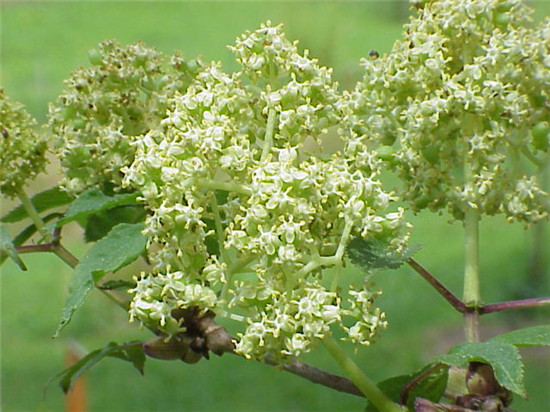
Cultivation Techniques for Elderberry
Elderberry seedlings can be transplanted in spring and autumn each year, cutting away weak, poorly developed and dried tender shoots. When the seedlings are 13-17 cm tall, carry out the first intertillage and weeding, and apply topdressing; carry out the second in June. The fertilizer is mainly human and livestock manure water. Two to three years after transplanting, carry out intertillage and weeding once each in spring and summer every year. During the growing period, fertilizer can be applied 2-3 times, and excessively vigorous shoots should be appropriately shortened to increase branching. Although elderberry likes a semi-shaded environment, if it grows under insufficient light for a long time, the branches become weak and slender, the flowers are sparse, and the tree shape is poor.
Garden application: elderberry has lush branches and leaves, is covered with white flowers in spring, and bears abundant red fruits in summer and autumn. It is a good ornamental shrub, suitable for planting on lawns, at forest edges or by water; according to measurements, it has strong resistance to hydrogen fluoride, and also relatively strong resistance to chlorine, hydrogen chloride, sulfur dioxide, aldehydes, ketones, alcohols, ethers, benzene and benzopyrine (a carcinogenic substance), so it can be used for shelterbelts in cities and factories.
Elderberry pests and diseases: common canker, leaf spot and powdery mildew are harmful, and can be sprayed with 65% zineb wettable powder at 1000 times dilution. Pests include clearwing moths, noctuid moths and scale insects, which can be killed by spraying with 50% fenitrothion emulsifiable concentrate at 1000 times dilution. Elderberry application: elderberry blooms with white flowers in early summer and bears red fruits in early autumn. It is suitable for planting by water, at forest edges and along lawn edges, and can be grown in pots or arranged in flower borders for viewing.
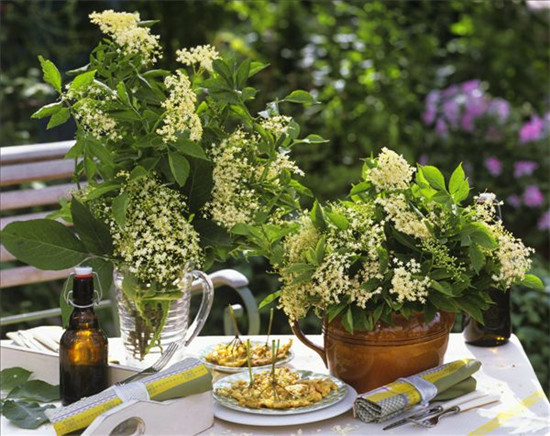
What Benefits Does Elderflower Have
Elderflower is a small yellow flower harvested from the flowers of plants in the honeysuckle family, produced in various places north and south, with an elegant sweet muscat grape fragrance. It is the flower grown on the tall shady street trees common in Europe. Its benefits and range of uses are treasures to Europeans, and it is even a childhood memory for many Europeans. The part of elderberry that can be made into herbal tea is the yellow-white flowers that bloom in June and July each year.
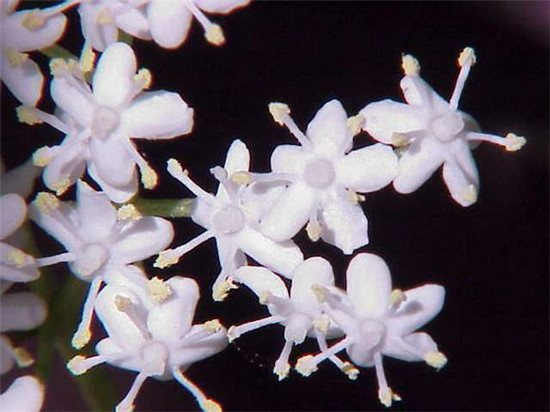
Elderflower has a common peduncle, and the inflorescence branches spread mostly at right angles. The flowers are small and dense, the calyx tube is cup-shaped, about 1 mm long, the calyx teeth are triangular-lanceolate, slightly shorter than the calyx tube. The flower buds are pinkish, and after opening they are white or pale yellow. The corolla is rotate, with 5 lobes, about 2 mm long. The stamens are equal in length to the corolla lobes, the anthers are yellow, the ovary has 3 chambers, the style is short, and the stigma is 3-lobed. The flowering period is April-May.
Since ancient times, elderflower has had the reputation of a "panacea." The ancient Egyptians believed it could ward off evil and misfortune and prevent illness and evil spirits from haunting people. For centuries, the Romani people have used elderberry to treat wind-cold, influenza and bronchial discomfort. Even today, Europeans still add brown sugar to elderflower tea to make a traditional cordial, a cold-prevention remedy much loved by children.
Elderflower added to compound herbal tea can be drunk, and the strong tea infusion used as a mouthwash can prevent inflammation of the oral cavity and gums and bad breath. A strong tea infusion or extract added to external medicinal cloths can exert an anti-inflammatory effect. To prevent allergies and hay fever, blend elderflower, peppermint and thyme at 3:2:1 and drink warm, which can prevent and relieve discomfort in the nose and respiratory system. The fragrant, delicious elderflower tea can have one or two fresh mint leaves added; the fresh sensation can lift one's spirits.
The above is all the content I have summarized for everyone on the benefits and cultivation of elderflower. I hope this article can help everyone. Please also continue to follow us.
It can prevent and relieve discomfort in the nose and respiratory system. The fragrant, delicious elderflower tea can have one or two fresh mint leaves added; the fresh sensation can lift one's spirits.The above is all the content I have summarized for everyone on the benefits and cultivation of elderflower. I hope this article can help everyone. Please also continue to follow us.