A Detailed Guide to the Growth Habits and Propagation Methods of Passiflora
Passiflora belongs to the family Passifloraceae and originated in South America. It can be used as an ornamental garden plant. Next, let us take a look at the habits and propagation of Passiflora.
Characteristics of Passiflora
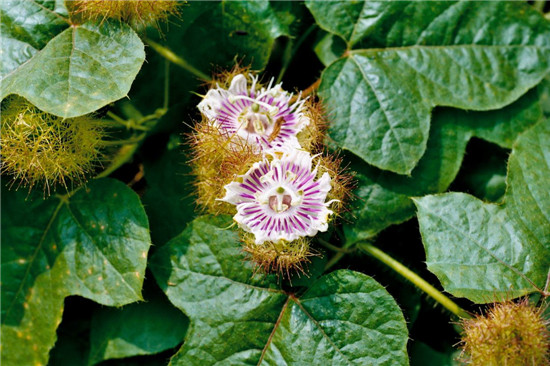
Herbaceous vine; stem cylindrical and slightly angular, hairless, slightly covered with white powder; leaves papery, 5-7 cm long, 6-8 cm wide, base heart-shaped, palmately 5-parted deeply, the middle lobe ovate-oblong, the lateral lobes slightly smaller, hairless, entire; petiole 2-3 cm long, with 2-4 (-6) small glands in the middle; stipules relatively large, kidney-shaped, stem-clasping, up to 1.2 cm long, margin wavy; cyme reduced to only 1 flower, opposite to the tendril; flower large, pale green, diameter large, 6-8 (-10) cm; pedicel 3-4 cm long; bracts broadly ovate, 3 cm long, entire; sepals 5, 3-4.5 cm long, pale green outside, greenish white inside, with 1 horn-like appendage at the outer apex.
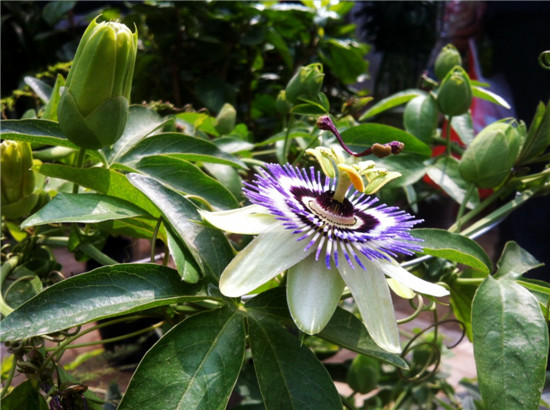
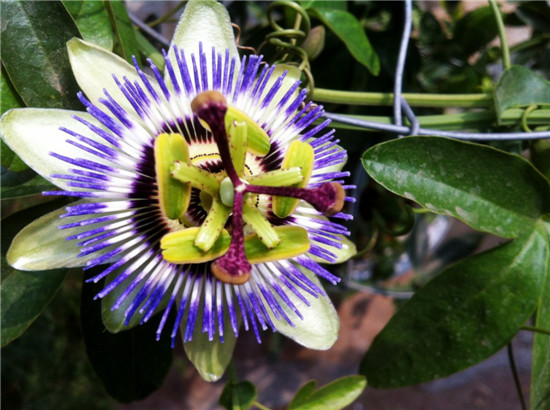
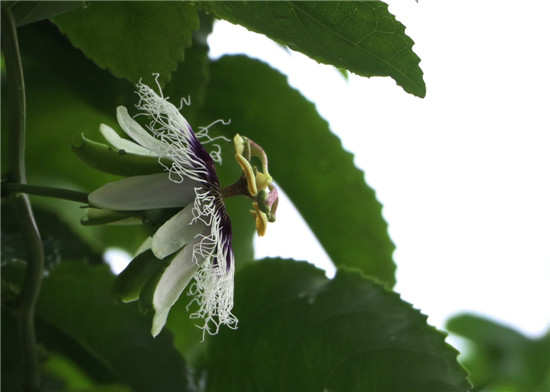
Petals 5, pale green, nearly as long as the sepals; outer corona in 3 series, filamentous, the outer and middle series up to 1-1.5 cm long, sky blue at the apex, white in the middle, purplish red below, the inner series filamentous, 1-2 mm long, with 1 purplish red head-like body at the apex, pale green below; inner corona fringed, lobes purplish red, with 1 dense glandular ring below; disk present, about 1-2 mm high; androgynophore 8-10 mm long; stamens 5, filaments free, about 1 cm long, flattened; anthers oblong, about 1.3 cm long; ovary ovoid-globose; styles 3, free, purplish red, about 1.6 cm long; stigma kidney-shaped. Berry ovoid-globose to nearly globose, about 6 cm long, orange-yellow or yellow when ripe; seeds numerous, obcordate, about 5 mm long. Flowering period May-July.
Growth Habits of Passiflora
Originating in South America, it is a perennial evergreen herbaceous or semi-woody climbing vine. Its homeland is the Mexican plateau region at an altitude of 1500 m, where the climate is cool and mild, with a low-temperature period for dormancy; it is neither cold-tolerant nor heat-tolerant. Passiflora is also known as egg fruit or passion fruit, and is also elegantly called the "fruit of passion." The fruit is sweet and sour, delicious, rich in flavor, and pleasantly aromatic.
The Flower Language of Passiflora
Although Passiflora originated in South America, it can also be grown in a greenhouse as long as one takes some extra time, and it will produce yellow and very delicious fruit. People often cultivate it because they want to eat this fruit. The fruit of Passiflora is like an egg, and its juice is also as clear yellow and tempting as an egg yolk, so it is also called egg fruit. The fruit colors include yellow, purple, and purple-yellow hybrid variants. Once the fruit is ripe, its fragrance is striking. After analysis, scientists found that it has the aromas of fruits such as pomegranate, pineapple, banana, sour plum, and strawberry, and it can be said to be the most fragrant fruit in the world. Therefore, people also call it "passion fruit."
Propagation Methods of Passiflora
1. Root division propagation. This method is the most commonly used. Because Passiflora can sprout only at the root crown, a portion of the root crown must be included when dividing; otherwise, new plants cannot sprout. To make identification easier, the pre-buried root method is often used to force sprouting, and after adventitious buds on the root crown sprout, they are divided and planted. The root division method is simple and easy to carry out, with a high survival rate and strong seedlings, but the number of propagated plants is limited.
2. Cutting propagation is the main propagation method of Passiflora, with a large propagation coefficient. It is generally carried out in early spring, and can also be done in summer and autumn. The survival rate of cuttings in a greenhouse or hotbed in March-April is the highest. Cuttings are taken from sprouted tuberous roots, and when a pair of leaves at the base of the new shoot unfolds, they can be peeled off from the base for cuttings. They can also be taken by leaving more than one node at the base of the new shoot, and later, as growth continues, tender shoots from axillary buds can be taken, so that more cuttings can be obtained. Spring cuttings that grow fully through summer and autumn can bloom in the same year. From early June to August, shoots can be taken from growing plants for summer cuttings, but the survival rate is lower than that of spring cuttings. The survival rate of cuttings in September-October is lower than in spring, but higher than in summer. The cutting medium is preferably sandy loam with a small amount of leaf mold or peat.
3. Seed propagation is limited to flowerbed varieties and breeding applications. In summer, seed set is often poor due to damp heat, so seeds are mostly collected from those that mature after the autumn cools. Pendulous-petal varieties are not easy to obtain seeds from and require artificial supplementary pollination. Sowing is generally carried out in a sowing box at about 20C, and they sprout and emerge in 4-5 days. After true leaves grow, they are transplanted separately and bloom after 1-2 years.
The above is the full content of the habits and propagation of Passiflora that I have summarized for everyone. I hope this article can help everyone. Please also continue to follow us.