An in-depth analysis of how to grow anthuriums and what to watch out for
Anthurium, also known as flamingo flower, tailflower and painter's palette, is a perennial herb in the genus Anthurium of the family Araceae. It has a spadix inflorescence and petal-like bracts; common bract colors include red, pink and white, and even when the flowers fade the foliage is still worth viewing. Anthuriums can be propagated by sowing and division. Pink anthuriums are harder to grow than red ones. It is native to the tropical rainforest regions of South America. Its traits are that it likes warmth and fears cold, likes moisture and fears drought, and likes shade and dislikes direct sun. So how should anthuriums be grown?
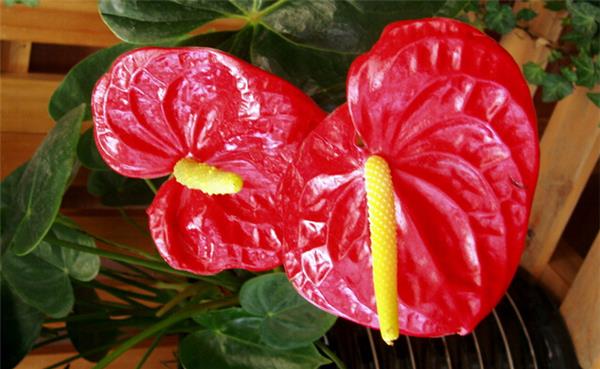
How to grow anthuriums, part one: temperature
Anthuriums like warmth and moisture, with a suitable growing temperature of 20-30°C and an air relative humidity requirement of above 80%. For growing anthuriums, the growing medium can be mixed from garden soil, decomposed pine needles and perlite (mainly to ensure good drainage and aeration and to make the pH of the growing medium acidic). The key to successfully growing anthuriums is maintaining suitable environmental humidity, so the growing medium should be kept moist at all times.
How to grow anthuriums, part two: fertilizing
During the growing season, apply a thin organic liquid fertilizer rich in potassium and nitrogen 1-2 times a month to ensure the plant has sufficient nutrients, so that the bracts are large and the flower stems long. To promote thick, sturdy branches and leaves and timely flowering, spray the leaves with 0.1% monopotassium phosphate 1-2 times a month. In winter, the temperature should be kept above 15°C and watering reduced. In the following spring, water thoroughly to encourage the plant to revive. If suitable light, temperature and humidity can be ensured, it can also grow and bloom normally in winter.
How to grow anthuriums, part three: pest prevention
During the care of anthuriums, it is best to spray a 750-fold dilution of carbendazim or chlorothalonil solution once every 7 to 10 days. Try to minimize artificial wounds to avoid infection by pathogens. The pests and diseases that easily harm anthuriums include scale insects, root rot, blight, red spider mites and thrips.
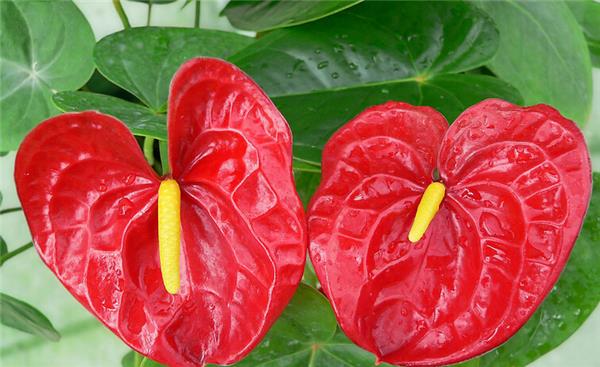
How to grow anthuriums, part four: watering
Normally water 2 to 3 times a week; in summer, water once a day, and every 10 to 15 days water with a thin solution made of sesame paste residue, ferrous sulfate and monopotassium phosphate. In addition, mist the leaves 2 to 3 times a day to wash dust off the leaves, and mist frequently around the plant to raise air humidity. When growing in pots, to ensure smooth drainage, place broken tiles etc. at the bottom of the pot, and provide shading to avoid direct light.
Is anthurium suitable for growing indoors?
Yes. But prevent small children from accidentally eating it or getting the sap in their eyes.
Anthurium can absorb benzene and trichloroethylene, which are harmful to human health, from indoor air. In addition, anthurium can regulate indoor air humidity, improve indoor air quality and help you relax.
Anthurium likes warm, humid and semi-shady environments, dislikes strong light and is not cold-tolerant. It should be placed in a semi-shady spot indoors, away from direct strong light.
Anthurium belongs to the family Araceae, and its flowers are mildly toxic; as long as they are not eaten, there is no problem. Wash your hands each time after pruning branches and leaves; its toxicity mainly comes from the sap, so with a little care there is nothing to worry about. The similar red anthurium also belongs to the family Araceae and is mostly toxic, but as long as you do not come into too close contact with it, there is no problem. Red anthurium can be grown at home; it is mildly toxic. So what is the difference between anthurium and red anthurium?
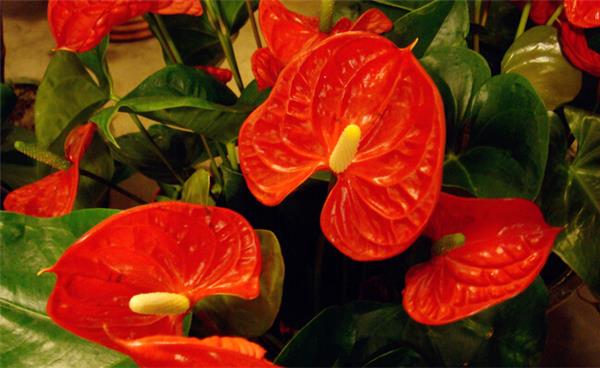
Although red anthurium and anthurium both belong to the genus Anthurium of the family Araceae and are both called Anthurium, they are actually different varieties of flowers. Red anthurium is also called candle flower, and anthurium is also called red flamingo lily. The former originates in southern Colombia in South America, while the latter originates in the area of Costa Rica and Guatemala. The main differences between the two flowers are:
1. The bract of red anthurium is nearly upright, while that of anthurium tends to be flat and spreading.
2. The spadix of red anthurium is upright and golden yellow, while the flower of anthurium is spiral-shaped and orange-red.
3. The leaves of red anthurium are slightly longer than those of anthurium.
Red anthurium is a tropical flower that likes shade and dislikes sun, likes moisture and dislikes drought, and likes high temperatures and fears cold. When caring for it at home, follow its habits and be careful not to expose it to strong sun, but do not leave it in a dim indoor spot for a long time either; it should be placed in a spot with scattered light and given some sunlight in the morning and evening. Generally, the growing medium for red anthurium is peat, which is loose and airy. When the temperature is suitable, the potting soil should be kept moist, or water should often be sprayed on the leaves to increase air humidity. The weather is turning cooler now; if the temperature cannot be kept above 12°C in winter, watering should be controlled to improve the cold tolerance of red anthurium. The lowest temperature must not fall below 8°C, otherwise it is easily damaged by cold. So what are the uses of anthurium?
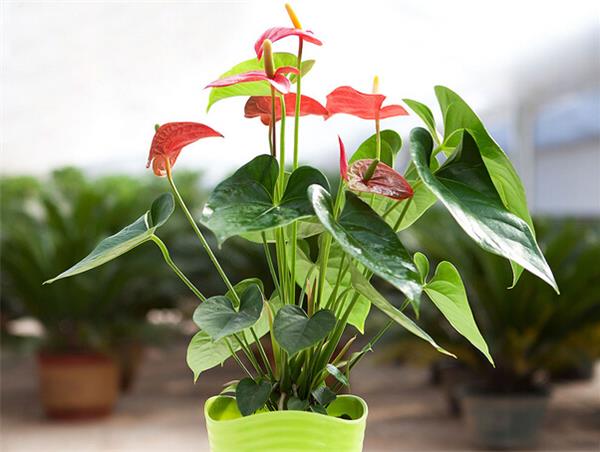
Clever household use of red anthurium: it absorbs benzene and trichloroethylene, which are harmful to human health, from the air, and has a healthy air-purifying effect.
When flowers of the family Araceae bloom, the flowers are mildly toxic, so it is best to move them outdoors to grow. Red anthurium, white anthurium, red gem and green gem all belong to the family Araceae. A representative of the family Euphorbiaceae is the poinsettia, also called Christmas flower; this flower is also toxic, but as long as it is not eaten there is no problem. Wash your hands each time after pruning branches and leaves; its toxicity mainly comes from the sap, so with a little care there is nothing to worry about.
Ornamental value:
Its flowers are unique, being spathes, with bright, gorgeous and rich colors, and it is a precious flower of the world. The flowering period is long; as a cut flower in water it can last up to 1.5 months, and the cut leaves can be used as filler foliage in flower arrangements. It can be grown as a potted plant, and a single flowering period in a pot can last up to 4-6 months. It can bloom year-round.
Economic value:
Red anthurium is an important tropical cut flower, with a spadix inflorescence; its spathe is large, thick and fleshy with a waxy texture, and its colors include red, pink, white, green and bicolor. With its bright colors, unusual shape, wide range of uses and high economic value, it is currently a fast-growing, high-demand premium tropical cut flower and potted flower worldwide.
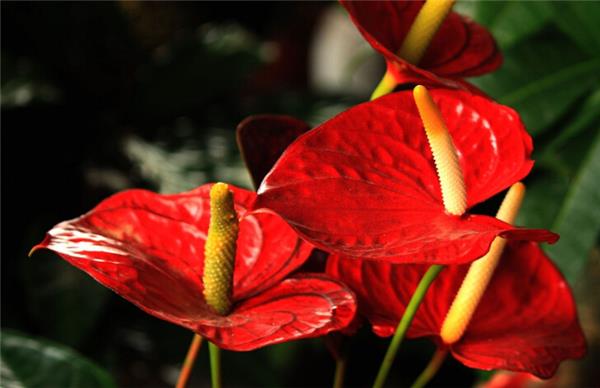
The anthurium has brilliant flower colors and a spirally curled inflorescence, and its graceful appearance gives people a bright and warm feeling. It is deeply loved by people, and many choose to place it in home living rooms and other spots. The growing methods for anthurium are introduced here, and I believe everyone now has a certain understanding of how to grow anthurium.
Clever household use of red anthurium: it absorbs benzene and trichloroethylene, which are harmful to human health, from the air, and has a healthy air-purifying effect.
When flowers of the family Araceae bloom, the flowers are mildly toxic, so it is best to move them outdoors to grow. Red anthurium, white anthurium, red gem and green gem all belong to the family Araceae. A representative of the family Euphorbiaceae is the poinsettia, also called Christmas flower; this flower is also toxic, but as long as it is not eaten there is no problem. Wash your hands each time after pruning branches and leaves; its toxicity mainly comes from the sap, so with a little care there is nothing to worry about.
Ornamental value:
Its flowers are unique, being spathes, with bright, gorgeous and rich colors, and it is a precious flower of the world. The flowering period is long; as a cut flower in water it can last up to 1.5 months, and the cut leaves can be used as filler foliage in flower arrangements. It can be grown as a potted plant, and a single flowering period in a pot can last up to 4-6 months. It can bloom year-round.
Economic value:
Red anthurium is an important tropical cut flower, with a spadix inflorescence; its spathe is large, thick and fleshy with a waxy texture, and its colors include red, pink, white, green and bicolor. With its bright colors, unusual shape, wide range of uses and high economic value, it is currently a fast-growing, high-demand premium tropical cut flower and potted flower worldwide.
The anthurium has brilliant flower colors and a spirally curled inflorescence, and its graceful appearance gives people a bright and warm feeling. It is deeply loved by people, and many choose to place it in home living rooms and other spots. The growing methods for anthurium are introduced here, and I believe everyone now has a certain understanding of how to grow anthurium.