A Detailed Guide to the Planting Methods and Techniques of Variegated Canna
Variegated canna belongs to the genus Canna in the family Cannaceae, and is one of the most commonly seen canna varieties. It is very well suited to being grown as a potted plant indoors. Let us now take a look at the planting methods for variegated canna.
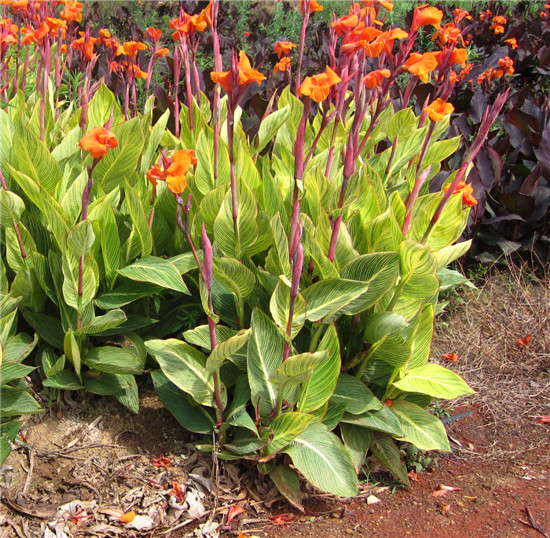
Variegated canna is a horticultural variety of canna. It is a perennial herbaceous plant with persistent roots. It is dwarf-growing, with plants reaching 50-80cm tall, and has thick rhizomes. Its leaves are broadly elliptical, alternate, with distinct midribs and pinnate lateral veins, and are mottled with various shades of earth yellow, cream yellow and greenish yellow. The terminal raceme bears around 10 red flowers, slightly smaller than those of terrestrial canna. The flowering period is from July to October, and the green period lasts about 240 days a year.
Variegated canna is one of the canna varieties newly introduced in recent years. Like canna, it grows vigorously, suffers from few pests and diseases, and has a long flowering period. What is even more valuable is that the plant is low-growing, only about 50 cm tall, making it very suitable for pot cultivation and appreciation. Moreover, its parallel veins are golden yellow, and on the curled, about-to-unfurl new leaves they look like golden threads inlaid into colourful makeup and green sleeves, presenting a delicate and graceful appearance that makes people adore it.
What Is Variegated Canna
Variegated canna is a horticultural variety of canna and a perennial herbaceous plant with persistent roots. It belongs to the genus Canna in the family Cannaceae. It is dwarf-growing and has thick rhizomes. Its leaves are broadly elliptical, alternate, with distinct midribs and pinnate lateral veins, and are mottled with various shades of earth yellow, cream yellow and greenish yellow. It is a perennial herbaceous plant with persistent roots.
The Benefits of Variegated Canna
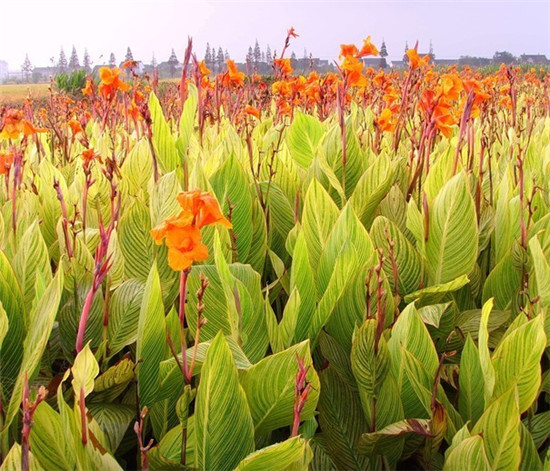
1. Ornamental value: Variegated canna has brilliant red flowers and brightly coloured leaves. It is suitable for mass planting in wetlands and flower borders, and can also be planted in small clumps in ponds. Besides adding decoration, it can also help purify the air and water quality. Variegated canna is worth viewing whether in flower or not, and whether placed as a single pot or grouped into a landscape, it can create an eye-catching highlight.
2. Medicinal value: The rhizomes and flowers of variegated canna can be used as medicine. They have the effects of clearing heat, draining dampness, calming the mind and lowering blood pressure. Variegated canna is also highly significant in purifying the air. It can not only absorb sulfur dioxide and hydrogen chloride, which are major components of automobile exhaust, but can also absorb carbon dioxide. This makes it easy to understand why variegated canna can be seen in the green belts of many cities.
The Morphological Characteristics of Variegated Canna
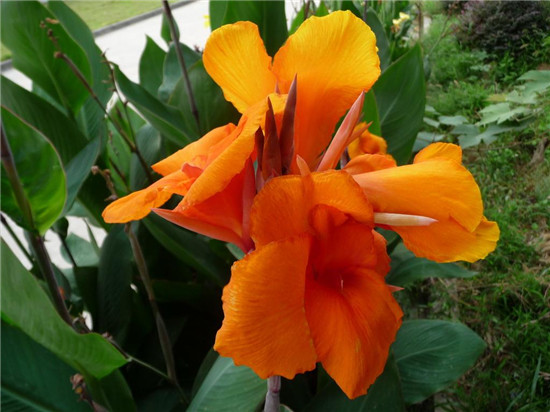
It is a perennial evergreen clumping herbaceous plant. The plant is 70-150 cm tall; the underground rhizome is fleshy. The leaves are alternate, long-elliptical to lanceolate, 20-30 cm long and 10-13 cm wide. They are leathery, with a golden yellow leaf surface interspersed with fine dense green stripes, and the leaf margins have a red edge and are entire. The inflorescence is a terminal raceme with 2-3 branches, and the flowers are orange-red. Flowering period: May to November.
Propagation and Cultivation of Variegated Canna
For potted canna, dwarf varieties should be chosen. The growing medium is generally best as leaf mold, garden soil and rice husk ash in a ratio of 1:1.5:0.5, mixed with a small amount of fertilizers such as soybean cake and bone meal.
In spring, from March to April, take out the tubers, remove the rotten parts, and select stem pieces with 2-3 healthy buds to bury in the potting soil; it is best if the bud tips are exposed above the potting soil. Because canna greatly likes fertilizer and tolerates moisture, the pot should be watered thoroughly. When it grows to the 5th leaf, apply 1 application of decomposed topdressing every 7-10 days, and water after fertilizing. Generally, apply 1% ferrous sulfate fertilizer solution once a month, or add a small amount of plant ash as well, to encourage the stems to be upright and robust, the leaves to be green and thick, and the flower colours to be vivid. Stop fertilizing at the flowering stage. If it is placed in a relatively cool place while flowering, the flowering period can be extended. After the flowers at the stem tip fade, the stem branches should be cut off from the base at any time, so as to sprout new buds and grow flowering branches that bloom in succession.
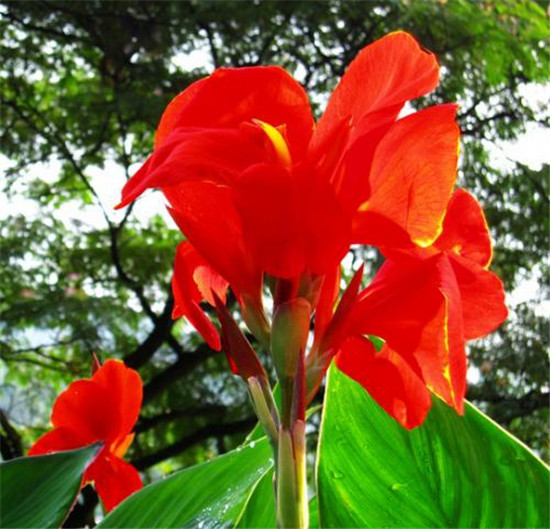
Potted canna sometimes develops symptoms of scorched and yellowing leaf edges, mainly caused by applying too much ferrous sulfate or by suffering drought or exposure to blazing sun. In hot summer, if water that is too cold is used, it can also cause scorched leaf edges. If fertilizer is applied too concentratedly during the height of summer, it can even burn the rhizome and "burn it to death." In addition, when the temperature is above 40, the canna can be moved to a ventilated and cool place. Around Frost's Descent, the potted canna can be moved to a place at 5-10, where it can safely overwinter. During overwintering, stop fertilizing.
The above is the full content of my summary of the planting methods for variegated canna and an introduction to the techniques for growing variegated canna. I hope this article can help everyone. Please also continue to follow us.