Snake Plant Care Methods and Classification Explained
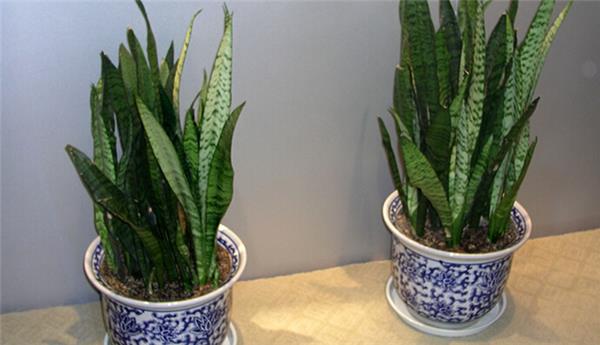
Snake plants (Sansevieria) are perennial herbaceous foliage plants with creeping rhizomes and linear lanceolate leaves. They are highly adaptable and not demanding about their growing environment, making them ideal for decorating living rooms and studies. Besides being ornamental, their greatest feature is their ability to purify the air. According to experts, snake plants can absorb more than 80% of harmful gases indoors, and their ability to handle formaldehyde in particular is extremely strong, making them especially useful in newly renovated homes. Snake plants can also protect against radiation. Based on these characteristics, we can roughly sum up the care methods for snake plants:
First, choosing the soil
Snake plants need loose soil with good air permeability, so when mixing soil for them, be sure to use 2/3 leaf mold plus 1/3 garden soil. Remember that the soil must be loose and airy, otherwise moisture will not evaporate easily and the rhizomes will rot.
Second, sunlight requirements
Snake plants love light, so be sure to let them come into contact with sunlight regularly. Ideally, place them somewhere they can be exposed to direct sunlight. If conditions do not allow that, then at least place them somewhere close to the sunlight. Being kept in a dark place for a long time will cause the leaves to turn yellow.
Third, temperature
Snake plants have fairly high temperature requirements. Their suitable growing temperature is 20-30°C, and in winter it should not drop below 10°C, so be sure to pay attention, especially in northern regions.
Fourth, watering
Snake plants also have fairly high water requirements. Generally speaking, if the soil is quite loose, they need watering twice a week, while in winter, because of the climate, once is enough.
Fifth, pruning
Compared with other green plants kept at home, snake plants grow relatively fast. Therefore, once the pot is full, manual pruning is needed, mainly by cutting away old leaves and overly dense areas to ensure they get sunlight and growing space.
Sixth, repotting
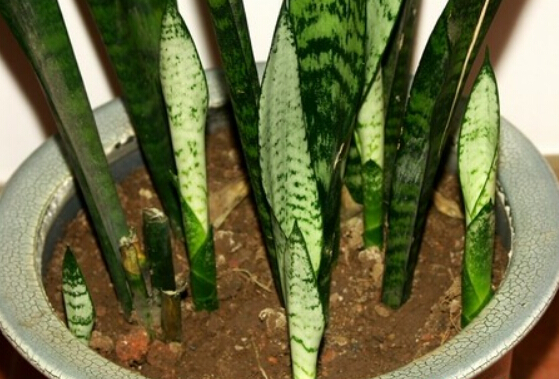
Snake plants are perennials, and generally they need to be repotted every two years. When repotting, be sure to add nutrients to the new soil so their nutritional supply is guaranteed.
Seventh, planting method
Snake plants are root-propagated plants. Generally you only need to plant a few plants, and after a year you can harvest a full pot. When planting, first place part of the soil at the bottom of the pot, then start planting from one side of the pot and plant evenly throughout the pot.
Eighth, fertilizing
Snake plants do not have high fertilizer requirements; you only need to fertilize twice a month during the growing season. Be sure to apply a dilute liquid fertilizer so the plants grow lushly.
Ninth, the threat of diseases and pests
The common diseases of snake plants are mainly leaf spot and anthracnose, which can be treated by spraying 50% carbendazim; a common pest is the weevil, which can be controlled by spraying a 1000-fold dilution of 50% fenitrothion emulsifiable concentrate.
Many people have probably heard about the role snake plants play in the home environment. Along with spider plants, Swiss cheese plants (Monstera deliciosa) and golden barrel cacti (Echinocactus grusonii), they are four plants with exceptionally strong air-purifying abilities. So what role do snake plants play in home life?
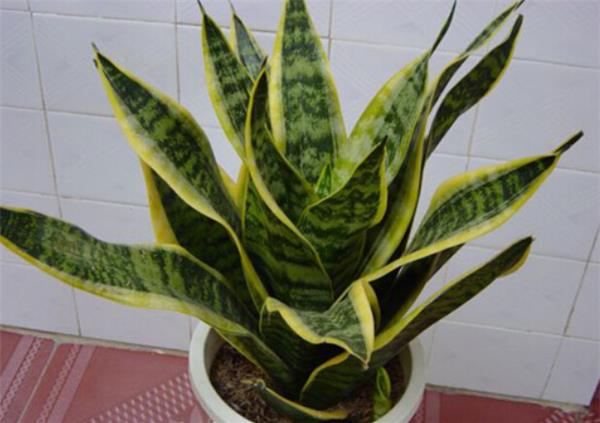
1. Snake plants can increase the indoor concentration of negative ions. While absorbing carbon dioxide, they can release oxygen, increasing the concentration of negative ions in indoor air. Negative ions are gas ions in the air that carry a negative charge, and they have a very important influence on the life activities of humans and other living things. The stomata on the fleshy stems of snake plants close during the day and open at night, and while absorbing carbon dioxide they can release a large number of negative ions, increasing the concentration of negative ions in indoor air. Moreover, snake plants have another important function: protecting against radiation, making them suitable for placing beside computers and televisions. Therefore, in homes, apartments, office buildings and similar places, the golden-edged snake plant (Sansevieria trifasciata 'Laurentii') has gradually become people's first choice of eco-friendly plant.
2. They can absorb many harmful gases. Like spider plants, snake plants can absorb more than 80% of harmful gases indoors, and their ability to absorb formaldehyde is especially strong, earning them the title of "natural scavenger." At the same time, they can also absorb large amounts of radioactive nuclides such as uranium. Besides removing formaldehyde, they also have a clear absorption effect on harmful substances such as trichloroethylene, hydrogen sulfide, benzene, phenol, hydrogen fluoride, ether and heavy metal particles. Their transpiration efficiency is relatively high, and they also have a certain ability to regulate indoor humidity. Therefore, in a 15 sq m room, growing 2-3 pots of snake plants can keep the air fresh. Snake plants have also become an indispensable eco-friendly indoor plant in modern life.
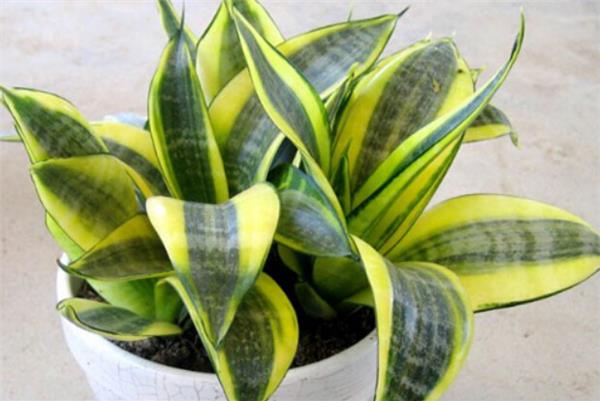
Snake plants are mainly distributed in Africa and southern Asia, and belong to the phylum Angiosperms, order Liliales. Snake plant, also known as tiger's tail orchid and thousand-year orchid, is a perennial evergreen plant. The leaves of snake plants are very upright, like little green guards, and the leaf surface usually has horizontal banded markings shaped like a tiger's tail. The golden-edged snake plant is a type of snake plant with relatively high ornamental value. Its leaves are generally composed of 3 colors: green, white and yellow, while the leaf edges are pure yellow, which is also the origin of the golden-edged snake plant's name. So what kinds of snake plants are there?
Common cultivated varieties of snake plants include:
Golden-edged snake plant (Sansevieria trifasciata 'Laurentii'): similar in shape to the snake plant, but the leaf margins are bordered with broad golden-yellow bands.
Onion-leaf snake plant (Sansevieria cylindrica): also called cylindrical-leaf snake plant. The leaves are cylindrical, roughly the same thickness from top to bottom, slightly pointed and slender at the tip, with shallow longitudinal grooves on the leaf surface, and each leaf grows independently.
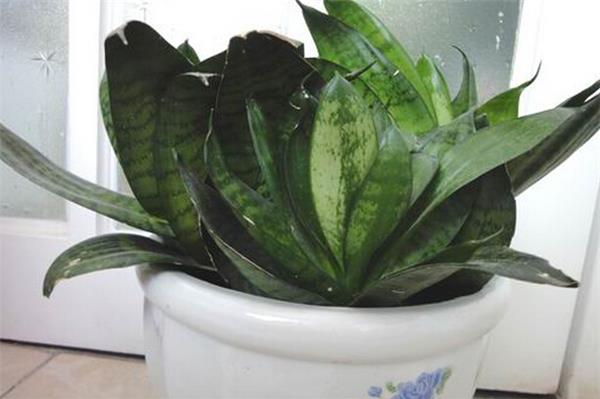
Short-spike snake plant (Sansevieria trifasciata 'Hahnii'): a dwarf variety, about 10-20 cm tall, a mutant of the golden-edged snake plant, with short and wide leaves that grow in a spiraling, overlapping rosette.
That is all the melon-related information about snake plants that the editor has introduced for you, and I hope it can help everyone.
Snake plants are mainly distributed in Africa and southern Asia, and belong to the phylum Angiosperms, order Liliales. Snake plant, also known as tiger's tail orchid and thousand-year orchid, is a perennial evergreen plant. The leaves of snake plants are very upright, like little green guards, and the leaf surface usually has horizontal banded markings shaped like a tiger's tail. The golden-edged snake plant is a type of snake plant with relatively high ornamental value. Its leaves are generally composed of 3 colors: green, white and yellow, while the leaf edges are pure yellow, which is also the origin of the golden-edged snake plant's name. So what kinds of snake plants are there?
Common cultivated varieties of snake plants include:
Golden-edged snake plant (Sansevieria trifasciata 'Laurentii'): similar in shape to the snake plant, but the leaf margins are bordered with broad golden-yellow bands.
Onion-leaf snake plant (Sansevieria cylindrica): also called cylindrical-leaf snake plant. The leaves are cylindrical, roughly the same thickness from top to bottom, slightly pointed and slender at the tip, with shallow longitudinal grooves on the leaf surface, and each leaf grows independently.
Short-spike snake plant (Sansevieria trifasciata 'Hahnii'): a dwarf variety, about 10-20 cm tall, a mutant of the golden-edged snake plant, with short and wide leaves that grow in a spiraling, overlapping rosette.
That is all the melon-related information about snake plants that the editor has introduced for you, and I hope it can help everyone.