A Detailed Introduction to Agastache rugosa: Getting to Know This Plant
Agastache rugosa is also known as Hexiang, Canggao, Shanhuixiang and so on. Every summer, people often use this plant, Agastache rugosa, to relieve heatstroke. Next, let us take a detailed look at this plant together.
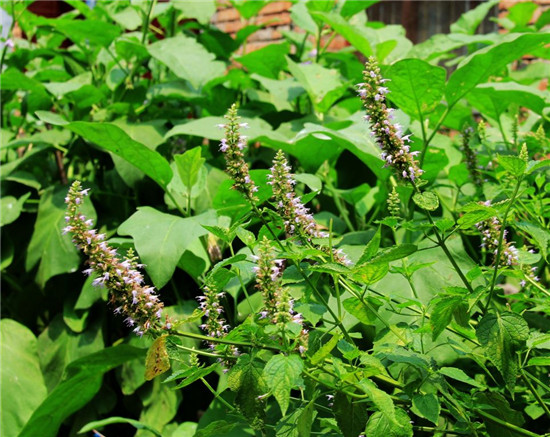
Agastache rugosa belongs to the order Tubiflorae (Lamiales) and is a perennial herbaceous plant in the family Lamiaceae (mint family). Its stems are erect, 0.5-1.5 m tall, four-angled, and up to 7-8 mm thick. Its leaves are cordate-ovate to oblong-lanceolate. The corolla is pale purplish-blue, about 8 mm long. The mature nutlets are ovoid-oblong, about 1.8 mm long and about 1.1 mm wide. The flowering period is June to September, and the fruiting period is September to November.
Agastache rugosa is a perennial herb. The stems are erect, 0.5-1.5 m tall, four-angled, up to 7-8 mm thick, covered with very short fine hairs on the upper part, hairless on the lower part, and bearing fertile branches on the upper part. The leaves are cordate-ovate to oblong-lanceolate, 4.5-11 cm long and 3-6.5 cm wide, gradually smaller upward, with a caudate long-acuminate apex and a cordate, rarely truncate, base, with coarse teeth along the margin, papery, olive-green above and nearly hairless, slightly paler beneath, covered with fine soft hairs and dotted glands; the petioles are 1.5-3.5 cm long. The verticillasters are many-flowered, forming a terminal dense cylindrical spike on the main stem or lateral branches; the spike is 2.5-12 cm long and 1.8-2.5 cm in diameter.
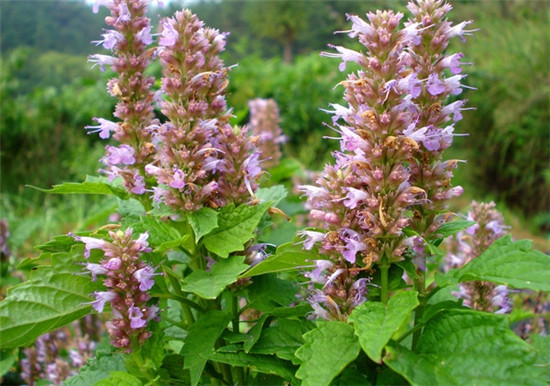
The bract leaves at the base of the inflorescence are no more than 5 mm long and about 1-2 mm wide, lanceolate-linear, long-acuminate; the bracts are similar in shape but smaller, about 2-3 mm long. The verticillasters have short pedicels, and the common peduncle is about 3 mm long, covered with glandular fine soft hairs. The calyx is tubular-inverted-conical, about 6 mm long and about 2 mm wide, covered with glandular fine soft hairs and small yellow glands, more or less tinged pale purple or purplish-red, with a slightly oblique throat; the calyx teeth are triangular-lanceolate, the posterior 3 teeth about 2.2 mm long, and the anterior 2 teeth slightly shorter. The corolla is pale purplish-blue, about 8 mm long, covered with fine soft hairs on the outside; the corolla tube is about 1.2 mm wide at the base, slightly exceeding the calyx, gradually widening upward to about 3 mm wide at the throat; the corolla limb is two-lipped, the upper lip straight and slightly emarginate at the apex, the lower lip 3-lobed, the middle lobe relatively broad and large, about 2 mm long and about 3.5 mm wide, spreading, with a wavy margin and a broad base, the lateral lobes semicircular. The stamens extend beyond the corolla; the filaments are slender, flattened, and hairless. The style is nearly as long as the stamens, thread-like, with two equal lobes at the apex. The disc is a thick ring. The apex of the ovary lobes bears downy hairs. The mature nutlets are ovoid-oblong, about 1.8 mm long and about 1.1 mm wide, with a ridge on the ventral side, short stiff hairs at the apex, and brown in color.
Growing habits: Agastache rugosa prefers high temperatures and a sunny environment, and grows poorly in shaded places. Areas with an annual average temperature of 19-26°C are more suitable for its growth; when the temperature is above 35°C or below 16°C, growth slows or stops. It likes to grow in humid, rainy environments and is afraid of drought, requiring annual rainfall of more than 1600 mm. Seedlings like rain, and during the growing period it likes a humid environment (but if the soil is too wet, the roots will rot and the plant will die). In areas with less rainfall, attention should be paid to irrigation. The seedling stage likes shade, so a shed or straw covering is needed; mature plants can grow under full light. The roots are relatively cold-tolerant and can overwinter in the north, sprouting again the following year to grow Agastache rugosa; the aboveground parts are not cold-tolerant, and after Frost's Descent (the last solar term of autumn) a large number of leaves fall and the plant gradually withers and dies. It is not strict about soil and can grow in general soils, but deep, fertile, and loose sandy loam or loam is best. It is afraid of waterlogging; when planted in low-lying areas prone to water accumulation, the roots easily rot and the plant dies. The seeds live for 2-4 years, so seeds from the previous year can be sown. Seed germination requires light conditions, the optimum germination temperature is 18-22°C, and germination takes 7-10 days.
Plant Culture
A long time ago, a family lived deep in the mountains, where a brother and his sister Huoxiang depended on each other. Only the sister-in-law and the sister-in-law lived in the household. In ordinary days, the sister-in-law and the sister-in-law were considerate of each other, going to the fields together every day and managing household chores together, and their days were harmonious and happy. One summer, the weather was stuffy and humid for days on end, and the sister-in-law suddenly fell ill from heatstroke due to exhaustion. She had fever and chills, headache and nausea, and fatigue and weakness, and was very uncomfortable. Huoxiang hurriedly helped the sister-in-law to the bed and said: "You are probably suffering from heatstroke. This illness is not hard to treat. There is a fragrant medicinal herb on the mountain behind our house that can treat this illness. Let me hurry up the mountain to pick it and cure your illness as soon as possible." The sister-in-law, thinking that the younger sister-in-law was young and that it was inconvenient for her to go out, urged her not to go. But Huoxiang paid no attention at all and insisted on going into the deep mountains.
The sister-in-law then affectionately called this fragrant medicinal herb "Huoxiang," and had everyone plant it in front of and behind the house and along the edges of fields and roads, so that it could be gathered at any time. From then on, the reputation of the "Huoxiang" herb spread wider and wider, and it cured many patients with heatstroke. Because it was a medicinal herb, over time people added a "grass" radical to the top of the character Huo, writing Huoxiang as "Huoxiang".
The above is the full content of the detailed introduction to Agastache rugosa that I have summarized for everyone. I hope this article can help everyone. Also, please continue to follow us.