Why does the sensitive plant move? The reason is here
The leaves of the sensitive plant (Mimosa pudica) close and droop immediately at the slightest touch, and even a gust of wind will produce this reaction. Next, let us take a look at why the sensitive plant moves.
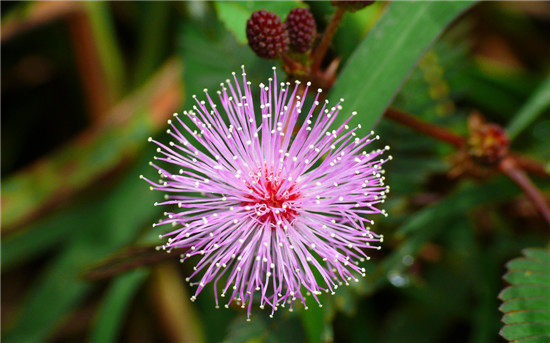
Many people who want to grow the sensitive plant will certainly want to know: the sensitive plant grows in open wasteland and among shrubs, and it is often cultivated along the Yangtze River basin for ornamental purposes. The sensitive plant likes a warm, humid environment with plenty of sunlight, and it is suited to well-drained sandy loam rich in organic matter. The plant is robust, grows quickly and has strong adaptability. Therefore, the sensitive plant is a relatively easy plant to grow, and everyone can try growing it.
The sensitive plant is a taproot plant with very few fibrous roots. It is suitable for propagation by seed, and it is best to sow the seeds directly in place to avoid damaging the roots when transplanting. If transplanting is necessary, it should be done at the seedling stage, otherwise the plant will not easily survive. As an annual crop, the sensitive plant is generally sown indoors in early spring. The sowing soil is prepared by mixing, after sifting, 2 parts leaf mold, 3 parts garden soil and 5 parts fine yellow sand.
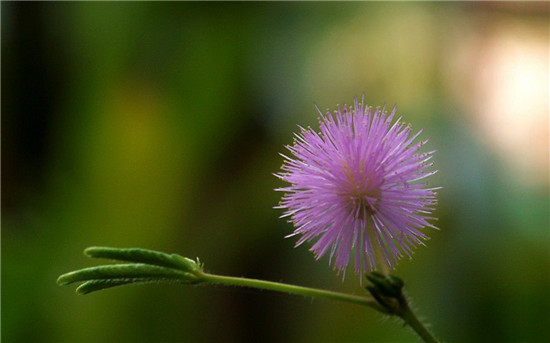
When sowing, first fill the pot with an appropriate amount of growing medium, spread it level and firm it down, then water it thoroughly with a watering can. Once the water has fully seeped in, sow the seeds immediately. For direct sowing in small pots, sow 1-2 seeds per pot. If using a shallow pot for raising seedlings, sow in spots at a spacing of 2 cm x 2 cm. After sowing, cover with soil 3-5 cm deep, just enough to cover the seeds. Cover the pot with glass or plastic film to retain moisture, and place the pot in a spot with bright, indirect light at around 20°C. Afterwards, when the soil in the pot looks dry, water it by the immersion method. After about 7-10 days, the seeds germinate and the seedlings emerge.
Why is it that when we touch the sensitive plant with our hand, it quickly folds its leaves up, as if it were very shy?
In our eyes, we always think that plants have no perception; if you break off a branch, it will not tell you "I am in pain." But do all trees, flowers and grasses really show no reaction? Not necessarily. When you gently touch the leaf of the sensitive plant with your hand, it acts as if shy, folding its leaves together and drooping them down. It is just like a delicate young person lowering their head in embarrassment upon seeing a stranger. The sensitive plant is a herbaceous plant that blooms small pale red flowers in summer and autumn. When the sensitive plant is touched by hand, the reason its leaves close together is that at the base of the sensitive leaf stalk there is a thin pad-like tissue called the pulvinus, which is filled with water. When our hand touches the leaf of the sensitive plant, the leaf vibrates, which causes the water in the pulvinus to flow at once to the upper side and the two sides of the leaf. At this moment, the water in the lower part of the leaf runs off, while the upper part of the leaf becomes full of water, so the leaf stalk droops and the leaves close along with it.
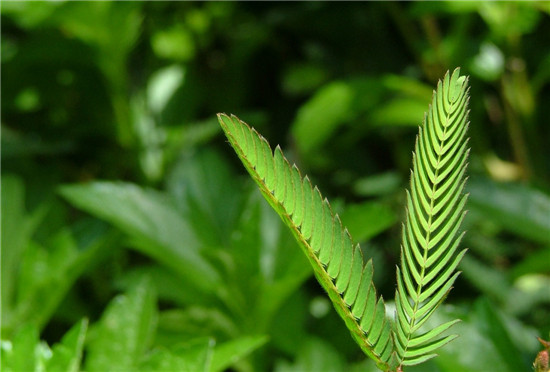
This characteristic of the sensitive plant is its adaptation to the natural environment. When wind and rain come together, at the first gust of wind and the first drop of rain that touches them, the leaves close up so as to avoid being battered by the wind and rain.
Among the plants in nature that can move, there are also the Venus flytrap and the pitcher plant, but the movement of the latter two is not for self-defense, but for catching prey.
People usually say this: what moves is an animal, and what does not move is a plant. Fish swim in the water, birds fly in the sky, and wild beasts run about everywhere, so they are all called animals; trees cannot walk, and grass cannot run, so they are called plants. At first hearing, this seems quite reasonable. But if you investigate deeply, you will find that some plants can also move. Among lower plants, there are quite a few motile species. Among higher plants, the leaves of the Venus flytrap can catch insects, and the leaves of the sensitive plant can move, closing at the slightest touch with a fairly sensitive response, and the closing movement is very rhythmic.
The above is all the content I have summarized for you on why the sensitive plant moves. I hope this article can help everyone. Please also continue to follow us.