How to Grow Geraniums: A Guide to Raising Healthy, Beautiful Geraniums
Geranium (Latin scientific name: Pelargonium hortorum), also known as zonal geranium, fish geranium, horseshoe geranium, and other names, is native to South Africa and is a perennial herbaceous flowering plant. The leaves are palmate with long petioles, the leaf margins are mostly serrated, and the leaf surface has fairly deep ring-shaped markings. The corolla usually has five petals, and the inflorescence is umbel-shaped, growing at the tip of upright peduncles. Because the clustered flowers are dense like a ball, it is also called "foreign hydrangea." Flower colors vary greatly among red, white, pink, and purple. The flowering period begins in early winter and lasts until early summer of the following year. Potted plants are suitable for indoor and outdoor decoration; they can also be used as spring flowerbed flowers. So, what are the methods for growing geraniums?
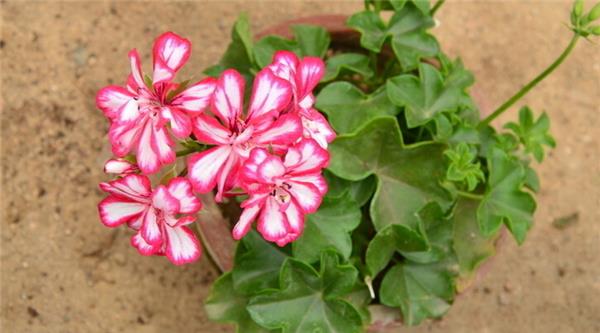
Methods for growing geraniums:
1. Soil: Geraniums are also highly adaptable and can grow in various soil types, but they grow best in sandy loam rich in humus.
2. Watering: Geraniums like dryness and dislike dampness, so watering in winter should not be excessive; water only when the soil is dry, and keep it alternately dry and moist. When the soil is wet, the stems are tender and soft, which is unfavorable for the sprouting and opening of flower branches; long-term excessive moisture will cause the plant to grow leggy, the flower-bearing position to move upward, and the leaves to gradually yellow and fall off.
3. Sunlight: Geraniums need sufficient sunlight during the growing period, so in winter they must be placed in a sunny spot. With insufficient light, the stems and leaves grow leggy, the peduncles become thin and soft, and the inflorescences develop poorly; flower buds under weak light often do not open smoothly and wither prematurely.
4. Temperature: Geraniums prefer warm winters and cool summers. Keeping the indoor temperature at I0-15°C each day in winter, with nighttime temperatures above 8°C, is enough for normal flowering. However, the optimum temperature is 15-20°C.
5. Fertilizing: Geraniums do not like heavy fertilizer; too much fertilizer will make geraniums grow excessively and be unfavorable for flowering. To make flowering abundant, apply a diluted thin fertilizer solution (decomposed soybean cake water) once every 1-2 weeks. Applying 800-times potassium dihydrogen phosphate solution every 7-10 days can promote normal flowering.
6. Pests and diseases: When geraniums have poor ventilation and are too humid, they are prone to leaf spot disease and flower wilt disease. After discovery, attention should be paid to ventilation, and diseased flowers and leaves should be removed immediately to prevent infection, and an equal-amount Bordeaux mixture should be sprayed for control. The main pests include red spiders and whiteflies, which harm leaves and flower branches, and can be killed by spraying 1000-times 40% omethoate emulsion.
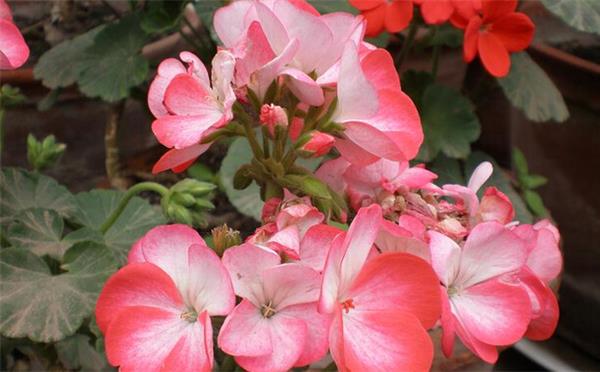
7. Pruning: Pruning branches and pinching out growing tips. To encourage more branching in geraniums and more flowering, the plant should be pinched multiple times to promote increased branching and flower bud formation. After the flowers fade, spent flowers should be cut off in a timely manner, and overly dense and thin, weak branches should be cut off to avoid excessive consumption of nutrients, but in cold winter, heavy pruning is not suitable.
Precautions for growing geraniums
(1) In order to control plant height and achieve the goal of large flowers and brilliant colors, in addition to choosing dwarf geranium varieties, the application of growth regulators is very important. Two weeks after geraniums are planted in 12 cm or 15 cm pots, 0.15% chlormequat or daminozide can be sprayed on the leaf surface once a week for 2 consecutive times, with 14-18 hours of light per day. This can effectively control the height of geraniums and provide high-quality commercial potted flowers.
(2) It is relatively tolerant of dryness and afraid of waterlogging. Too much water can easily cause plant death, and under high temperature and high humidity, the roots are prone to rot. It requires well-drained, loose soil rich in organic matter. The flowering period is long, with the peak flowering period from April to June. If given a relatively high temperature in winter and managed properly, it can bloom continuously from September in autumn to June of the following year.
Geraniums come from South Africa and are perennial herbs. They not only have good ornamental value but also extremely high economic value. They can be used to treat various conditions, and their extracts can also beautify and nourish the skin. They are suitable for all skin types, can deeply cleanse the skin, tighten pores, and balance oil secretion. So, what types of geraniums are there?
Zonal geranium: Plant height 30-HO cm. It is named because of the obvious dark brown horseshoe-shaped markings inside the leaf margins. The petals are of the same color, from deep red to white; the upper two petals are extremely short, and the petals are narrowly wedge-shaped. Many variegated-leaf varieties have been bred from this species.
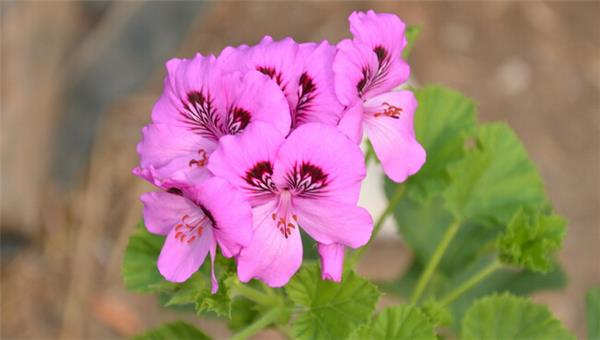
Regal geranium: Also known as butterfly geranium or foreign butterfly. The whole plant has soft hairs. The leaves have no horseshoe markings, and the leaf margin teeth are sharp and irregular. The flowers are large, with colors including white, pale red, pale purple, and others. It is named because the petals have two red or purple blotches.
Ivy geranium: Also called trailing geranium or ivy-leaved geranium. The stems are semi-trailing, and the plant is prostrate or climbing. The leaves are shield-shaped and slightly glossy. The flowers are small, gathered in clusters of 4-8, with colors including white, pink, red, purple, and peach red. The flowering period is winter and spring.
Scented geranium: Also known as musk geranium or round-leaved geranium. The stems are slender and trailing, and new branches and new leaves are often clustered at the top of the stem. The inflorescence is umbel-shaped, the flowers are small and white, and the upper two petals have red-purple markings. When the leaves are touched by hand, they immediately emit an attractive fragrance.
Rose-scented geranium: Also known as "touch-me fragrance." Semi-shrub. The leaves are palmate with 5-7 deep lobes, and the lobes are further pinnately shallowly lobed. The flowers are peach red or pale red, with purple-red markings in the center, and the upper two petals are larger. The flowering period is summer.
Chrysanthemum-leaved geranium: The stems have long hairs. The leaves are palmately deeply lobed, and the lobes are further divided into linear segments. The whole plant is covered with white powder. The flowers are rose red with purple spots and stripes. The flowering period is summer.
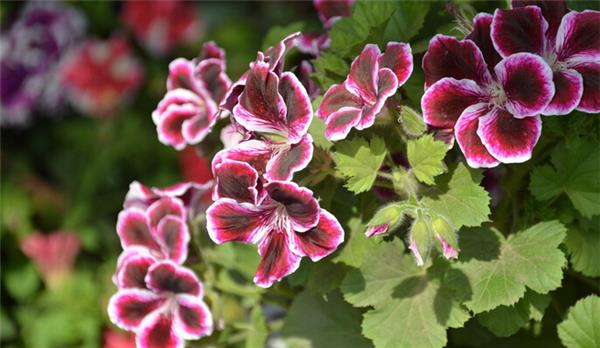
Beautiful flowers can add a touch of color to our homes and our courtyards. Successful flower cultivation is not only a way to cultivate body and mind, but also an enjoyment of beauty. So, what are the uses of geraniums?
Psychological effects
Geranium is a tonic for the nervous system. It can soothe anxiety and depression and also lift the mood. It helps the mind regain balance, and because it can also affect the adrenal cortex, it can relieve stress.
Physiological effects
Geranium essential oil has the functions of stimulating the lymphatic system and promoting urination. These two functions can mutually enhance each other and help the body quickly and effectively eliminate excess body fluids. It can be used to treat cellulitis, fluid retention, and ankle swelling; it can help the liver and kidneys detoxify; it can treat jaundice, kidney stones, and various urinary tract infections; it can also help many women reduce symptoms of premenstrual fluid retention.
Beauty value
Geranium is suitable for various skin conditions because it can balance sebum secretion and make the skin plump. It may be beneficial for eczema, burns, shingles, herpes, ringworm, and chilblains. It is also very good for sagging skin, clogged pores, and oily skin, and can be called an all-around cleansing oil. Because geranium can promote blood circulation, after use it makes pale skin more rosy and vibrant. Used in an aroma lamp or applied to the face with a towel, it can stimulate the lymphatic system and strengthen the circulatory system.
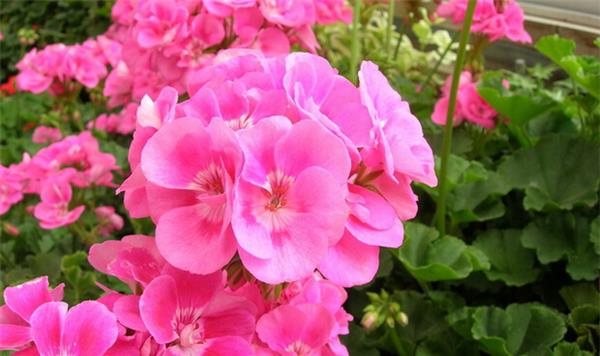
Geraniums are highly valued abroad, and Hungary even designated them as its national flower. Reports and cases of geraniums being toxic have never been heard of, and certain clinical trials have also proven that geranium extract is harmless to the human body. In Germany, the use of geranium extract to make herbal medicines has also been approved, so friends who grow geraniums can cultivate and enjoy them with complete peace of mind.
Beautiful flowers can add a touch of color to our homes and our courtyards. Successful flower cultivation is not only a way to cultivate body and mind, but also an enjoyment of beauty. So, what are the uses of geraniums?
Psychological effects
Geranium is a tonic for the nervous system. It can soothe anxiety and depression and also lift the mood. It helps the mind regain balance, and because it can also affect the adrenal cortex, it can relieve stress.
Physiological effects
Geranium essential oil has the functions of stimulating the lymphatic system and promoting urination. These two functions can mutually enhance each other and help the body quickly and effectively eliminate excess body fluids. It can be used to treat cellulitis, fluid retention, and ankle swelling; it can help the liver and kidneys detoxify; it can treat jaundice, kidney stones, and various urinary tract infections; it can also help many women reduce symptoms of premenstrual fluid retention.
Beauty value
Geranium is suitable for various skin conditions because it can balance sebum secretion and make the skin plump. It may be beneficial for eczema, burns, shingles, herpes, ringworm, and chilblains. It is also very good for sagging skin, clogged pores, and oily skin, and can be called an all-around cleansing oil. Because geranium can promote blood circulation, after use it makes pale skin more rosy and vibrant. Used in an aroma lamp or applied to the face with a towel, it can stimulate the lymphatic system and strengthen the circulatory system.
Geraniums are highly valued abroad, and Hungary even designated them as its national flower. Reports and cases of geraniums being toxic have never been heard of, and certain clinical trials have also proven that geranium extract is harmless to the human body. In Germany, the use of geranium extract to make herbal medicines has also been approved, so friends who grow geraniums can cultivate and enjoy them with complete peace of mind.